

On this page
The properties of an amino acid depend on the balance of its acidic carboxyl (−COOH) and basic amino (−NH₂) groups. When we classify them by their chemical properties, we look at whether their side chains carry a charge (Chemistry LibreTexts/18%3A_Amino_Acids_Proteins_and_Enzymes/18.01%3A_Properties_of_Amino_Acids)).
What makes an amino acid acidic, basic or neutral?
Amino acids are the building blocks of proteins, and every amino acid has at least one basic amino group and one acidic carboxyl group. The side chain (often called the R group) attached to the centre of the molecule determines its overall chemical nature.
Based on the chemical properties of their side chains at a neutral pH, amino acids are grouped into three main types (Chemistry LibreTexts/18%3A_Amino_Acids_Proteins_and_Enzymes/18.01%3A_Properties_of_Amino_Acids)):
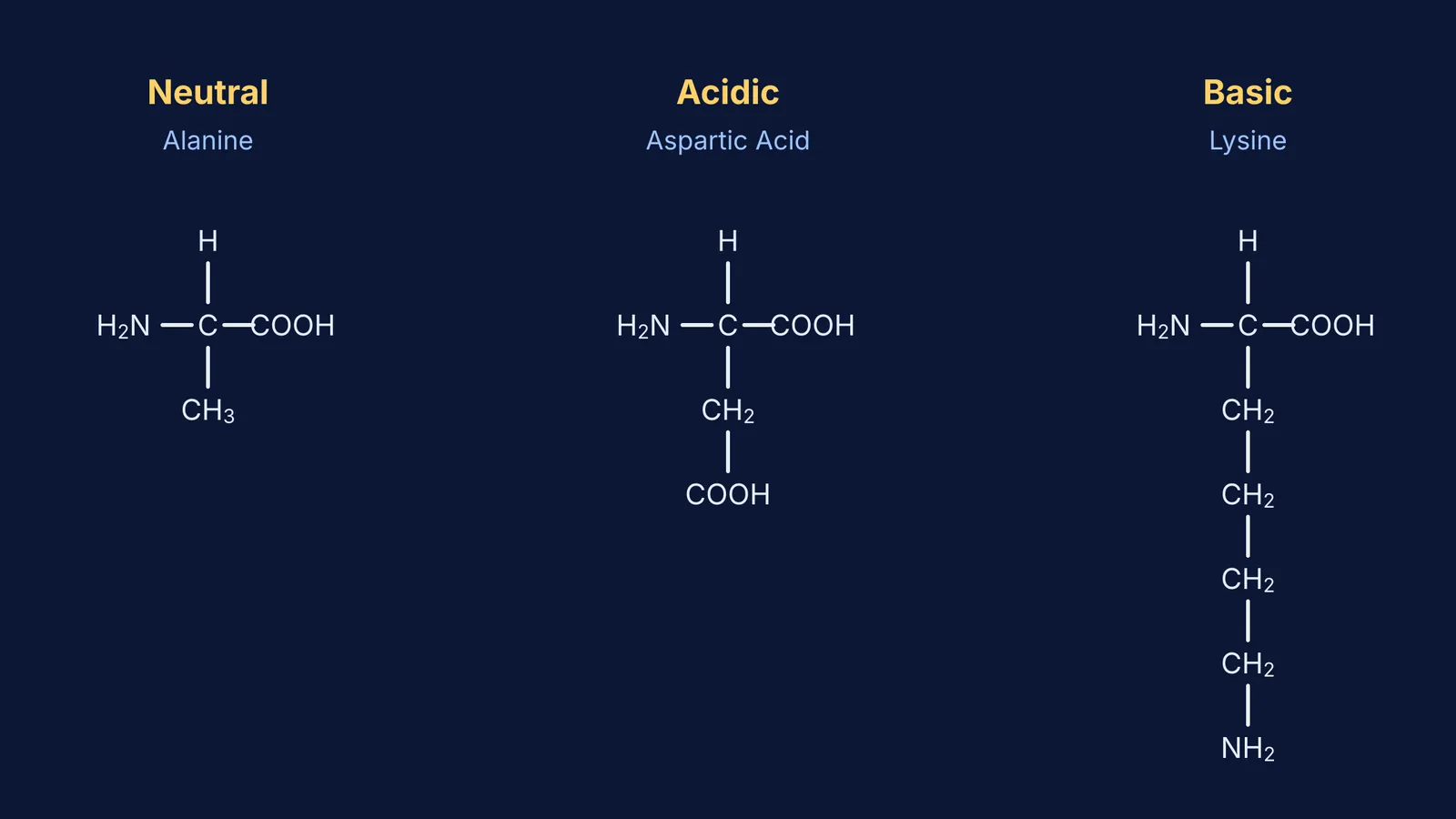
Neutral amino acids: These have side chains that do not ionize at a neutral pH. Because they lack an extra acidic or basic group, the molecule has no net charge on its side chain. Examples include glycine and alanine.
Acidic amino acids: The side chain contains an extra carboxylic acid group, giving the molecule a net negative charge at physiological pH. Aspartic acid and glutamic acid are the two main acidic amino acids.
Basic amino acids: Their side chain contains an extra nitrogen-based group, which acts as a base and accepts a proton to take on a positive charge in the body. Lysine, arginine, and histidine are basic amino acids.
When you are trying to remember these structures, the Fermi Concept Library groups biomolecules into a clear map so you can see how they relate to one another, rather than memorising them as isolated facts.
Which are the essential and nonessential amino acids?
Beyond their chemical structure, amino acids are also classified by whether your body can manufacture them. While you need 20 standard amino acids to build proteins, your cells cannot build all of them from scratch.
According to the U.S. National Library of Medicine, there are 9 essential amino acids that your body cannot produce (MedlinePlus). You must obtain these through your diet. They are:
Histidine
Isoleucine
Leucine
Lysine
Methionine
Phenylalanine
Threonine
Tryptophan
Valine
The body can produce the other amino acids, even if you do not get them from food. These are known as nonessential amino acids, and they include alanine, aspartic acid, and glutamic acid.
A subset of the nonessential group is called conditionally essential amino acids. These are usually not essential, except in times of illness and stress (MedlinePlus). Arginine, cysteine, and glutamine fall into this category.
What are some examples of acidic, basic and neutral amino acids?
To see how these two classification systems overlap, it helps to look at a few common examples and map out their chemical properties alongside their nutritional role.
Alanine (Neutral, Nonessential): With a simple methyl side chain that does not ionize, alanine is a neutral molecule. Your body can synthesize it easily.
Lysine (Basic, Essential): Lysine has an extra amine group on its side chain, making it basic. Because it is one of the nine essential amino acids, you must get it from foods like meat, dairy, or legumes.
Aspartic Acid (Acidic, Nonessential): The side chain of this molecule contains a carboxyl group, making it acidic. Your body can make its own aspartic acid.
If you struggle to recall whether a specific amino acid acts as an acid or a base in different environments, Fermi's AI tutor can help. Instead of just giving you the answer, the tutor will ask you to count the functional groups and work out the net charge yourself, checking your understanding as it goes.
Once you understand individual amino acids, you can explore how they link together via peptide bonds or how they behave in solution as zwitterions.


