

On this page
Your left hand's reflection looks like a right hand, and no turn makes it sit exactly on your left. Some molecules behave the same way. For the wider map of isomer types, see our guide to stereoisomerism in organic chemistry.
Objects that cannot be superimposed on their mirror image are chiral, and objects that can are achiral, as NCERT's Class 12 chemistry textbook puts it in Unit 6, Haloalkanes and Haloarenes. The same chapter states that chiral molecules are optically active and achiral ones are not.
How do you test whether a molecule is chiral in 3D?
Use a model kit, a 3D viewer or careful drawing.
Draw the molecule with wedges and dashes so every group has a fixed place in space.
Draw its mirror image: keep up and down, swap left and right.
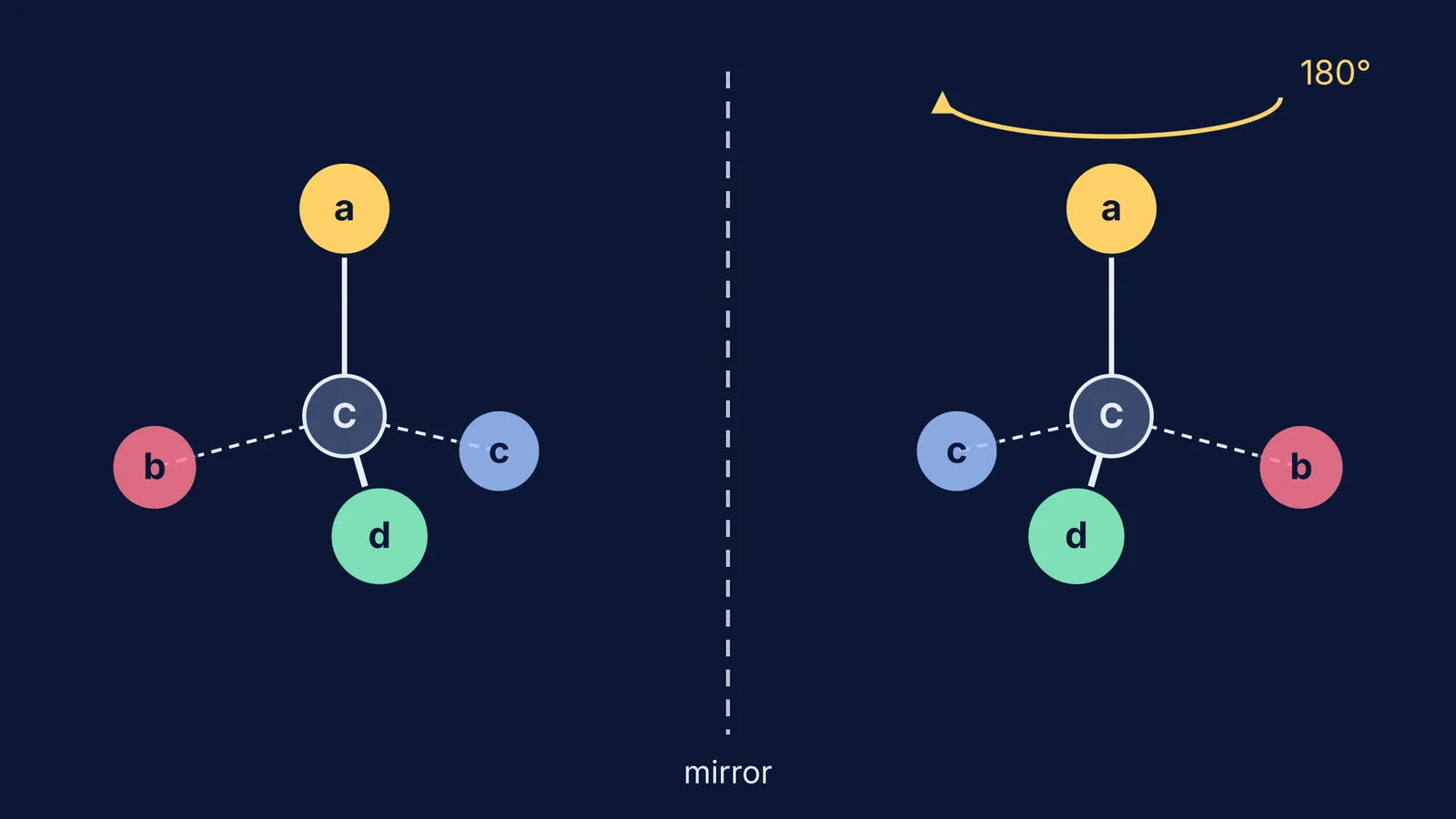
Rotate the mirror image as a rigid object, without breaking bonds, and try to lay it on the original, group on group.
If some rotation matches every group, the molecule is achiral; if none does, it is chiral and the two forms are enantiomers. NCERT runs this test in the same chapter: the mirror image of propan-2-ol, rotated by 180°, overlaps the original; the rotated mirror image of butan-2-ol does not. Propan-2-ol's central carbon carries two identical CH3 groups. Butan-2-ol's carries H, OH, CH3 and C2H5, four different groups.
How do you predict chirality from four different groups?
NCERT credits van 't Hoff and Le Bel, who independently argued in 1874 that a carbon's four groups sit at the corners of a tetrahedron and that, if all four differ, the mirror image cannot be superimposed (NCERT Class 12, Unit 6). Such a carbon is called an asymmetric carbon or stereocentre.
So list the four groups on each sp3 carbon, looking past the first atom: CH3 and CH2CH3 both start with carbon but are different groups.
NCERT calls the asymmetric carbon an aid to recognising chirality, not the definition. One stereocentre means chiral; two or more may not. That is the meso trap.
Why does a meso compound look chiral but is not?
A meso compound is an achiral compound that is superimposable on its mirror image and optically inactive even though it contains two or more stereocentres (LibreTexts, Meso Compounds).
Worked example: tartaric acid, HOOC–CH(OH)–CH(OH)–COOH. Both middle carbons carry H, OH, COOH and the rest of the molecule, so both are stereocentres. Two stereocentres could give four stereoisomers, but tartaric acid has only three: two enantiomers and one meso form (LibreTexts). The same source lists specific rotations of +13° and −13° for the two enantiomers and 0° for meso-tartaric acid.
Where did the fourth go? Take the form in which one stereocentre mirrors the other and rotate about the central C–C bond until the two OH groups are eclipsed. A mirror plane now cuts between the middle carbons, so two drawings show one compound. For molecules with more centres, see how to count stereoisomers from chiral centres.
A four-question meso check:
Two or more stereocentres?
Do they carry the same set of groups, splitting the molecule into matching halves?
In an eclipsed or Fischer view, does a plane reflect one half onto the other?
If yes, it is meso and optically inactive; if not, it is chiral.
Do 3D models actually help with stereochemistry?
They help when you use them to check yourself. In a 2012 study, Shamin Padalkar and Mary Hegarty at UC Santa Barbara asked undergraduates who had taken organic chemistry to convert dash-wedge, Newman and Fischer diagrams (Padalkar and Hegarty, 2012). In a pilot with six students, most relied on rules and mental visualisation rather than the models, and they felt confident despite making many errors.
The intervention: align a ball-and-stick model with the given diagram, then with your own answer, and redraw if it does not fit. Of 54 participants, the 30 who got this routine went from fewer than 2 correct answers out of 6 on average to about 5, while the 24 controls scored about 3 on the post-test (Padalkar and Hegarty). Both groups had models; the checking routine made the difference. It was one short session, and the authors say lasting gains need further study.
A ten-minute rotation drill
You need toothpicks and plasticine in five colours.
Build butan-2-ol's stereocentre, one colour each for H, OH, CH3 and C2H5, and its mirror image beside it.
Rotate the copy until you are sure it cannot be superimposed.
Give the CH3 and C2H5 balls the same colour (now it stands for propan-2-ol) and try again. It fits.
Join two stereocentres as meso-tartaric acid, rotate to the eclipsed view and find the mirror plane.
If screens suit you better than plasticine, the Fermi Simulation Lab has interactive simulations for ideas that are easier to see than to read; our post on simulations versus static diagrams explains when that helps. To revise stereocentres and optical activity one at a time, the Fermi Concept Library gives each concept its own lesson.
Build one model tonight and check your drawing against it before you trust it.


