

On this page
Say the question gives you x³ − 2x² + 3x − 5 = 0 and asks for α³ + β³ + γ³. The roots are ugly: one real, two complex. You never need them.
What are Newton's identities?
Newton's identities relate the power sums of a set of numbers to their elementary symmetric polynomials, as set out in Wikipedia's article on Newton's identities. Isaac Newton found them around 1666, and Albert Girard had already written down the first four in 1629, which is why MathWorld calls them the Newton-Girard formulas.
For three roots α, β, γ, write:
e₁ = α + β + γ
e₂ = αβ + βγ + γα
e₃ = αβγ
pₖ = αᵏ + βᵏ + γᵏ (the power sum you are asked for)
For ax³ + bx² + cx + d = 0, Vieta's formulas give e₁ = −b/a, e₂ = c/a and e₃ = −d/a.
The closed forms from the Newton's identities article are p₂ = e₁² − 2e₂, p₃ = e₁³ − 3e₁e₂ + 3e₃ and p₄ = e₁⁴ − 4e₁²e₂ + 4e₁e₃ + 2e₂² − 4e₄, where e₄ = 0 for a cubic. You need not memorise these; a recurrence gives the same results:
p₁ = e₁
p₂ = e₁p₁ − 2e₂
p₃ = e₁p₂ − e₂p₁ + 3e₃
For k above 3: pₖ = e₁pₖ₋₁ − e₂pₖ₋₂ + e₃pₖ₋₃
Notice the k·eₖ term: 2e₂ in step 2, 3e₃ in step 3. Once k is bigger than the degree, that term disappears.
How do you find α³ + β³ + γ³ without solving?
Take x³ − 2x² + 3x − 5 = 0. Here a = 1, b = −2, c = 3, d = −5, so e₁ = 2, e₂ = 3, e₃ = 5.
p₁ = e₁ = 2
p₂ = e₁p₁ − 2e₂ = 4 − 6 = −2
p₃ = e₁p₂ − e₂p₁ + 3e₃ = −4 − 6 + 15 = 5
So α³ + β³ + γ³ = 5. The closed form agrees: e₁³ − 3e₁e₂ + 3e₃ = 8 − 18 + 15 = 5.
One more step gives the fourth powers: p₄ = e₁p₃ − e₂p₂ + e₃p₁ = 10 + 6 + 10 = 26.
Don't panic at p₂ = −2: two of these roots are complex, and their squares can be negative.
How do you find α⁴ + β⁴ for a quadratic?
If you first met sums and products of zeroes in school, our Class 10 polynomials formulas: zeroes and coefficients is the starting point.
Take x² − 5x + 3 = 0, so s = α + β = 5 and q = αβ = 3. The recurrence is pₖ = s·pₖ₋₁ − q·pₖ₋₂, starting from p₀ = 2 (two roots, each to the power zero) and p₁ = 5.
p₂ = 5 × 5 − 3 × 2 = 19
p₃ = 5 × 19 − 3 × 5 = 80
p₄ = 5 × 80 − 3 × 19 = 343
Check p₄ another way: α⁴ + β⁴ = (α² + β²)² − 2(αβ)² = 361 − 18 = 343.
How can you check your answer in 30 seconds?
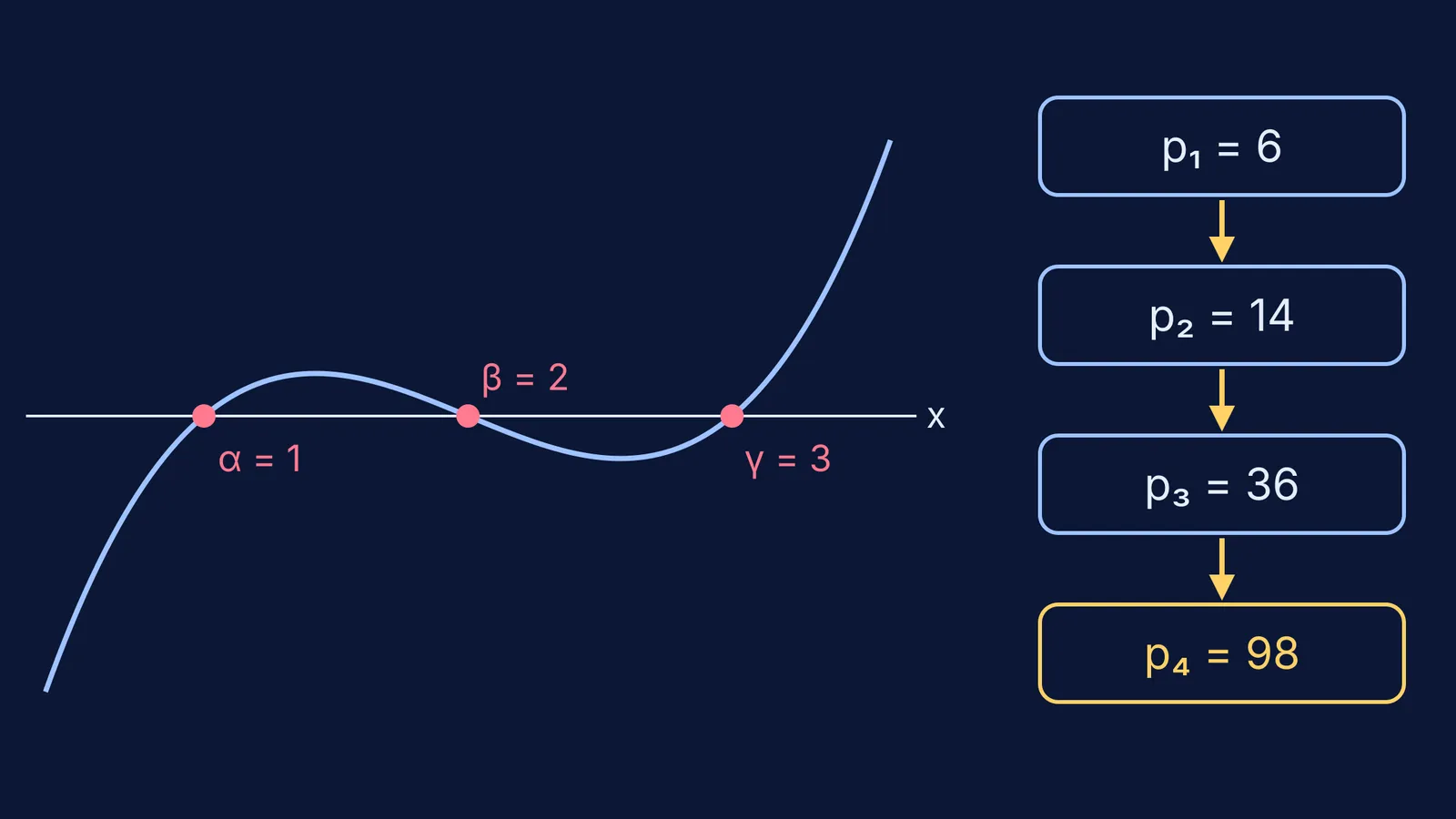
Run the recurrence on a cubic whose roots you know. x³ − 6x² + 11x − 6 = (x − 1)(x − 2)(x − 3), so e₁ = 6, e₂ = 11, e₃ = 6.
p₂ = 36 − 22 = 14, and 1 + 4 + 9 = 14
p₃ = 6 × 14 − 11 × 6 + 18 = 36, and 1 + 8 + 27 = 36
p₄ = 6 × 36 − 11 × 14 + 6 × 6 = 98, and 1 + 16 + 81 = 98
Then check the usual traps:
Divide by the leading coefficient first when a is not 1.
Signs alternate: e₁ = −b/a, e₂ = +c/a, e₃ = −d/a.
Use k·eₖ while k is at most the degree (2e₂, 3e₃).
If a sign keeps going wrong, the Fermi Problem Library has worked problems with a step-by-step solver that explains the reasoning rather than printing an answer, so you can see the exact line where yours went off. If symmetric polynomials themselves feel shaky, the Fermi Concept Library gives each mathematics concept its own lesson and its place in the map.
Where does this show up next?
Power sums turn up wherever a question hides an equation behind its roots, such as cube roots of unity or symmetric expressions in α and β. Our guide to preparing complex numbers and quadratics for JEE Advanced shows where these questions sit, and the roots of unity filter for binomial sums uses the same habit of adding powers of roots.
Next time a question asks for αᵏ + βᵏ + γᵏ, write e₁, e₂, e₃ in the margin and run the recurrence. Leave the roots alone.


