

On this page
Writing out every term of C(n, 0) + C(n, 3) + C(n, 6) + … is slow and error-prone. The short method is to substitute the cube roots of unity into (1 + x)ⁿ and average. This is often called a root of unity filter, the name used on Wikipedia's series multisection page.
What is the roots of unity filter?
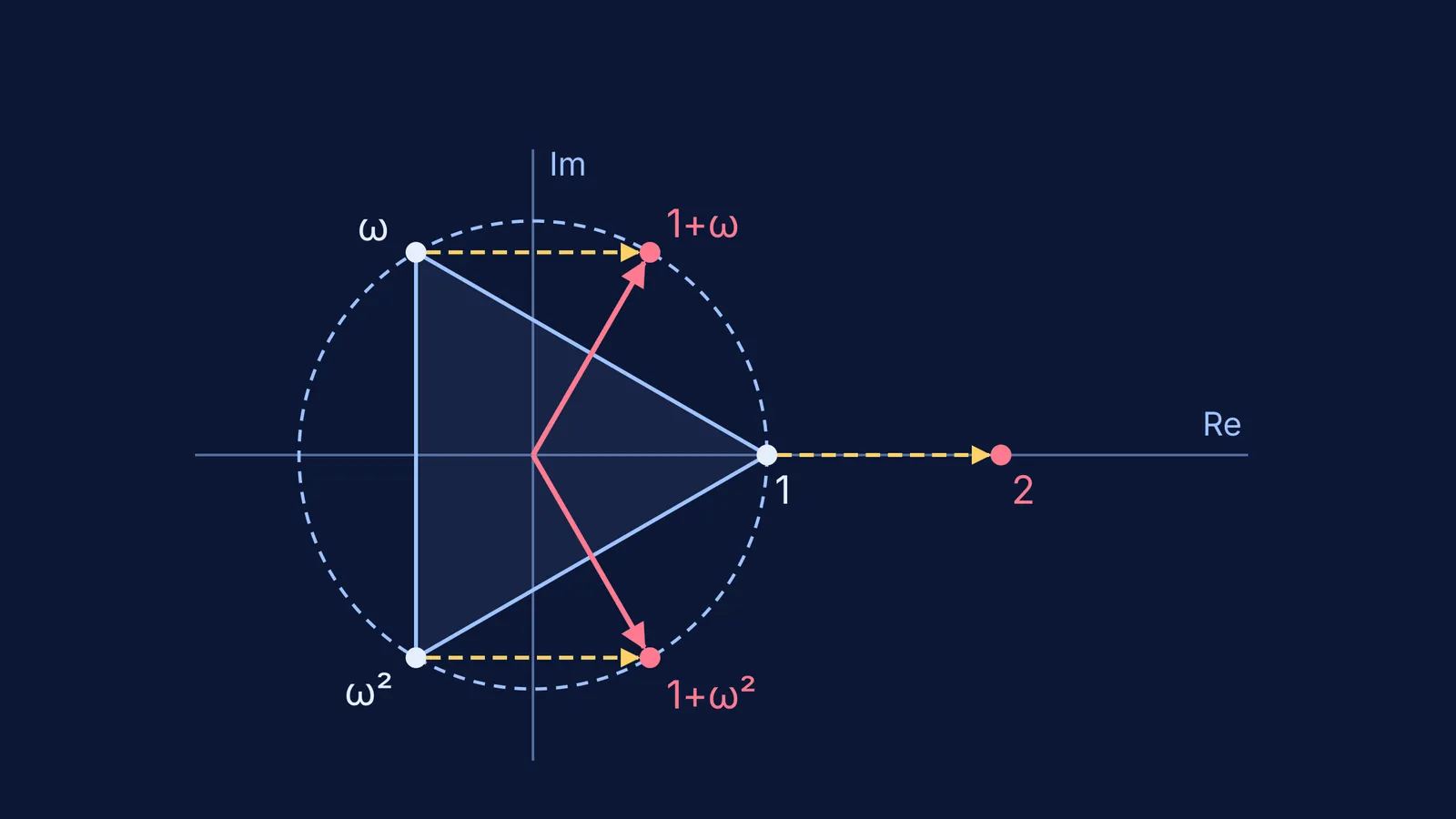
An nth root of unity is a number z with zⁿ = 1, as defined on Wikipedia's root of unity page. For n = 3 the roots are 1, ω and ω², where ω = (−1 + i√3)/2. The same page shows that the nth roots of unity add up to 0 whenever n > 1, so 1 + ω + ω² = 0.
Take any power xᵏ and add its values at x = 1, ω and ω²:
if k is a multiple of 3, each value is 1, so the total is 3;
if k leaves remainder 1, the total is 1 + ω + ω² = 0;
if k leaves remainder 2, the total is 1 + ω² + ω⁴ = 1 + ω² + ω = 0.
So for any polynomial f, f(1) + f(ω) + f(ω²) keeps three times the coefficients of x⁰, x³, x⁶, … and throws the rest away. That is the filter.
How do you find the sum of every third binomial coefficient?
Apply the filter to f(x) = (1 + x)ⁿ, whose coefficients are C(n, 0), C(n, 1), …, C(n, n). If the expansion feels shaky, revise it first with our binomial theorem formulas for Class 11.
f(1) = 2ⁿ.
1 + ω = −ω², which is cos 60° + i sin 60°. So (1 + ω)ⁿ = cos(nπ/3) + i sin(nπ/3).
1 + ω² is its conjugate, so (1 + ω²)ⁿ = cos(nπ/3) − i sin(nπ/3).
Add the three values and divide by 3.
The imaginary parts cancel, and C(n, 0) + C(n, 3) + C(n, 6) + … = (2ⁿ + 2cos(nπ/3))/3, the closed form listed under multisections of sums on Wikipedia's binomial coefficient page. Steps 2 and 3 use De Moivre's theorem; our complex numbers formulas for Class 11 has it if you need a refresher.
Worked example: n = 8
Count directly: C(8, 0) + C(8, 3) + C(8, 6) = 1 + 56 + 28 = 85.
Now the formula: cos(8π/3) = cos(2π/3) = −1/2, so the sum is (256 − 1)/3 = 85.
For the shifted sums, multiply each f(ωʲ) by ω⁻ʲʳ before averaging, where r is the remainder you want. For n = 8 you get C(8, 1) + C(8, 4) + C(8, 7) = 8 + 70 + 8 = 86 and C(8, 2) + C(8, 5) + C(8, 8) = 28 + 56 + 1 = 85. Together 85 + 86 + 85 = 256 = 2⁸, as it must be.
What about every fourth coefficient (the mod 4 version)?
Use the fourth roots of unity 1, i, −1 and −i, which also add up to 0.
f(1) = 2ⁿ, and f(−1) = 0 for n ≥ 1.
1 + i has modulus √2 and angle 45°, so (1 + i)ⁿ = 2^(n/2)(cos(nπ/4) + i sin(nπ/4)).
(1 − i)ⁿ is its conjugate; the two add to 2 × 2^(n/2) cos(nπ/4).
Add everything and divide by 4.
The result is C(n, 0) + C(n, 4) + C(n, 8) + … = 2ⁿ⁻² + 2^(n/2 − 1) cos(nπ/4), which is the form ½(2ⁿ⁻¹ + 2^(n/2) cos(nπ/4)) on the same Wikipedia page, multiplied out.
Check it with n = 8: C(8, 0) + C(8, 4) + C(8, 8) = 1 + 70 + 1 = 72, and 2⁶ + 2³ cos 2π = 64 + 8 = 72.
How do you check your answer before moving on?
Run these checks:
Small n. For n = 3: C(3, 0) + C(3, 3) = 2, and (8 + 2cos π)/3 = 2.
Whole number. The answer counts subsets, so it must be an integer.
Total. The three mod 3 sums (or four mod 4 sums) must add to 2ⁿ.
Size. In the mod 3 case the correction 2cos(nπ/3)/3 is at most 2/3 in size, so the answer is always within 2/3 of 2ⁿ/3.
Where can you practise sums like these?
Our guide to preparing sequences, series and the binomial theorem for JEE Advanced shows where this idea fits in a study plan.
When a sum refuses to simplify, the Fermi Problem Library has a step-by-step solver that explains the reasoning, so you can see which roots to substitute and why. If ω itself is the gap, the Fermi Concept Library covers every concept in mathematics, so you can revise complex numbers first.
Try it on n = 9: C(9, 0) + C(9, 3) + C(9, 6) + C(9, 9) should come out to 170.


