On this page
The binomial theorem chapter has one theorem, a few special cases and the binomial coefficients behind Pascal's triangle. The formulas below follow NCERT Class 11 Mathematics, Chapter 7 (Reprint 2026-27) and the CBSE 2026-27 Mathematics syllabus. Not included: expansions for fractional or negative powers, because NCERT studies the theorem "for positive integral indices only".
For proofs and solved examples, see our Binomial Theorem Class 11 guide.
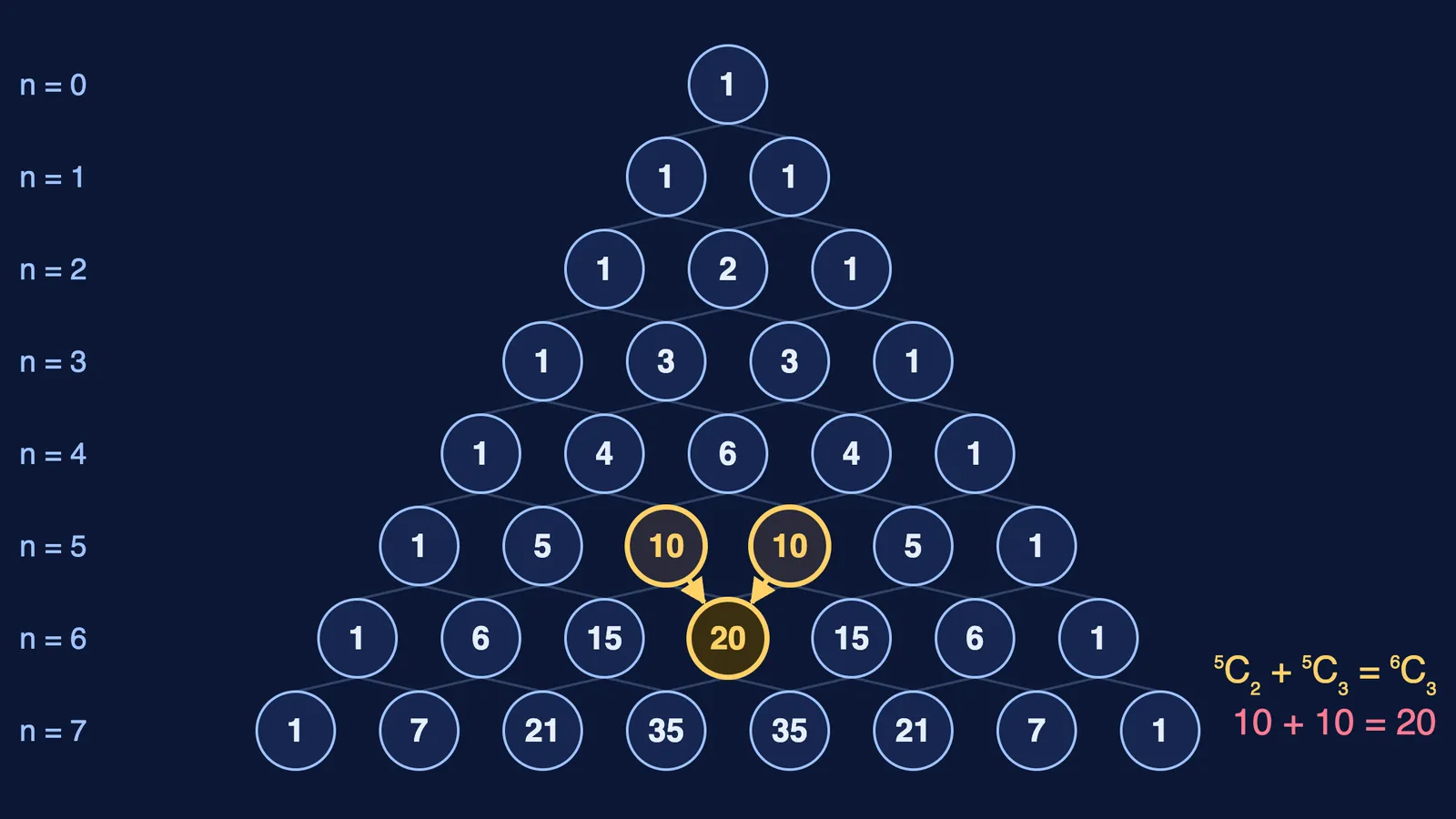
Binomial coefficients and Pascal's triangle
ⁿCᵣ = n! / (r!(n − r)!), where n is a non-negative integer, r is an integer with 0 ≤ r ≤ n, and n! = 1 × 2 × … × n with 0! = 1.
End values: ⁿC₀ = ⁿCₙ = 1. Every row of Pascal's triangle starts and ends with 1.
Pascal's rule: ⁿCᵣ + ⁿCᵣ₋₁ = ⁿ⁺¹Cᵣ, for 1 ≤ r ≤ n. Each entry is the sum of the two above it.
Symmetry: ⁿCᵣ = ⁿCₙ₋ᵣ.
Worked example: row 5 is 1, 5, 10, 10, 5, 1. Adding neighbours gives row 6: 1, 6, 15, 20, 15, 6, 1. Check: ⁶C₃ = 720 / (6 × 6) = 20.
Watch for: Pascal's rule needs lower indices that differ by 1. ⁸C₃ + ⁸C₂ = ⁹C₃ = 84, but ⁸C₃ + ⁸C₅ = 112 is not ⁹C₅.
What is the binomial theorem formula for Class 11?
(a + b)ⁿ = ⁿC₀aⁿ + ⁿC₁aⁿ⁻¹b + ⁿC₂aⁿ⁻²b² + … + ⁿCₙ₋₁abⁿ⁻¹ + ⁿCₙbⁿ, for any positive integer n.
Sigma form: (a + b)ⁿ = Σ ⁿCₖ aⁿ⁻ᵏ bᵏ, k = 0 to n.
Number of terms: n + 1.
The power of a falls from n to 0 as the power of b rises from 0 to n; in every term they add up to n.
The ⁿCᵣ are the binomial coefficients (NCERT 7.2.1).
Worked example: expand (3x + 2)⁴. Row 4 is 1, 4, 6, 4, 1, so (3x + 2)⁴ = (3x)⁴ + 4(3x)³(2) + 6(3x)²(2²) + 4(3x)(2³) + 2⁴ = 81x⁴ + 216x³ + 216x² + 96x + 16.
Watch for: raise the whole term, coefficient included. (3x)⁴ is 81x⁴, not 3x⁴.
Special cases: (x − y)ⁿ, (1 + x)ⁿ and the sums of coefficients
(x − y)ⁿ = ⁿC₀xⁿ − ⁿC₁xⁿ⁻¹y + ⁿC₂xⁿ⁻²y² − … + (−1)ⁿ ⁿCₙyⁿ. Signs alternate, starting with +.
(1 + x)ⁿ = ⁿC₀ + ⁿC₁x + ⁿC₂x² + … + ⁿCₙxⁿ.
(1 − x)ⁿ = ⁿC₀ − ⁿC₁x + ⁿC₂x² − … + (−1)ⁿ ⁿCₙxⁿ.
Sum of the coefficients (put x = 1 in (1 + x)ⁿ): ⁿC₀ + ⁿC₁ + … + ⁿCₙ = 2ⁿ.
Alternating sum (put x = 1 in (1 − x)ⁿ): ⁿC₀ − ⁿC₁ + ⁿC₂ − … + (−1)ⁿ ⁿCₙ = 0, for n ≥ 1.
Putting x = 3 in (1 + x)ⁿ gives Σ 3ʳ ⁿCᵣ = 4ⁿ (NCERT Exercise 7.1, Q14).
(x + y)ⁿ + (x − y)ⁿ keeps only the odd-numbered terms, doubled; (x + y)ⁿ − (x − y)ⁿ keeps only the even-numbered ones, doubled.
Worked example: (x − 2)⁵ = x⁵ − 10x⁴ + 40x³ − 80x² + 80x − 32, and the coefficients of (1 + x)⁷ add up to 2⁷ = 128.
Watch for: the last term's sign is (−1)ⁿ: −32 in (x − 2)⁵, but +64 in (x − 2)⁶.
How is the binomial theorem used for powers, comparisons and divisibility?
NCERT's applications (Examples 2 to 4) use the theorem in three ways, plus approximation.
Powers of numbers: write the number as a round number ± a small one, e.g. 103 = 100 + 3, 98 = 100 − 2.
Comparisons: (1 + x)ⁿ > 1 + nx for x > 0 and n ≥ 2, since the later terms are positive.
Divisibility: write the base as 1 + m and take out m² from the third term onwards.
Approximation: (1 + x)ⁿ ≈ 1 + nx + ⁿC₂x² for small x.
Worked example: (103)⁴ = (100 + 3)⁴ = 100000000 + 12000000 + 540000 + 10800 + 81 = 112550881. And (1.02)⁶ ≈ 1 + 6(0.02) + 15(0.02)² = 1.126; the exact value is 1.12616…
Divisibility: 7ⁿ⁺¹ = (1 + 6)ⁿ⁺¹ = 1 + 6(n + 1) + 36[ⁿ⁺¹C₂ + ⁿ⁺¹C₃·6 + …], so 7ⁿ⁺¹ − 6n − 7 is a multiple of 36 for every positive integer n (n = 2 gives 324 = 36 × 9).
Watch for: in a divisibility proof, call the leftover bracket k and say why it is a natural number.
What are the general term and middle term formulas?
The current NCERT chapter does not include this section. The CBSE 2026-27 syllabus lists "General and middle term in binomial expansion" among Class XI topics that "will be assessed only formatively".
General term: Tᵣ₊₁ = ⁿCᵣ aⁿ⁻ʳ bʳ is the (r + 1)th term of (a + b)ⁿ, for r = 0, 1, …, n.
Middle term, n even: one middle term, the (n/2 + 1)th.
Middle terms, n odd: two, the ((n + 1)/2)th and the ((n + 3)/2)th.
Term independent of x: set the power of x in Tᵣ₊₁ to 0 and solve for a whole number r.
Worked example: (x/2 + 3)⁷ has two middle terms, T₄ and T₅. T₄ = ⁷C₃ (x/2)⁴ 3³ = 945x⁴/16 and T₅ = ⁷C₄ (x/2)³ 3⁴ = 2835x³/8. In (x² − 1/x)⁹, Tᵣ₊₁ has x to the power 18 − 3r, so r = 6 and the constant term is ⁹C₆ = 84.
Watch for: the 4th term uses r = 3, not r = 4.
How to revise this formula sheet
Write Pascal's triangle to row 7 from memory, then check three entries with the factorial formula.
Expand one (ax + b)ⁿ and one (ax − b)ⁿ a day for a week, checking each at x = 1.
Redo NCERT Examples 2 to 4 without the book.
Test yourself with our binomial theorem case study questions and assertion-reason questions. If an expansion keeps going wrong, the Fermi Problem Library has worked problems with a step-by-step solver that explains the reasoning rather than printing an answer.