On this page
Three original case studies on a maths-club display, a fixed deposit and a newspaper calendar puzzle, each with four graded parts and worked answers. For the theory and solved examples, read our Binomial Theorem Class 11 guide.
What do these binomial theorem case study questions cover?
Class 11 exams are set by your school, so the pattern varies. Treat these as practice in the case-based style.
Every part stays inside Chapter 7 of NCERT Class 11 Mathematics (Reprint 2026-27): Pascal's triangle, the theorem for positive integral indices, the special cases, and applications such as evaluating powers, comparing numbers and remainders. The CBSE 2026-27 Class XI Mathematics curriculum lists "General and middle term in binomial expansion" as assessed only formatively, so these cases avoid the general-term formula.
Case 1: Meru Prastara in paper cups
For Maths Day, Meera's maths club in Bhopal builds Pascal's triangle, which NCERT notes is also called Meru Prastara by Pingla. Each paper cup carries one number. The top cup (row for index 0) shows 1, and the bottom row is the row for index 6. Every inside cup shows the sum of the two cups just above it. A visitor asks how many cups were used and what the numbers add up to.
(i) The middle cup of the bottom row shows: (a) 10 (b) 15 (c) 20 (d) 35
(ii) How many terms does the expansion of (a + b)⁶ have, and what is the sum of the numbers in the bottom row?
(iii) How many cups are there in all, and what is the total of all the numbers on them?
(iv) Use the row for index 4 to expand (3 + 2x)⁴.
Answers.
(i) (c) 20. The row for index 6 is 1, 6, 15, 20, 15, 6, 1.
(ii) 7 terms, one more than the index. Putting a = b = 1 gives 1 + 6 + 15 + 20 + 15 + 6 + 1 = 2⁶ = 64.
(iii) Rows have 1, 2, ..., 7 cups, so 28 cups. The row sums are 2⁰, 2¹, ..., 2⁶, so the total is 1 + 2 + 4 + 8 + 16 + 32 + 64 = 127.
(iv) Row 4 is 1, 4, 6, 4, 1. (3 + 2x)⁴ = 3⁴ + 4(3³)(2x) + 6(3²)(2x)² + 4(3)(2x)³ + (2x)⁴ = 81 + 216x + 216x² + 96x³ + 16x⁴.
Case 2: A fixed deposit in Coimbatore
Lakshmi's grandmother puts ₹1,00,000 in a five-year fixed deposit. In this case, assume the bank pays 7% a year, compounded annually, so the maturity amount is 1,00,000 × (1.07)⁵. With no calculator, Lakshmi writes 1.07 = 1 + 0.07 and expands. Her cousin claims that 7% simple interest for five years would give "about the same", ₹1,35,000.
(i) How many terms does the expansion of (1 + 0.07)⁵ have? (a) 5 (b) 6 (c) 7 (d) 10
(ii) Use the first three terms to estimate the maturity amount.
(iii) Find the exact maturity amount using all the terms.
(iv) Use the binomial theorem to show that compound interest beats simple interest here, and find the difference.
Answers.
(i) (b) 6, one more than the index 5.
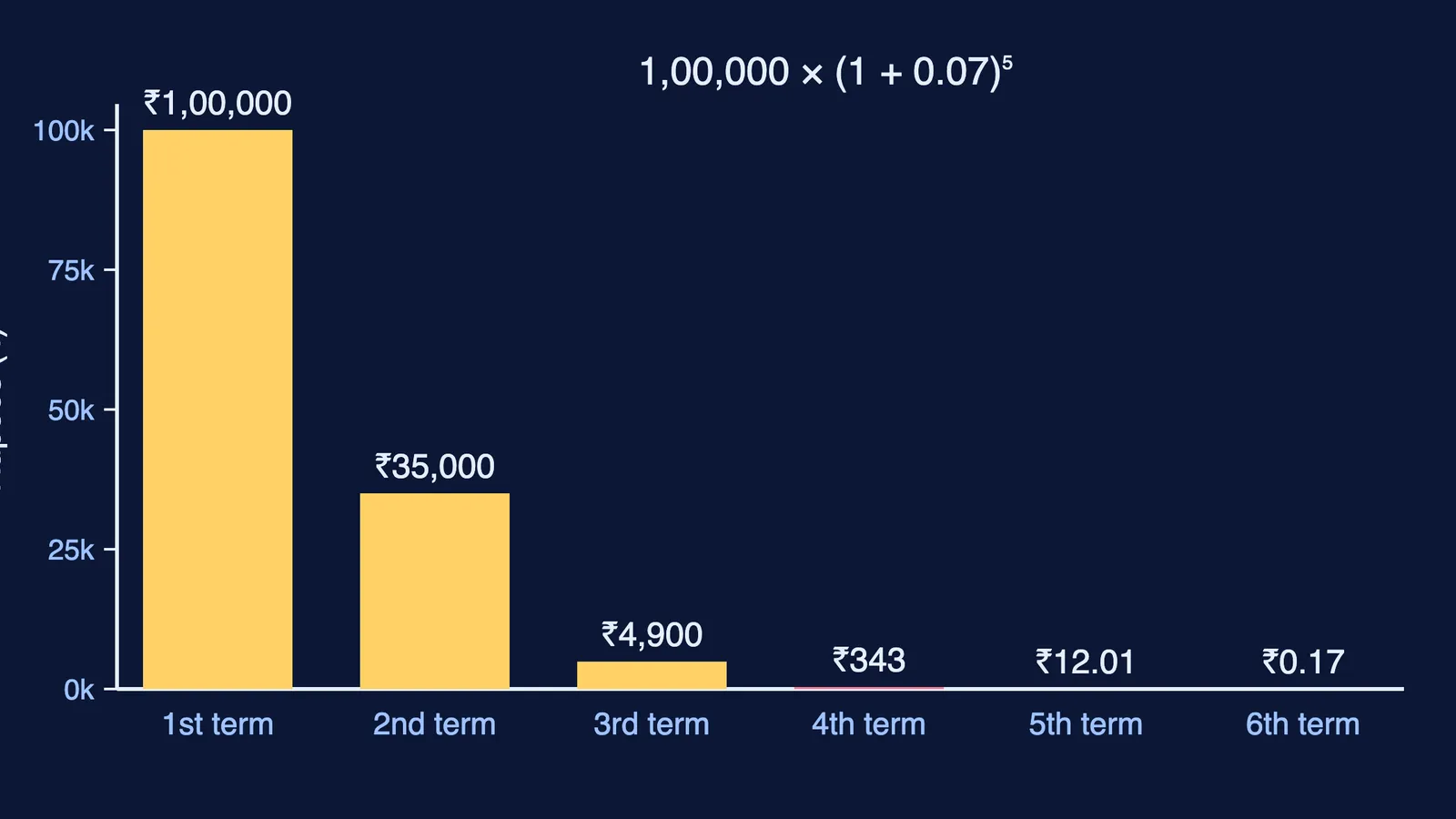
(ii) (1 + 0.07)⁵ ≈ 1 + 5(0.07) + 10(0.07)² = 1 + 0.35 + 0.049 = 1.399. Estimate: ₹1,39,900.
(iii) The remaining terms are 10(0.07)³ = 0.00343, 5(0.07)⁴ = 0.00012005 and (0.07)⁵ = 0.0000016807. The total is 1.4025517307, so the amount is ₹1,40,255.17. The three-term estimate was off by only ₹355.17.
(iv) (1 + 0.07)⁵ = 1 + 5(0.07) + other positive terms, and 1 + 5(0.07) = 1.35 is exactly the simple-interest factor. So compound interest is larger by the other positive terms: ₹1,40,255.17 − ₹1,35,000 = ₹5,255.17.
Case 3: The Sunday newspaper puzzle
The puzzle corner of a Sunday newspaper in Pune asks: "Today is Sunday. Which day of the week will it be 8¹⁰ days from today?" Kabir, in Class 11, notices that only the remainder on division by 7 matters, so he writes 8 = 7 + 1 and expands.
(i) The remainder when 8¹⁰ is divided by 7 is: (a) 0 (b) 1 (c) 6 (d) 7
(ii) Using (1 + 7)ⁿ, show that 8ⁿ − 1 is divisible by 7 for every positive integer n. Which day is it after 8¹⁰ days?
(iii) Which day will it be 6⁹ days from this Sunday?
(iv) Find the remainder when 8²⁰ is divided by 49.
Answers.
(i) (b) 1, as part (ii) shows.
(ii) (1 + 7)ⁿ = 1 + ⁿC₁(7) + ⁿC₂(7²) + ... + 7ⁿ. Every term after the first has a factor 7, so 8ⁿ − 1 = 7k. After 8¹⁰ days the day moves on by 1: Monday.
(iii) 6⁹ = (7 − 1)⁹. Every term except the last, (−1)⁹ = −1, has a factor 7, so 6⁹ = 7k − 1 = 7(k − 1) + 6. The remainder is 6, so the day moves on by 6: Saturday.
(iv) (1 + 7)²⁰ = 1 + 20(7) + ²⁰C₂(7²) + ... All terms from the third on contain 49, so 8²⁰ = 141 + 49m. Since 141 = 2 × 49 + 43, the remainder is 43.
How do you attack binomial theorem case-study questions?
Write the index first, then the number of terms (index + 1); half the MCQs are settled there.
For powers of numbers near a round value, split them as (1 + small) or (round ± small), as in Case 2.
For remainders, write the base as (divisor ± 1); every term but the last carries the divisor.
Keep the signs alternating in (a − b)ⁿ and check the last term separately.
Put a = b = 1 in your expansion to check the coefficients add up to 2ⁿ.
For more on how these questions work, see how to handle case-based questions. If one step keeps going wrong, the Fermi Problem Library has worked problems with a step-by-step solver that explains the reasoning rather than printing an answer.