On this page
Every statement below stays inside Chapter 7 of NCERT Class 11 Mathematics (Reprint 2026-27), and we checked every number with Python.
How do you answer assertion-reason questions on the binomial theorem?
Treat this as a practice set, not a prediction of any paper.
The CBSE 2026-27 Class XI Mathematics curriculum lists the statement and proof of the binomial theorem for positive integral indices, Pascal's triangle and simple applications. None of these items needs the general-term formula.
Judge A, judge R, then read A, say "because", read R. More in our assertion-reason question strategy.
Assertion-reason keys:
(A) Both A and R are true and R is the correct explanation of A.
(B) Both A and R are true but R is NOT the correct explanation of A.
(C) A is true but R is false.
(D) A is false but R is true.
Statement I / Statement II keys:
(A) Both statements are correct.
(B) Both statements are incorrect.
(C) Statement I is correct, Statement II is incorrect.
(D) Statement I is incorrect, Statement II is correct.
Binomial theorem assertion-reason questions with answers
Q1 (easy). Assertion (A): The expansion of (3x − y)⁷ has 8 terms. Reason (R): The expansion of (a + b)ⁿ, for a positive integer n, has n + 1 terms.
Answer: (A). Write (3x − y)⁷ as [3x + (−y)]⁷ with n = 7, so it has 7 + 1 = 8 terms. R is exactly the NCERT observation that gives the count.
Trap: thinking the minus sign changes the number of terms.
Q2 (easy). Assertion (A): In every term of the expansion of (x + y)⁹, the powers of x and y add up to 9. Reason (R): ⁹Cᵣ = ⁹C₉₋ᵣ for every r from 0 to 9.
Answer: (B). A is true because the power of x falls by 1 as the power of y rises by 1, starting from x⁹. R is true too, but symmetry of the coefficients says nothing about the powers.
Trap: ticking (A) because both lines are correct textbook facts.
Q3 (medium). Assertion (A): The sum of the coefficients in the expansion of (2x − y)⁶ is 1. Reason (R): ⁿC₀ + ⁿC₁ + ... + ⁿCₙ = 2ⁿ.
Answer: (B). Put x = y = 1: the sum of the coefficients is (2 − 1)⁶ = 1, so A is true. R is true, but it adds the bare binomial coefficients; the coefficients here also carry powers of 2 and alternating signs.
Trap: answering 2⁶ = 64.
Q4 (medium). Assertion (A): (1.02)⁵⁰ > 2. Reason (R): For x > 0 and an integer n ≥ 2, (1 + x)ⁿ > 1 + nx, because all the remaining terms of the expansion are positive.
Answer: (A). With x = 0.02 and n = 50, 1 + nx = 1 + 1 = 2, and R makes the inequality strict. This is the same idea NCERT uses to compare (1.01)¹⁰⁰⁰⁰⁰⁰ with 10,000.
Trap: reaching for a calculator.
Q5 (hard). Assertion (A): 7ⁿ − 6n − 1 is divisible by 36 for every positive integer n. Reason (R): 7ⁿ leaves remainder 1 when divided by 36, for every positive integer n.
Answer: (C). 7ⁿ = (1 + 6)ⁿ = 1 + 6n + 36(ⁿC₂ + 6·ⁿC₃ + ...), so A is true. R is false: 7 and 49 leave remainders 7 and 13.
Trap: dropping the 6n term and assuming 7ⁿ − 1 alone is a multiple of 36.
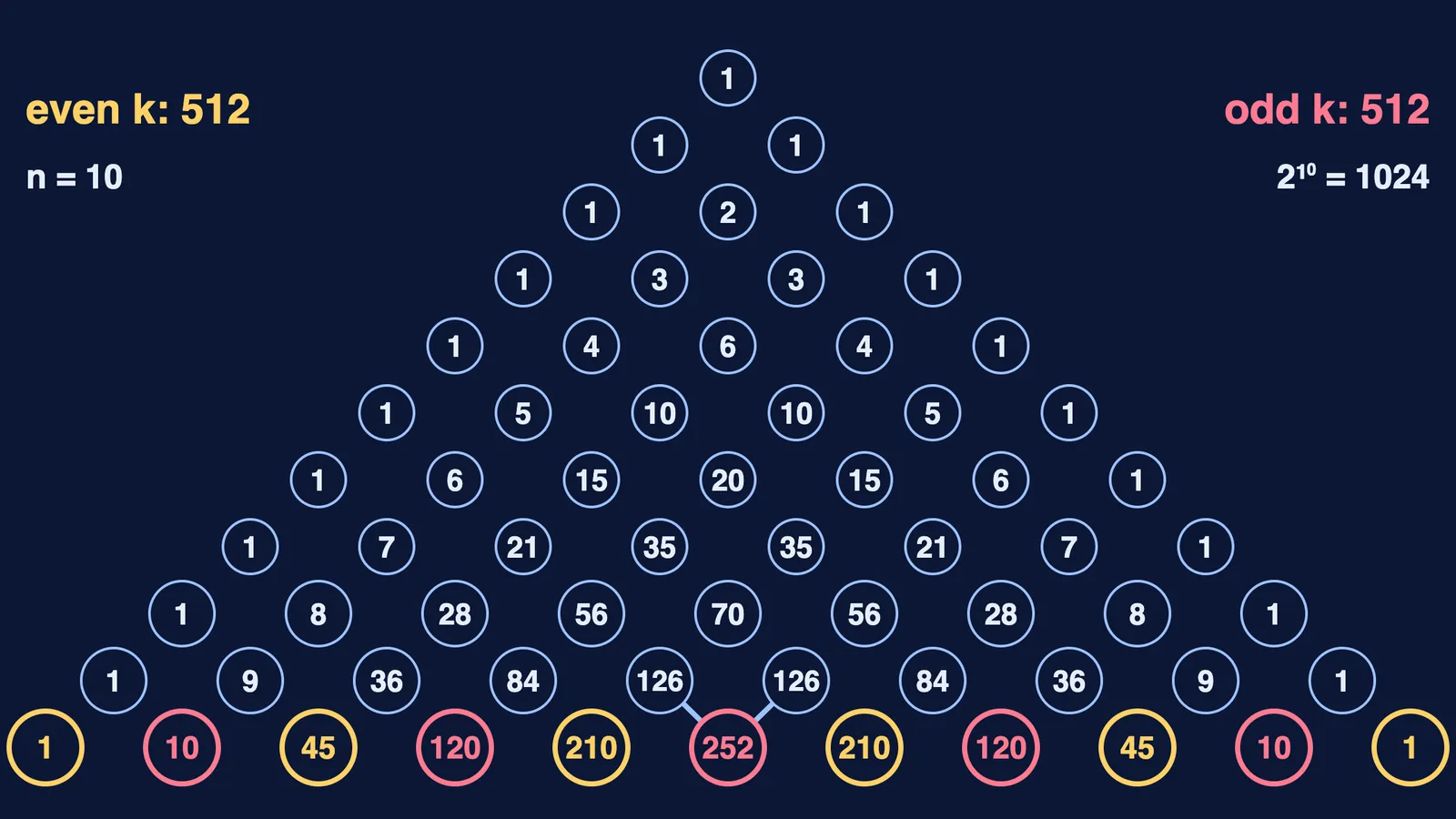
Q6 (hard). Assertion (A): ¹⁰C₀ + ¹⁰C₂ + ¹⁰C₄ + ... + ¹⁰C₁₀ = 1024. Reason (R): ⁿC₀ − ⁿC₁ + ⁿC₂ − ... + (−1)ⁿ ⁿCₙ = 0 for every positive integer n.
Answer: (D). R is NCERT's result from putting x = 1 in (1 − x)ⁿ. It shows the even-position and odd-position sums are equal, so each is half of 2¹⁰: 512, as the hero diagram shows. A is false.
Trap: forgetting to halve.
Statement I and Statement II questions on the binomial theorem
Q7 (easy). Statement I: The row for index 5 in Pascal's triangle is 1, 5, 10, 10, 5, 1. Statement II: All six coefficients in the expansion of (x − 2)⁵ are positive.
Answer: (C). I is correct. II is wrong: (x − 2)⁵ = x⁵ − 10x⁴ + 40x³ − 80x² + 80x − 32, so the signs alternate.
Trap: copying the Pascal row and forgetting the powers of −2.
Q8 (medium). Statement I: The coefficient of x³ in (2x + 3)⁴ is 4. Statement II: The coefficient of x² in (1 + x)⁸ is 28.
Answer: (D). The x³ term is ⁴C₁(2x)³(3) = 96x³, so I is wrong. II is right: the coefficient is ⁸C₂ = 28.
Trap: giving the binomial coefficient ⁴C₁ instead of the full coefficient.
Q9 (medium). Statement I: (97)⁴ = 88529281. Statement II: (97)⁴ − 81 is divisible by 94.
Answer: (A). (100 − 3)⁴ = 100000000 − 12000000 + 540000 − 10800 + 81 = 88529281. II follows from NCERT's result that a − b is a factor of aⁿ − bⁿ for distinct integers a, b, here with a = 97, b = 3 and 97 − 3 = 94.
Trap: giving every term a plus sign or dropping the powers of 3.
Q10 (hard). Statement I: (1.05)²⁰ < 2. Statement II: (√5 + √2)⁴ + (√5 − √2)⁴ is irrational.
Answer: (B). (1.05)²⁰ = 1 + 1 + 0.475 + (positive terms) > 2, so I is wrong. In the sum, the odd-power terms cancel: 2(25 + 6·5·2 + 4) = 178, which is rational, so II is wrong too.
Trap: assuming that adding surds must give a surd.
How should you use this set?
Cover the answers and do all ten in one sitting, about 15 minutes.
For every miss, write the trap in your own words.
Redo Q5, Q6 and Q10 a week later without looking.
If expansions or sign errors keep slipping, the Fermi Problem Library has worked problems with a step-by-step solver that explains the reasoning rather than printing an answer.
For the theory and solved examples, read our Binomial Theorem Class 11 guide. Preparing for JEE Main as well? Our binomial theorem guide for JEE adds general and middle terms.