On this page
Many board and JEE questions give you a quadratic with an unknown k and one extra fact, such as "the roots differ by 1". Solving for both roots in terms of k gets messy fast. One formula for the gap between the roots does it in two lines, whatever the leading coefficient.
What is the formula for α − β of a quadratic?
Start from the quadratic formula. The roots of ax² + bx + c = 0 are x = (−b ± √(b² − 4ac))/2a, as listed on Wolfram MathWorld's quadratic equation page. The expression under the square root, D = b² − 4ac, is called the discriminant (Wikipedia: Quadratic equation).
Call the root with the plus sign α and the one with the minus sign β. When you subtract, the −b terms cancel:
α − β = (−b + √D)/2a − (−b − √D)/2a = 2√D/2a = √D/a.
Which root you call α is your choice, so the sign is not fixed. The distance between the roots is the useful quantity: |α − β| = √D/|a|.
There is a second route that never touches the quadratic formula. Vieta's formulas give α + β = −b/a and αβ = c/a (Wikipedia: Vieta's formulas). Then
(α − β)² = (α + β)² − 4αβ = b²/a² − 4c/a = (b² − 4ac)/a² = D/a².
Taking square roots gives the same result. Rearranged, D = a²(α − β)², the form the Wikipedia article on the discriminant uses for the quadratic case.
How do you find k when the roots differ by 1?
Set √D/|a| = 1 and square both sides. The condition becomes D = a². If the roots must differ by some number d instead, the condition is D = a²d².
Example 1: x² − kx + 6 = 0
Here a = 1, b = −k and c = 6, so D = k² − 24.
The roots differ by 1, so D = a² = 1.
k² − 24 = 1, so k² = 25.
k = 5 or k = −5.
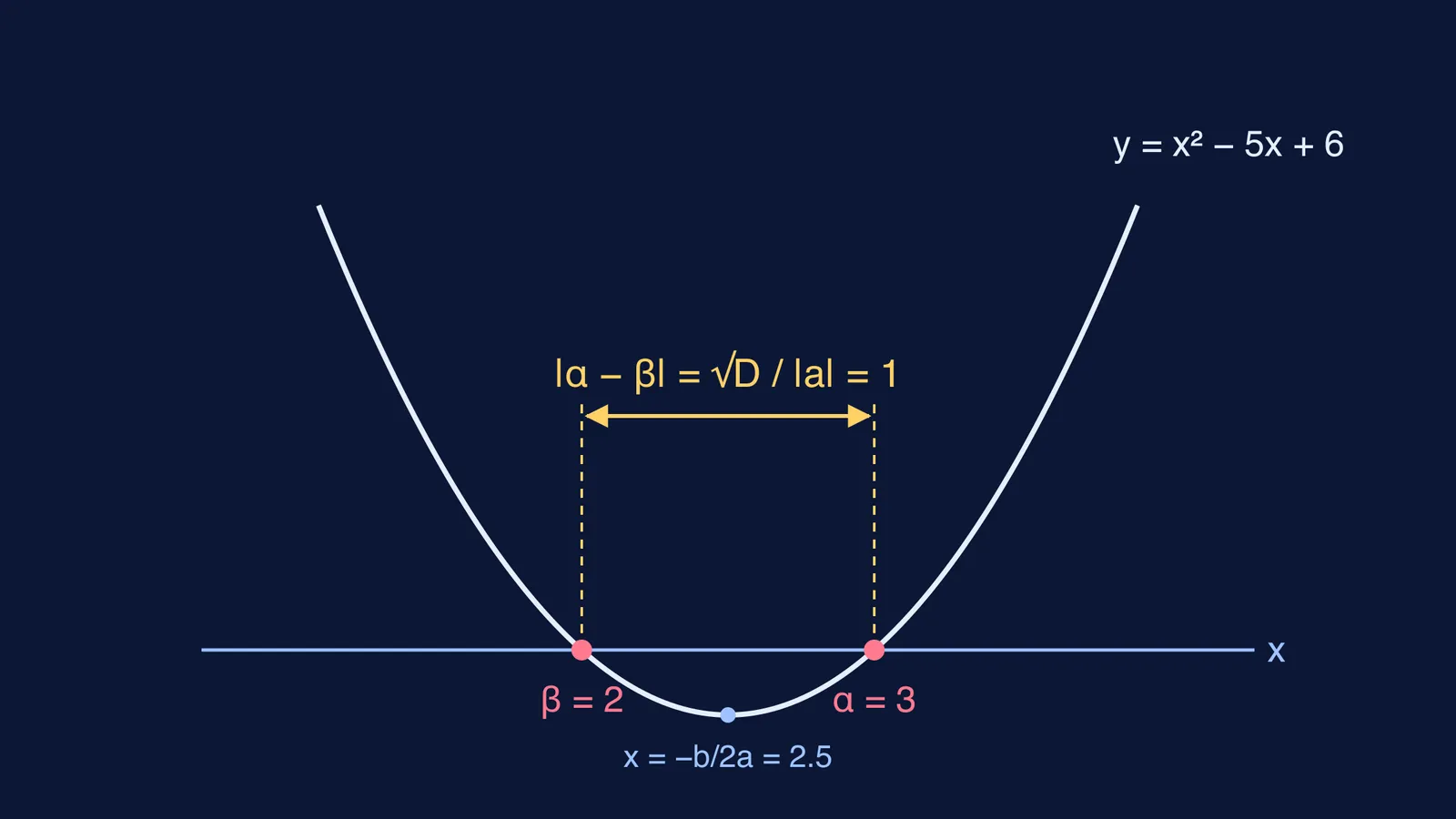
Check: with k = 5 the equation is x² − 5x + 6 = (x − 2)(x − 3), roots 2 and 3. With k = −5 the roots are −2 and −3. Both pairs differ by 1, and you never solved a quadratic in k.
Example 2: 2x² − 10x + k = 0
Here a = 2, b = −10 and c = k, so D = 100 − 8k.
The roots differ by 1, so D = a² = 4.
100 − 8k = 4, so 8k = 96.
k = 12.
Check: 2x² − 10x + 12 = 2(x − 2)(x − 3), roots 2 and 3 again.
This is where the common slip happens. If you write D = 1 and forget the a², you get 100 − 8k = 1, so k = 99/8. With that k the roots differ by √1/2 = 1/2, not 1.
Why does the gap depend on √D and a?
The graph explains it. The vertex of a parabola sits halfway between its roots, at x = −b/2a (Wikipedia: Quadratic equation). Each root lies √D/(2|a|) to one side of that line, so the full gap is √D/|a|.
Two things follow:
A bigger |a| makes the parabola narrower, so its roots sit closer together, even with the same D.
When D = 0 the gap is zero, which is just the equal-roots case. Our post on how to find k for equal roots of a quadratic works through that condition.
If D is negative, the roots are non-real complex conjugates (Wikipedia: Quadratic equation), so there is no real gap. Since D = a²d² is never negative, squaring the condition adds no fake answers.
A four-step check for "roots differ by d" questions
Write the equation as ax² + bx + c = 0 and read off a, b and c, signs included.
Write D = b² − 4ac in terms of k.
Set D = a²d² and solve for k. Keep both signs if k appears squared.
Check each value. If k sits in the leading coefficient, reject any value that makes a = 0. Then substitute one value back and factorise to confirm the gap.
The same idea, rewriting what the question asks for in terms of α + β and αβ, also handles other symmetric expressions. See how to find α⁵ + β⁵ without solving the quadratic and the condition for the roots of a quadratic in the ratio m to n.
If you keep landing on k = 99/8-style answers, a step is going missing. The Fermi Problem Library has worked problems with a step-by-step solver that explains the reasoning rather than printing an answer, so you can see exactly where the a² went missing. To revise discriminants and Vieta's formulas from the start, try the Fermi Concept Library.
Try it yourself: find k if the roots of x² + kx + 12 = 0 differ by 1. You should get k = ±7.