On this page
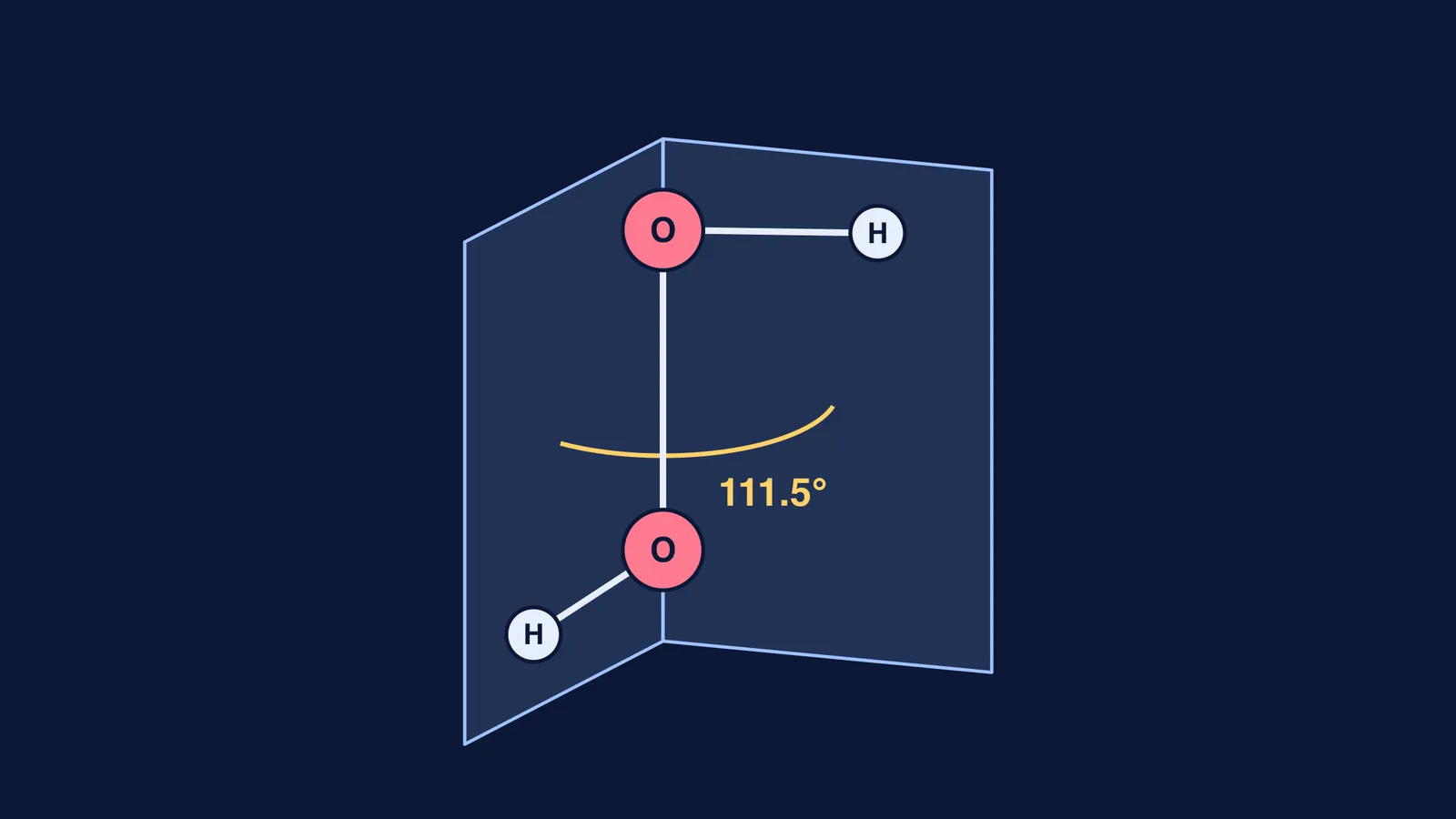
When your textbook calls hydrogen peroxide an "open book", it means something exact. The O–O bond is the spine, each O–H bond lies on one page, and the pages are held partly open.
Why is H2O2 non-planar?
Each oxygen in H–O–O–H has two bonds and two lone pairs. In the usual textbook picture, one lone pair on each oxygen sits in a p-type orbital standing at right angles to that oxygen's H–O–O plane. Compare three shapes, looking down the O–O bond.
Flat, both H on the same side (cis): the O–H bonds eclipse each other, and the two p-type lone pairs lie parallel, side by side. Most repulsion.
Flat, H on opposite sides (trans): the H atoms are far apart, but the two p-type lone pairs are still parallel and push on each other.
Twisted: the two H–O–O planes turn apart, so those lone pairs are no longer parallel and the O–H bonds no longer eclipse. Least repulsion.
A 1965 far-infrared study by Hunt, Leacock, Peters and Hecht derived from the spectrum the energy needed to force the molecule flat: 386 cm⁻¹ through the trans form and 2460 cm⁻¹ through the cis form. That is about 4.6 kJ/mol and 29.4 kJ/mol. The cis barrier is over six times higher, which fits the simple picture: the cis form adds eclipsed O–H bonds to the lone-pair clash.
Background: how lone pairs shrink the bond angles in CH4, NH3 and H2O and Newman projections of ethane and butane.
What is the dihedral angle of H2O2 in gas and solid phase?
The dihedral angle is the angle between the two pages: the plane holding H–O–O and the plane holding O–O–H.
The NIST Computational Chemistry Comparison and Benchmark Database lists the gas-phase O–O bond as 1.475 Å, O–H as 0.950 Å and the H–O–O angle as 94.8°, from a 1962 infrared study by Redington, Olson and Cross. Its geometry table gives that paper's dihedral angle of 119.8°, while its dipole section uses Hunt and co-workers' later equilibrium value of 111.5°.
In the solid, the book closes partway. A neutron-diffraction study of crystalline H2O2 by Busing and Levy found a dihedral angle of 90.2°, an O–O distance of 1.453 Å and an O–H distance of 0.988 Å. The molecules are hydrogen-bonded (O–H···O distance 2.799 Å), and the authors concluded that the dihedral angle is quite sensitive to the molecule's environment.
The 4.6 kJ/mol trans barrier is less than twice RT at room temperature (about 2.5 kJ/mol), so the twist is floppy and crystal neighbours can shift it.
Why does H2O2 have a dipole moment?
Each O–H bond is polar, because oxygen is more electronegative than hydrogen. The molecular dipole is the vector sum of the two O–H bond dipoles; the O–O bond joins identical atoms and adds nothing.
Flat trans: the two O–H dipoles point in opposite directions and cancel. NIST gives this form zero dipole by symmetry.
Open book: they do not cancel. The sum lies along the line bisecting the dihedral angle, at right angles to the O–O bond.
To put numbers on it, the same NIST page quotes Hunt's dipole function μ = 3.1 cos(θ/2) debye, where θ is the dihedral angle.
Flat trans, θ = 180°: cos 90° = 0, so μ = 0.
Gas phase, θ = 111.5°: cos 55.75° ≈ 0.563, so μ ≈ 1.75 D. With the 3.15 D prefactor in Hunt's paper you get the 1.77 D that NIST lists.
So H2O2 is polar because of the twist, not just its polar bonds. If dipole moment or molecular shape is shaky, the Fermi Concept Library has a lesson on every concept in chemistry, each with its place in the map.
How do you make a paper model of H2O2?
Take an index card, ruler and protractor. Scale: 2 cm per Å.
Fold the card in half. The fold is the O–O bond.
Mark two dots on the fold 3 cm apart (1.475 Å). Label them O.
On the left page, from the lower O, draw a 1.9 cm line (0.95 Å) at 95° to the fold, leaning slightly away from the upper O. Label the end H.
On the right page, do the same from the upper O, leaning away from the lower O.
On a sheet of paper, draw two lines meeting at 111.5°. Stand the card on it, fold down, one page along each line. This is gas-phase H2O2.
Close the pages to about 90°. This is close to the crystal's twist.
Open the card flat and draw an arrow from each H towards its O. The arrows point opposite ways and cancel.
Fold back to 111.5°. Both arrows now lean the same way; their sum lies along the bisector.
For the rest of the story, read how hydrogen peroxide is made and why it is kept in plastic bottles.