On this page
Hydrogen peroxide is made in factories by a loop that recycles its own starting material, and almost every rule for storing it exists to stop it breaking down into water and oxygen. Here is the route, the reason behind each rule, and an answer you can write in an exam.
How is hydrogen peroxide prepared industrially?
Industrially, hydrogen peroxide is prepared by the auto-oxidation of 2-alkylanthraquinols, with 2-ethylanthraquinol as the example, according to section 9.7.1 of the NCERT Class 11 Chemistry Hydrogen chapter (2019-20 edition).
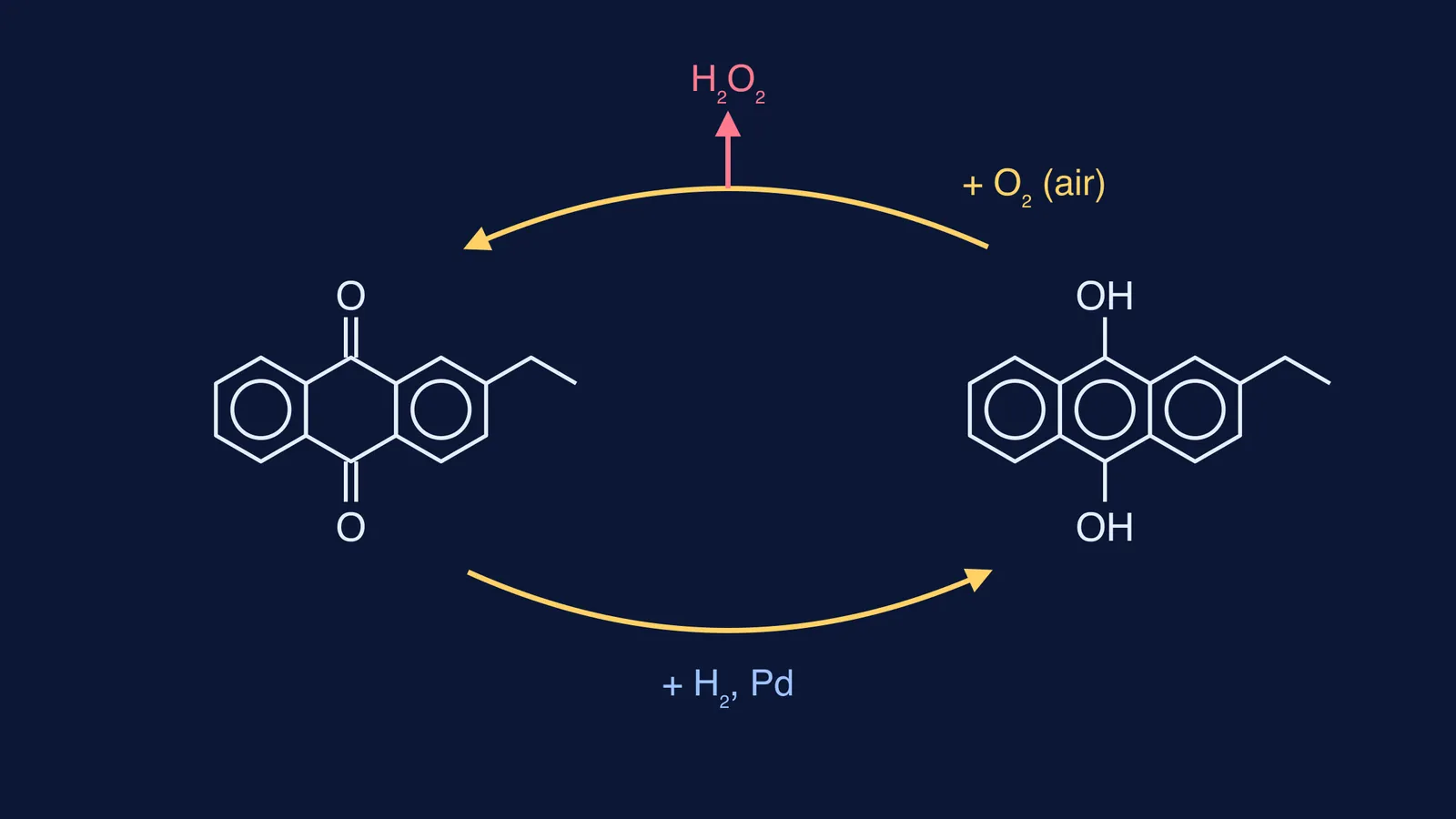
The loop has three steps:
Air oxidises 2-ethylanthraquinol. It gives up two hydrogen atoms to oxygen, forming H2O2 and the oxidised product, 2-ethylanthraquinone.
The H2O2 is extracted with water.
Hydrogen gas over a palladium catalyst reduces the quinone back to the quinol, ready for the next pass.
Because the anthraquinone is recycled, the net change is just H2 + O2 → H2O2. A review in Angewandte Chemie by Campos-Martin, Blanco-Brieva and Fierro describes this anthraquinone oxidation process as the way H2O2 is produced on an industrial scale: sequential hydrogenation and oxidation of an alkylanthraquinone dissolved in organic solvents, then liquid-liquid extraction (Campos-Martin et al., 2006).
The extract is weak. NCERT states that the process forms 1% H2O2, which is concentrated to about 30% by mass by distillation under reduced pressure, and to about 85% by careful distillation at low pressure; freezing out the remaining water gives pure H2O2 (NCERT, section 9.7.1).
The same NCERT section lists two other methods. Acidifying barium peroxide octahydrate with sulphuric acid gives H2O2 and insoluble BaSO4, and the excess water is removed by evaporation under reduced pressure. Peroxodisulphate, made by electrolysing acidified sulphate solution at high current density, gives H2O2 on hydrolysis; NCERT says this route is now used to prepare D2O2 in the lab. The barium peroxide idea goes back a long way: read how Thénard first made hydrogen peroxide in 1818.
Why is hydrogen peroxide stored in plastic bottles in the dark?
NCERT's storage section gives the whole answer in a few sentences (NCERT, section 9.7.5). H2O2 decomposes slowly on exposure to light: 2H2O2(l) → 2H2O(l) + O2(g). Metal surfaces or traces of alkali present in glass containers catalyse this reaction. So it is stored in wax-lined glass or plastic vessels in the dark, urea can be added as a stabiliser, and it is kept away from dust, because dust can induce explosive decomposition.
Read each rule as a fix for one cause:
Light speeds decomposition, so the bottle is stored in the dark.
Alkali in glass catalyses decomposition, so the liquid goes in plastic, or in glass lined with wax so it never touches bare glass.
Metal surfaces catalyse it too, so the liquid should not touch metal.
Dust can induce explosive decomposition, so the bottle stays clean and closed.
Slow background decomposition still happens, so a stabiliser such as urea is added.
Commercial solutions use other stabilisers as well. PubChem's hydrogen peroxide record says a low percentage of an inhibitor such as acetanilide or sodium stannate is usually added to counter the catalytic effect of traces of iron, copper and other heavy metals (PubChem, Stability and shelf life). The same record says a relatively stable sample typically decomposes at about 0.5% per year at room temperature.
If you want to measure that decomposition yourself, see how the first-order kinetics of H2O2 decomposition is followed by KMnO4 titration.
How do you write this as an exam answer?
A five-line answer that follows the NCERT text:
Name the method: auto-oxidation of 2-ethylanthraquinol.
Write the cycle: 2-ethylanthraquinol + O2 (air) gives H2O2 + 2-ethylanthraquinone; H2 over Pd regenerates the quinol.
Give the numbers: about 1% H2O2 forms, concentrated to about 30% by distillation under reduced pressure.
Write the decomposition: 2H2O2 → 2H2O + O2, sped up by light, metal surfaces and alkali in glass.
State the storage: wax-lined glass or plastic vessels, in the dark, urea as stabiliser, away from dust.
The strength numbers connect to the same chapter. NCERT says a 30% solution is marketed as "100 volume" H2O2, and the commercially marketed 10 volume sample contains 3% H2O2 (NCERT, section 9.7.2). Work through the conversion in how to calculate the volume strength of hydrogen peroxide.
If volume-strength or redox problems on H2O2 still feel shaky, the Fermi Problem Library has worked problems with a step-by-step solver that explains the reasoning rather than printing an answer. Try writing all five lines from memory first, then check them against the NCERT page.