

On this page
Look straight down the carbon–carbon bond of ethane and turn the back carbon like a dial. Every position has an energy, and the topic comes down to one graph of energy against angle. Here is how to predict it yourself.
What is a Newman projection, and what does the angle mean?
A Newman projection views the carbon–carbon bond end-on and draws the two carbons as a circle, as the OpenStax Organic Chemistry section on ethane conformations/03:_Organic_Compounds-_Alkanes_and_Their_Stereochemistry/3.06:_Conformations_of_Ethane) explains. Bonds on the front carbon meet at the centre. Bonds on the back carbon stick out from the edge of the circle.
The angle you turn is the dihedral angle. It is the angle between a bond on the front carbon and a bond on the back carbon, seen end-on (same source/03:_Organic_Compounds-_Alkanes_and_Their_Stereochemistry/3.06:_Conformations_of_Ethane)). For butane we track the angle between the two CH3 groups. At 0° the two methyls line up, and at 180° they point in opposite directions.
Staggered: the back bonds sit exactly between the front bonds (60°, 180°, 300°).
Eclipsed: the back bonds hide behind the front bonds (0°, 120°, 240°).
Gauche: a staggered butane with its two CH3 groups 60° apart.
Anti: a staggered butane with its two CH3 groups 180° apart.
Why is eclipsed ethane higher in energy than staggered?
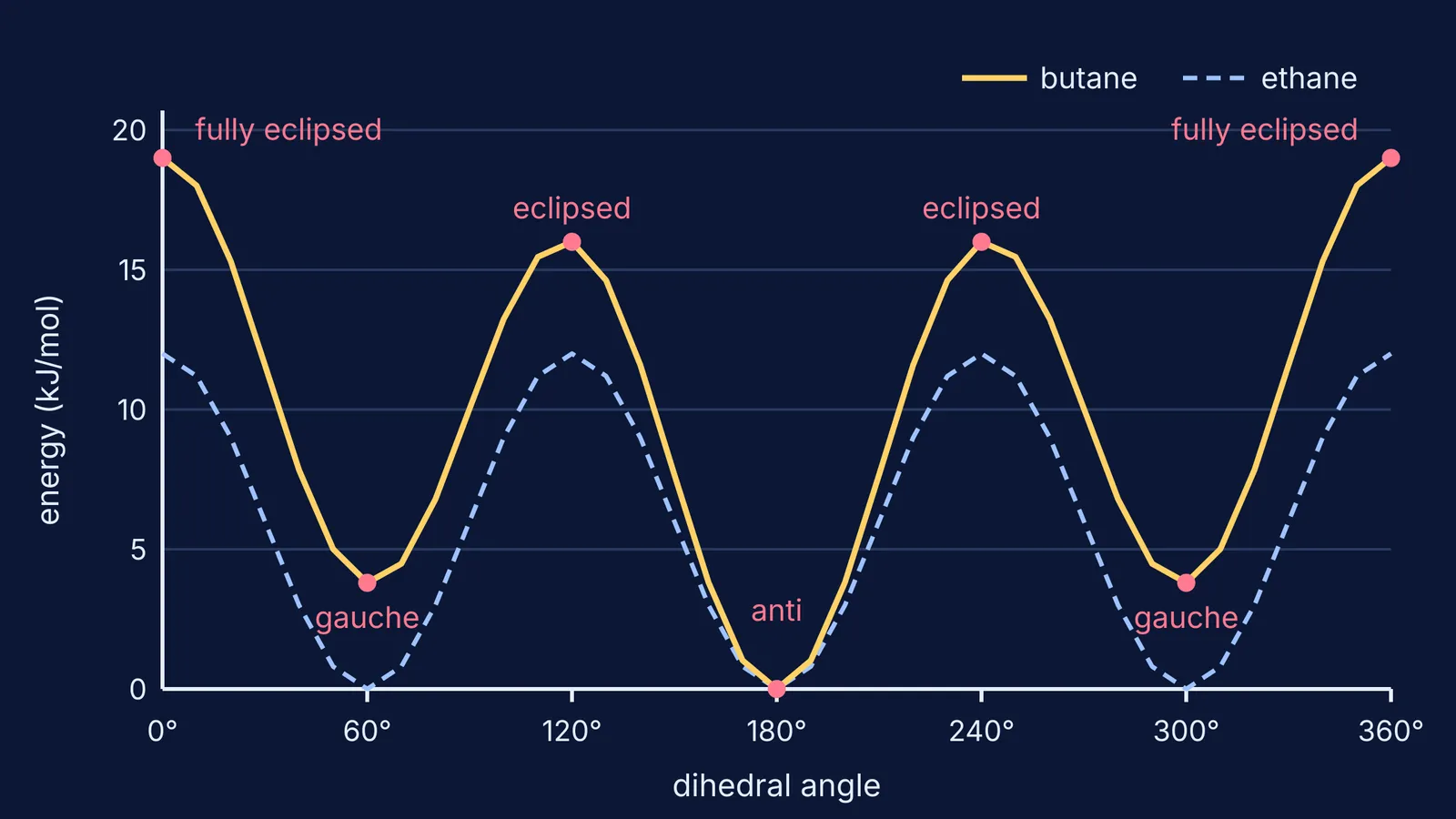
Ethane has a small barrier to rotation of 12 kJ/mol (2.9 kcal/mol). That extra energy in the eclipsed form is called torsional strain, according to OpenStax on LibreTexts/03:_Organic_Compounds-_Alkanes_and_Their_Stereochemistry/3.06:_Conformations_of_Ethane). The same source splits the barrier into three H–H eclipsing interactions of about 4.0 kJ/mol each.
The barrier is too small to stop rotation at room temperature. At any instant, about 99% of ethane molecules are close to staggered and about 1% are near eclipsed (OpenStax on LibreTexts/03:_Organic_Compounds-_Alkanes_and_Their_Stereochemistry/3.06:_Conformations_of_Ethane)).
Chemists have long debated why eclipsing costs energy. In 2001, Vojislava Pophristic and Lionel Goodman published a Nature paper called Hyperconjugation not steric repulsion leads to the staggered structure of ethane. For school and JEE answers, "torsional strain" is still the term to write.
What are the energies of butane's anti, gauche and eclipsed conformations?
Butane has two methyl groups, and they change the shape of the graph. These figures come from OpenStax Organic Chemistry, section 3.7, on LibreTexts/03:_Organic_Compounds-_Alkanes_and_Their_Stereochemistry/3.07:_Conformations_of_Other_Alkanes):
Anti (180°): the lowest-energy conformation, taken as zero.
Gauche (60° and 300°): 3.8 kJ/mol above anti. Nothing is eclipsed, but the two methyls are close enough to cause steric strain.
Eclipsed (120° and 240°): about 16 kJ/mol above anti.
Fully eclipsed (0°): about 19 kJ/mol above anti, the highest point.
Ethane's graph has three equal hills. Butane's has two depths of valley and two heights of hill.
How do you predict the butane energy graph yourself?
You don't need to memorise the four numbers. You can build them from four interaction costs in the same OpenStax table/03:_Organic_Compounds-_Alkanes_and_Their_Stereochemistry/3.07:_Conformations_of_Other_Alkanes): H/H eclipsed 4.0 kJ/mol, H/CH3 eclipsed 6.0 kJ/mol, CH3/CH3 eclipsed 11.0 kJ/mol and CH3/CH3 gauche 3.8 kJ/mol. Take a model or a 3D viewer, then turn the back carbon 60° at a time and say the number before you look.
Start at 180° (anti). Nothing is eclipsed and the methyls are as far apart as they can be. Predict 0.
Turn to 120°. Every front bond now hides a back bond: CH3 behind H twice, and H behind H once. Add 6.0 + 6.0 + 4.0 = 16 kJ/mol.
Turn to 60° (gauche). The molecule is staggered again, so nothing is eclipsed, but the methyls are now neighbours. Predict 3.8 kJ/mol.
Turn to 0°. CH3 sits behind CH3 and H behind H twice. Add 11.0 + 4.0 + 4.0 = 19 kJ/mol.
Carry on to 360°. The graph mirrors itself about 180°, because 240° is the 120° conformation seen from the other side.
Plot the points and join them with smooth hills and valleys. That is the curve at the top of this post. New to turning molecules on screen? Read our guide to 3D molecule viewers and what they help with.
Some students find the 3D picture the hardest part. The Fermi Simulation Lab has interactive simulations for ideas that are easier to see than to read. Fermi's AI tutor can draw the figure for you and check your understanding as it goes.
What mistakes do students make on conformation questions?
Treating conformations as isomers you can separate. At room temperature, rotation about the σ bond is fast enough to keep all the conformers in equilibrium (OpenStax on LibreTexts/03:_Organic_Compounds-_Alkanes_and_Their_Stereochemistry/3.07:_Conformations_of_Other_Alkanes)).
Calling gauche an eclipsed form. Gauche is staggered. Its extra 3.8 kJ/mol comes from steric strain, not torsional strain.
Drawing butane's highest peak at 120°. The tallest hill is at 0°, where the two methyls eclipse each other.
Drawing unequal peaks for ethane. All three of ethane's eclipsed positions are identical, so all three hills have the same height.
For a full ethane walkthrough with sawhorse drawings, read our post on conformations of ethane and torsional strain. When you move on to molecules that cannot be turned into each other, stereoisomerism step by step picks up from there.


