

On this page
If you look at the night sky, dark patches obscure the glowing band of the Milky Way. For early astronomers, these clouds of interstellar dust were a brick wall, blocking the visible light from the centre of our galaxy. The solution came in 1944 from a 25-year-old student working in the occupied Netherlands, who realised that the coldest, emptiest spaces in the universe were broadcasting a steady radio signal.
Why did astronomers need the 21 cm line?
In the 1940s, Dutch astronomer Jan Oort was frustrated. He wanted to map the spiral structure of the Milky Way, but the dust clouds scattered visible light, rendering large portions of our own galaxy completely invisible to traditional telescopes. He asked his student, Hendrik van de Hulst, to find out if there was any spectral line in the radio frequency range that could penetrate the dust.
Radio waves have much longer wavelengths than visible light, allowing them to pass through microscopic dust particles undisturbed. If a common element in space emitted a specific radio wave, astronomers could use it as a beacon to map the unseen regions of the galaxy. Because hydrogen is the building block of stars and the primary component of interstellar gas, it was the perfect candidate for this cosmic mapping project.
How did Hendrik van de Hulst predict the hydrogen 21 cm line?
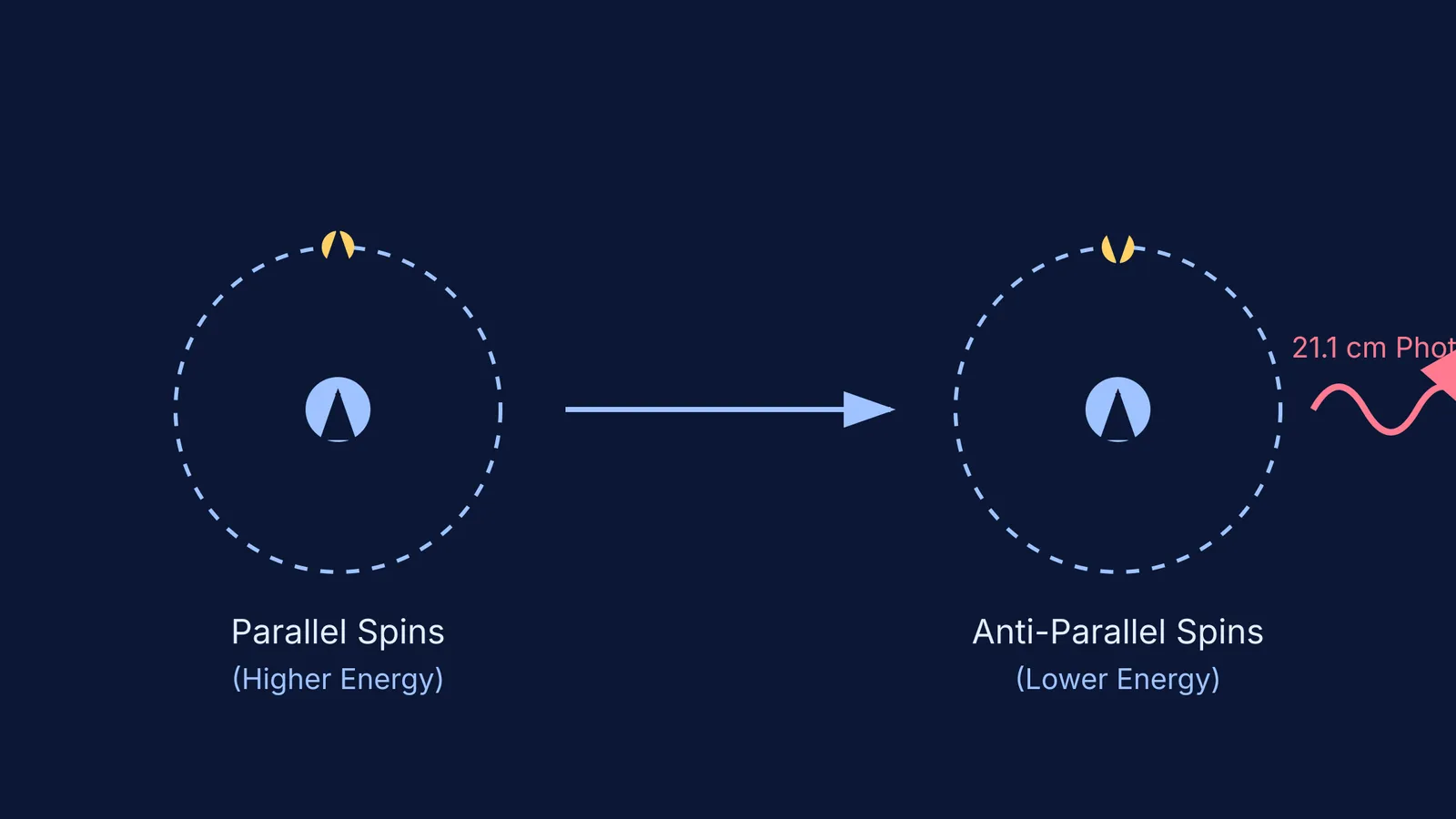
Van de Hulst looked at neutral hydrogen, the most abundant element in the universe. In the cold vacuum of space, hydrogen atoms sit in their lowest energy state. However, because of a property called hyperfine structure, that ground state is actually split into two slightly different energy levels.
The proton and the electron in a hydrogen atom both have "spin", making them act like tiny magnets. When their magnetic poles point in the same direction (parallel spin), the atom holds a tiny bit more energy than when they point in opposite directions (anti-parallel spin).
Van de Hulst calculated that when an electron's spin naturally flips from parallel to anti-parallel, it must release the extra energy as a photon. He predicted this photon would have a frequency of 1420.4 MHz, giving it a wavelength of exactly 21.1 cm. This calculation proved that the hydrogen gas filling the galaxy was not silent; it was humming at a very specific frequency.
If you are a student trying to grasp atomic structure and hyperfine splitting, Fermi Concept Library breaks these ideas down with its own lesson and its place in the map.
When was the hydrogen 21 cm line first detected?
Van de Hulst published his prediction in 1945, but because the transition is extremely rare for any given atom, it took time to build sensitive enough equipment. Astronomers realised that the sheer volume of hydrogen clouds in deep space would easily make up for the rarity of the individual atomic events.
The signal was finally detected on 25 March 1951 by Harold Ewen and Edward Purcell at Harvard University, using a horn antenna protruding from a laboratory window. Groups in the Netherlands and Australia confirmed the finding weeks later, launching a new era of radio astronomy.
Because we know the exact frequency (1420.4 MHz), astronomers can measure how much the signal is Doppler-shifted to calculate how fast the gas is moving. This technique finally allowed us to map the rotating spiral arms of the Milky Way, revealing a dynamic galactic structure that optical telescopes could never see. If you find wave propagation and Doppler shifts hard to picture, the interactive simulations in the Fermi Simulation Lab let you explore the ideas that are easier to see than to read.
Worked example: Finding the energy of the 21 cm photon
The energy gap between the two spin states is incredibly small. We can calculate it using E = 1240/λ: the quick photon-energy formula.
Convert the wavelength to nanometres. 21.1 cm is 0.211 metres, which is 211,000,000 nm (2.11 × 10⁸ nm).
Divide 1240 by the wavelength in nm: E = 1240 / (2.11 × 10⁸).
For context, bumping an electron from the first to the second orbit in hydrogen takes 10.2 eV. The 21 cm spin-flip gap is nearly two million times smaller. This is why you only need the faint thermal energy of cold deep space to power it, a concept that ties directly into the energy density and intensity of an EM wave. Understanding these tiny energy differences is the key to unlocking the large-scale structure of our entire universe.


