

On this page
In short When one gram of mass is completely converted into energy, it releases 9 × 10¹³ Joules. This total conversion yields roughly 1,000 times more energy than the fission of the same mass of uranium, and nearly four billion times more than burning coal.
Albert Einstein's famous equation, E = mc², tells us that mass and energy are two forms of the same thing. In modern physics questions for JEE and NEET, you are often asked to compare different ways that mass turns into energy, from simple chemical reactions up to nuclear explosions.
While total mass conversion releases an unfathomable amount of energy, practical processes like burning fuel or splitting atoms only release a tiny fraction of that potential. Let us look at how the math works, why the difference matters, and how you can avoid the most common traps when solving these problems on an exam.
How do you calculate the energy from one gram of mass?
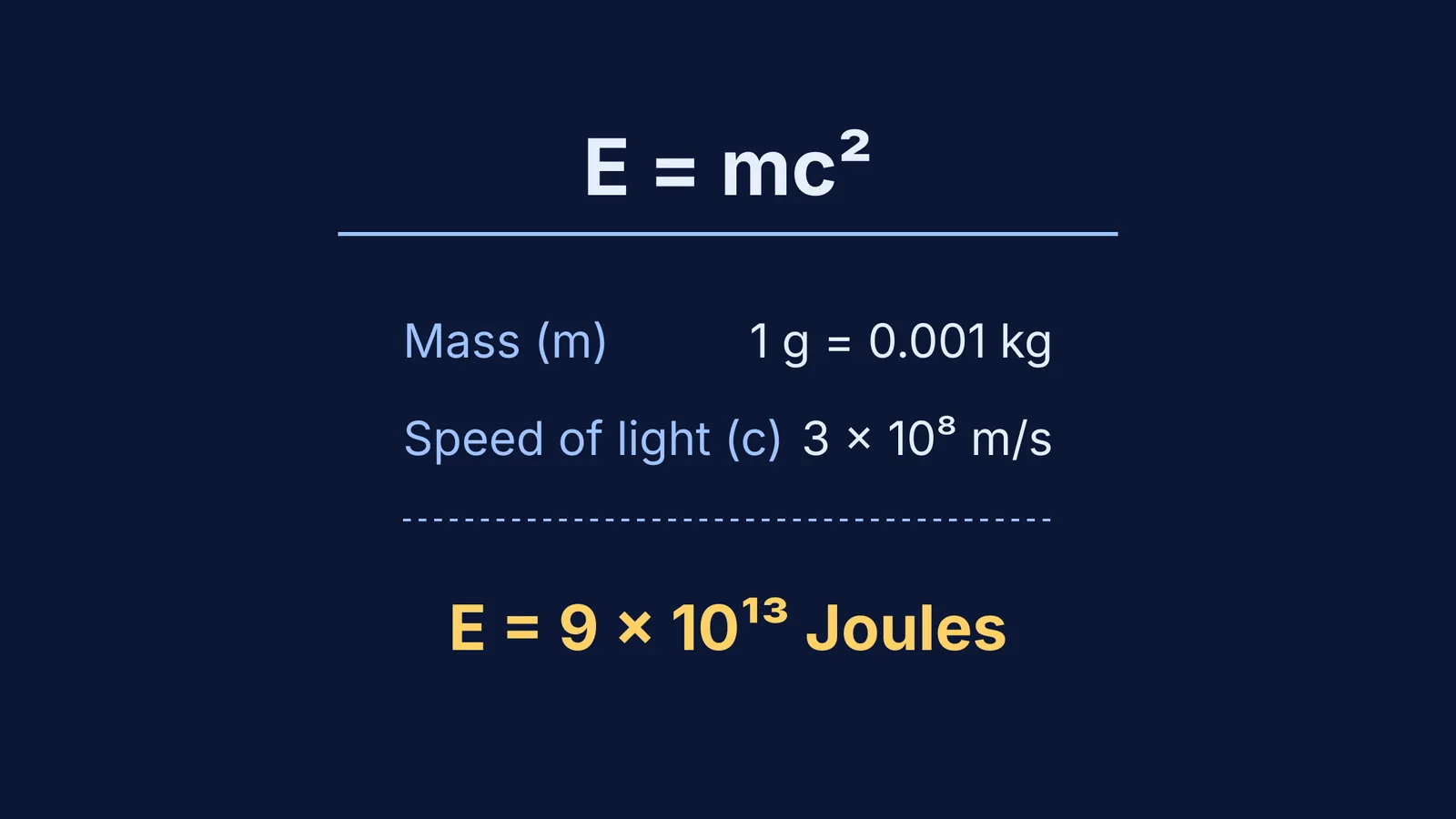
According to HyperPhysics, the formula E = mc² requires standard SI units. When one gram of mass is completely converted into energy, it releases 9 × 10¹³ Joules, which equals 90 terajoules or about 21.5 kilotons of TNT. Here is a step-by-step breakdown of how that calculation works:
Identify the mass (m): You must convert the mass into kilograms. Therefore, 1 gram becomes 0.001 kg, which can also be written in scientific notation as 10⁻³ kg.
Identify the speed of light (c): The speed of light in a vacuum is approximately 3 × 10⁸ metres per second.
Square the speed of light (c²): When you square 3 × 10⁸, you get 9 × 10¹⁶.
Multiply mass by c²: Finally, multiply the mass (10⁻³ kg) by the squared speed of light (9 × 10¹⁶ m²/s²). The exponents add together (−3 + 16 = 13), leaving you with a final answer of 9 × 10¹³ Joules.
This amount of energy is entirely unprecedented in daily life. A single paperclip weighing one gram contains enough latent energy to power a small city for years, provided you could release all of it at once. However, true 100 percent mass conversion is incredibly rare in nature. It generally requires the annihilation of matter with antimatter, an event that does not happen in our everyday surroundings. Instead, humans rely on processes that convert only a minute sliver of mass into usable energy.
How does it compare to burning coal or nuclear fission?
To understand the sheer scale of this total conversion, we can compare it to the energy sources we actually use on Earth for generating electricity and powering industry.
Chemical combustion (coal): When you burn coal, the energy comes from rearranging chemical bonds between atoms. The mass lost in this process is so small that chemists completely ignore it when balancing equations. Burning one gram of coal releases about 24,000 Joules of energy (Energy Education). This is enough to heat a cup of water, but it pales in comparison to the power hidden inside the nucleus.
Nuclear fission (Uranium-235): In a nuclear reactor, heavy atoms split into lighter ones, and a measurable fraction of their mass (the mass defect) becomes energy. The fission of one gram of Uranium-235 releases roughly 8.8 × 10¹⁰ Joules (HyperPhysics). This process powers nuclear submarines and massive electrical grids around the world, yet it still leaves most of the original uranium mass intact in the form of lighter daughter nuclei.
Total conversion: As we saw earlier, if you could somehow annihilate one gram of matter with one gram of antimatter, all of the original mass would become energy, leaving no physical residue behind.
Comparing these three different mechanisms reveals the vast gaps in their efficiency:
Fission releases about 3.6 million times more energy than burning the exact same mass of coal.
Total conversion (E = mc²) releases roughly 1,000 times more energy than nuclear fission, and nearly 4 billion times more than chemical coal combustion.
These massive differences explain why a small nuclear fuel pellet can do the work of a whole freight train loaded with coal.
Where do students go wrong in E = mc² problems?
The most common trap in exam numericals is confusing the mass of the entire sample with the "mass defect" (Δm). Many students automatically take the given mass and multiply it by c², which is a fatal error in nuclear physics problems.
When a question asks for the energy released in a specific nuclear reaction, you cannot simply plug the total mass of the uranium or plutonium into E = mc². You must first find the difference in mass between the starting reactants and the final products. Only that tiny missing mass (the mass defect) is actually converted into energy. The remaining mass simply becomes the new elements formed by the reaction. (If you want to review similar nuclear topics involving the conservation of momentum and energy, see our guide on the recoil of the daughter nucleus in alpha decay).
Another frequent mistake is forgetting to convert the mass into standard kilograms before running the calculation. If you leave the mass in grams, you will end up with an answer that is completely distorted, which will lead you to choose the wrong multiple-choice option.
If you struggle to remember when to use which formula, the Fermi Concept Library breaks down the core ideas behind modern physics so you understand exactly why the equations work the way they do. When you face a tough numerical and do not know where to start, the Fermi Problem Library has worked problems with a step-by-step solver that explains the reasoning behind each jump rather than just printing an answer.


