On this page
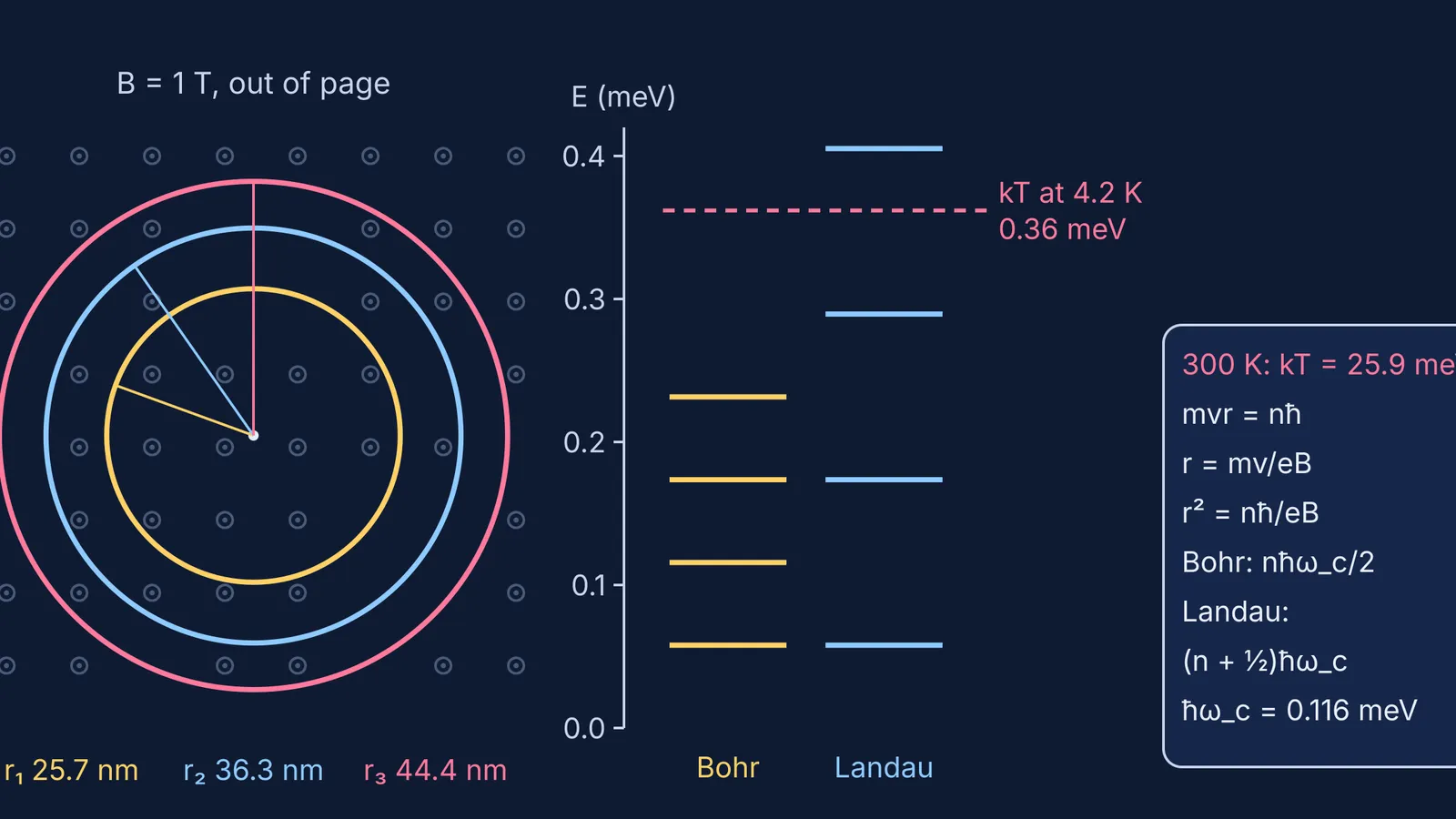
Bohr's rule mvr = nħ was built for an electron held by a nucleus. JEE Advanced likes to swap the force. Here the electron is held in a circle by a magnetic field instead. Combine Bohr's rule with r = mv/eB and the allowed circles have radii √(nħ/eB): 25.7 nm, 36.3 nm and 44.4 nm in a 1 T field. The energy steps are tiny, about 0.06 meV, which is why such effects show up only in cold, strong-field experiments. This post works the model step by step and then shows where it goes wrong: quantum mechanics gives energy steps twice as large.
How do you apply Bohr's rule to an electron in a magnetic field?
You need two equations, just as for hydrogen.
Circular motion. A charge e moving at speed v perpendicular to a field B feels a force evB, always at right angles to its velocity. That supplies the centripetal force: mv²/r = evB, so r = mv/eB. This is the classical result covered in charged particles in magnetic fields.
Bohr's rule. mvr = nħ, with n = 1, 2, 3, ... and ħ = h/2π.
From step 1, mv = eBr. Put it into step 2:
eBr × r = nħ, so r² = nħ/eB and r_n = √n × √(ħ/eB)
The radii go as √n: 1 : √2 : √3. The speed follows from v = eBr/m, so v_n = √(nħeB)/m, also growing as √n.
This is the same pattern you get for a spring-like pull. Our post on Bohr orbits for other force laws found r² = nħ/mω for that case. The magnetic case is that formula with ω replaced by ω_c = eB/m, the cyclotron angular frequency. The energies differ, though, because a spring stores potential energy and a magnetic field does not.
What are the energy levels in the Bohr-style model?
A magnetic force does no work, so there is no potential energy term here. The energy is all kinetic:
E_n = ½mv_n² = ½m × nħeB/m² = n × ħeB/(2m)
Write ω_c = eB/m. Then
E_n = n × ħω_c/2
The levels are evenly spaced, with step ħω_c/2, unlike hydrogen's levels, which crowd together near zero.
A neat check: the magnetic flux through orbit n is Bπr_n² = nπħ/e = n × h/2e. In this model the flux through each allowed circle comes in whole units of h/2e.
Worked example: an electron in a 1 T field
Take B = 1.0 T, m = 9.109 × 10⁻³¹ kg, e = 1.602 × 10⁻¹⁹ C and ħ = 1.055 × 10⁻³⁴ J s (CODATA values from NIST).
Step 1. Basic length. √(ħ/eB) = √(1.055 × 10⁻³⁴ ÷ 1.602 × 10⁻¹⁹) = √(6.58 × 10⁻¹⁶ m²) = 2.57 × 10⁻⁸ m.
Step 2. Radii. r₁ = 25.7 nm, r₂ = 25.7 × √2 = 36.3 nm, r₃ = 25.7 × √3 = 44.4 nm.
Step 3. Speed in the first orbit. v₁ = eBr₁/m = 1.602 × 10⁻¹⁹ × 1 × 2.57 × 10⁻⁸ ÷ 9.109 × 10⁻³¹ = 4.51 × 10³ m/s, about 4.5 km/s.
Step 4. Cyclotron frequency. ω_c = eB/m = 1.76 × 10¹¹ rad/s, so f_c = ω_c/2π = 28.0 GHz.
Step 5. Energies. ħω_c = 1.055 × 10⁻³⁴ × 1.76 × 10¹¹ = 1.85 × 10⁻²³ J = 0.116 meV. The Bohr-style step is half of that: E₁ = ħω_c/2 = 0.058 meV. Check: ½mv₁² = ½ × 9.109 × 10⁻³¹ × (4512)² = 9.27 × 10⁻²⁴ J = 0.058 meV.
Step 6. Ten times the field. At 10 T, r scales as 1/√B, so r₁ = 25.7 ÷ √10 = 8.1 nm. The energies scale as B, so ħω_c = 1.16 meV.
Units check: ħ/eB has units J s ÷ (C × T). Since 1 T = 1 kg/(C s), this is (kg m²/s) ÷ (kg/s) = m². Its square root is a length. Good.
What does quantum mechanics actually give?
The real answer, worked out by Lev Landau, is a set of Landau levels:
E = (n + ½)ħω_c, with n = 0, 1, 2, ...
You can check this in David Tong's lecture notes on the quantum Hall effect at the University of Cambridge, section 1.4.
The step is ħω_c, not ħω_c/2. The Bohr-style ladder has the right shape (evenly spaced, proportional to B) but half the spacing.
The lowest level is ħω_c/2, not zero. There is a zero-point energy, as for the quantum harmonic oscillator.
The length scale survives. Tong's notes define the magnetic length l_B = √(ħ/eB) and quote about 2.5 × 10⁻⁸ m at 1 T. That is exactly the Bohr-style r₁.
Why does Bohr's rule get the step wrong? In a magnetic field, the angular momentum that quantum mechanics quantises is not mvr alone. It includes a contribution from the field itself. So mvr = nħ is a model for JEE, not the true rule. If you take the Landau energy and ask for the classical circle with that kinetic energy, ½mω_c²r² = (n + ½)ħω_c gives r² = (2n + 1)ħ/eB: 25.7 nm, 44.4 nm and 57.4 nm for n = 0, 1, 2. The flux through these circles is (n + ½) × h/e, twice the Bohr-style unit.
Why are these steps seen only near absolute zero?
To see separate levels, the steps must be larger than the thermal energy kT. With k = 8.617 × 10⁻⁵ eV/K:
At 300 K, kT = 25.9 meV.
At 4.2 K (liquid helium), kT = 0.36 meV.
The true step at 1 T, ħω_c = 0.116 meV, is smaller than kT even at 4.2 K. At 10 T it is 1.16 meV, about three times kT at 4.2 K, so the levels start to stand apart. To beat room temperature with a free electron you would need ħω_c = 25.9 meV, which means B ≈ 220 T. Treat that as an order-of-magnitude figure.
Real experiments cool samples well below 4.2 K and use electrons in semiconductors, which move as if they had an effective mass smaller than mₑ. A smaller mass means a larger ω_c = eB/m and larger steps. Those are the conditions behind the quantum Hall effects, which you can read about in Daniel Tsui and the fractional quantum Hall effect.
Practising this kind of question
Modified-Bohr paragraphs (a new force, the same rule) appear in JEE Advanced. The method is always: write the force balance, add mvr = nħ, solve for r, then v, then E. The Fermi Problem Library has a step-by-step solver that explains the reasoning for problems like this. If you want a structured plan, Fermi Test Prep offers personalised preparation for JEE Main & Advanced with an AI tutor, live classes, adaptive mocks, mentorship and a study plan that updates based on mastery.
Quick checklist
Force balance: r = mv/eB. Bohr's rule: mvr = nħ.
Combine: r_n = √(nħ/eB), so radii go as 1 : √2 : √3.
Bohr-style energy: E_n = nħω_c/2, with ω_c = eB/m.
At 1 T: r₁ = 25.7 nm, v₁ = 4.5 km/s, f_c = 28.0 GHz, step 0.058 meV.
True Landau levels: (n + ½)ħω_c, spacing ħω_c = 0.116 meV at 1 T.
Levels show only when ħω_c is larger than kT: cold samples, strong fields.