On this page
Bohr built his model for one force, the Coulomb pull of a nucleus. But his two equations do not care what the force is. Feed them a constant pull or a spring-like pull and they give orbits and energy levels just as readily, with different powers of n. JEE Advanced has used exactly this twist. This post works through the constant force and the spring force, gives the general rule for any power law, and shows why the levels crowd together for hydrogen but not for the others.
Do Bohr's two equations need the Coulomb force?
No. The model rests on two statements, as in deriving the radius and energy of the nth Bohr orbit:
Circular motion: the central force supplies the centripetal force, mv²/r = F(r).
Quantisation: the angular momentum is a whole number of ħ, mvr = nħ, with ħ = h/2π.
Only the first equation knows about the force. Change F(r) and you get a new set of orbits. This is the quantum cousin of changing the force law for a planet's orbit, where the orbits are classical and not quantised.
What happens with a constant pull, U = Fr?
Take potential energy U = Fr, with F a positive constant. The force is dU/dr = F, the same size at every distance, always pointing to the centre.
Force balance: mv²/r = F, so mv² = Fr.
Quantisation: v = nħ/(mr). Substitute: m(nħ/mr)² = Fr, so n²ħ²/(mr²) = Fr.
Radius: r³ = n²ħ²/(mF), so r ∝ n^(2/3).
Speed: v = nħ/(mr) ∝ n/n^(2/3), so v ∝ n^(1/3). The particle moves faster in higher orbits, the opposite of hydrogen.
Energy: kinetic energy ½mv² = ½Fr, potential energy Fr, so E = (3/2)Fr ∝ n^(2/3).
Substituting r gives E = (3/2)(n²h²F²/4π²m)^(1/3). This is the setup of Q.7 in JEE Advanced 2020 Paper 1: a particle in circular orbits with V(r) = Fr, its energies found from the Bohr model. The options pair R ∝ n^(2/3) with v ∝ n^(1/3), and offer the energy with a factor of 3/2 or 2 in front. The working above picks R ∝ n^(2/3), v ∝ n^(1/3) and the 3/2.
Worked example: an electron pulled by a constant force
Take an electron (m = 9.11 × 10⁻³¹ kg) held by a constant force of 1 eV per nanometre, F = 1.60 × 10⁻¹⁰ N. That is the force a field of 10⁹ V/m would exert on it. These are illustrative numbers, chosen to keep the speeds well below c.
Ground orbit radius. r³ = ħ²/(mF) = (1.055 × 10⁻³⁴)²/(9.11 × 10⁻³¹ × 1.60 × 10⁻¹⁰) = 7.62 × 10⁻²⁹ m³. So r₁ = 0.424 nm.
Speed. v = ħ/(mr₁) = 2.73 × 10⁵ m/s, about 0.09% of c, so the non-relativistic treatment is fine.
Energies. Potential energy Fr₁ = 0.424 eV, kinetic energy 0.212 eV, total E₁ = 0.636 eV.
Higher orbits. Multiply by n^(2/3): r₂ = 0.673 nm, r₃ = 0.882 nm; E₂ = 1.009 eV, E₃ = 1.323 eV.
Gaps. E₂ − E₁ = 0.373 eV, E₃ − E₂ = 0.313 eV.
Units check: ħ²/(mF) has units (J s)²/(kg × N) = m³.
What about a spring-like pull?
Now take U = ½kr² = ½mω²r², a force mω²r towards the centre.
Force balance: mv²/r = mω²r, so v = ωr.
Quantisation: m(ωr)r = nħ, so r² = nħ/(mω), r ∝ n^(1/2).
Energy: kinetic ½mω²r² equals potential ½mω²r², so E = mω²r² = nħω.
The levels are evenly spaced, ħω apart. For an electron with ħω = 1 eV, the orbits are 0.276, 0.390 and 0.478 nm, and the levels sit at exactly 1, 2 and 3 eV.
Full quantum mechanics gives (n + ½)ħω for this well. The spacing ħω is right, but the Bohr model misses the ground-state ½ħω.
Is there one rule for any power law?
Yes. Let U = Cr^k, with C and k of the same sign so the force points inwards. The force is kCr^(k−1), so mv²/r = kCr^(k−1), which gives
mv² = kU, so kinetic energy = (k/2)U and E = (1 + k/2)U.
Combining with mvr = nħ gives r^(k+2) ∝ n², so
r ∝ n^(2/(k+2)) and E ∝ n^(2k/(k+2)).
Check with hydrogen, k = −1: r ∝ n², E ∝ 1/n², and kinetic energy = −U/2, the relation in why Bohr orbit KE = −E and PE = 2E. The constant force is k = 1 (n^(2/3)), the spring k = 2 (n¹).
Do the levels crowd together or spread out?
It depends on the exponent 2k/(k+2).
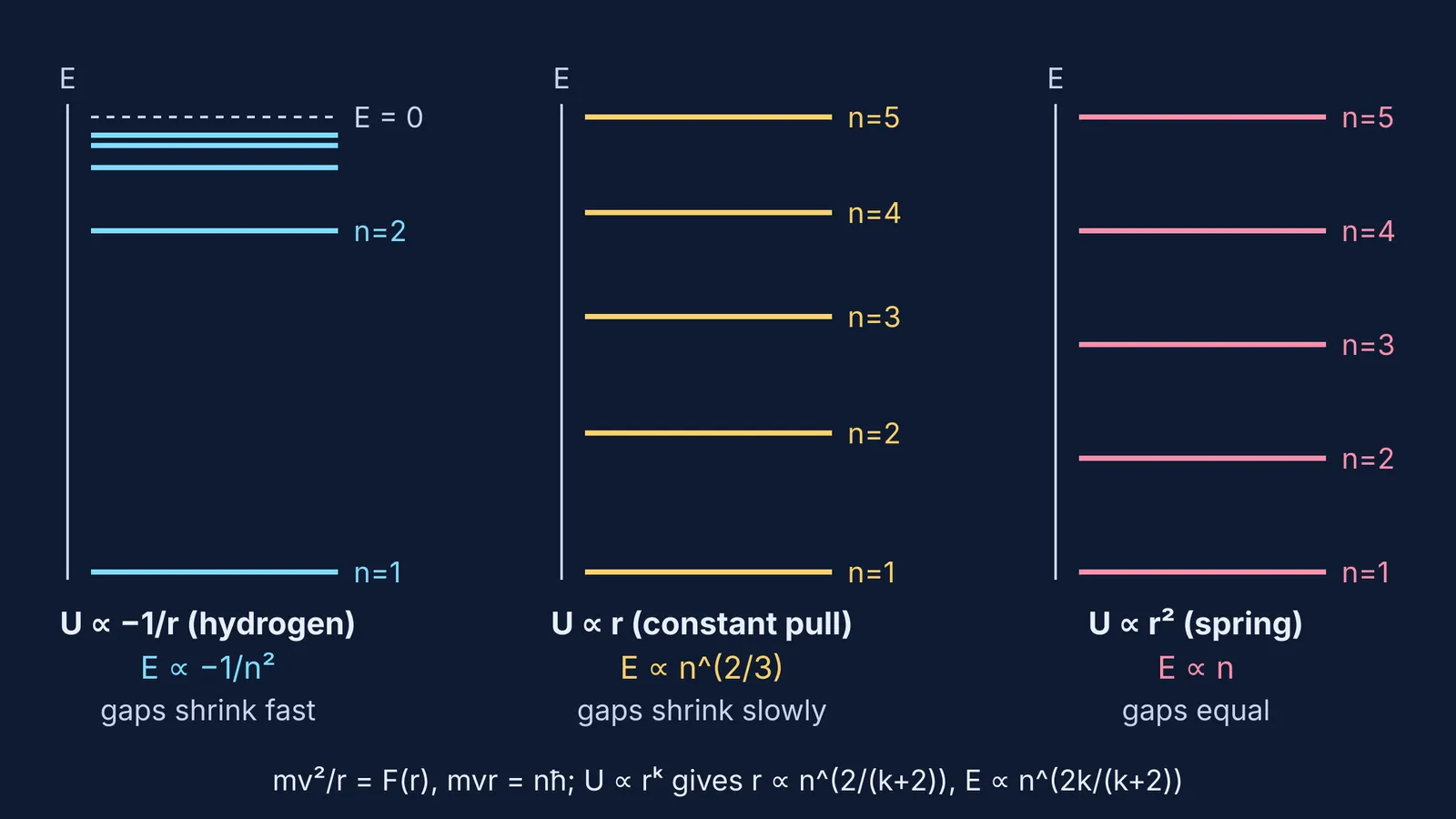
Hydrogen (k = −1): gaps shrink fast, and the levels crowd up towards zero energy.
Constant force (k = 1): the energy still rises, but the gaps shrink slowly, as n^(−1/3). In the example: 0.373 eV, then 0.313 eV.
Spring (k = 2): the gaps are all equal.
Steeper walls (k > 2): the gaps grow. As k becomes very large the well turns into a hard-walled box and E ∝ n², the particle-in-a-box result.
So a constant pull does not make the levels spread apart, as you might guess from "the opposite of hydrogen". Only a well steeper than a spring does that.
Does any real system behave like this?
Loosely. The force between a heavy quark and antiquark is often modelled by the Cornell potential, a Coulomb-like term plus a term rising linearly with distance, proposed in Eichten and colleagues' 1975 paper on charmonium. At large separations the linear part dominates, which is the U = Fr case. But the quarks move at a good fraction of c and both terms matter, so the n^(2/3) ladder is a teaching model, not a match to measured levels. Orbits under other force laws are beyond the NCERT syllabus; treat this as a JEE Advanced extension.
The Fermi Problem Library has Bohr-model problems with a step-by-step solver that explains the reasoning. If you are preparing for JEE Main & Advanced, Fermi Test Prep offers personalised preparation with an AI tutor, live classes, adaptive mocks, mentorship and a study plan that updates based on mastery.
Quick checklist
Bohr's model is two equations: mv²/r = F(r) and mvr = nħ.
Constant pull, U = Fr: r ∝ n^(2/3), v ∝ n^(1/3), E = (3/2)Fr ∝ n^(2/3).
Spring, U = ½mω²r²: r ∝ n^(1/2), E = nħω, evenly spaced.
General U ∝ r^k: mv² = kU, r ∝ n^(2/(k+2)), E ∝ n^(2k/(k+2)).
Gaps shrink for k < 2, are equal for k = 2 and grow for k > 2.