

On this page
How does orbit time period depend on an inverse nth power force?
Exams like JEE Main and JEE Advanced frequently test your ability to derive physical relations from first principles rather than relying on memorised formulas. A classic mechanics problem asks how a satellite's orbital time period T changes if gravitational attraction follows an arbitrary power law F = k / rⁿ, where r is the orbital radius, k is a positive constant, and n is a real index.
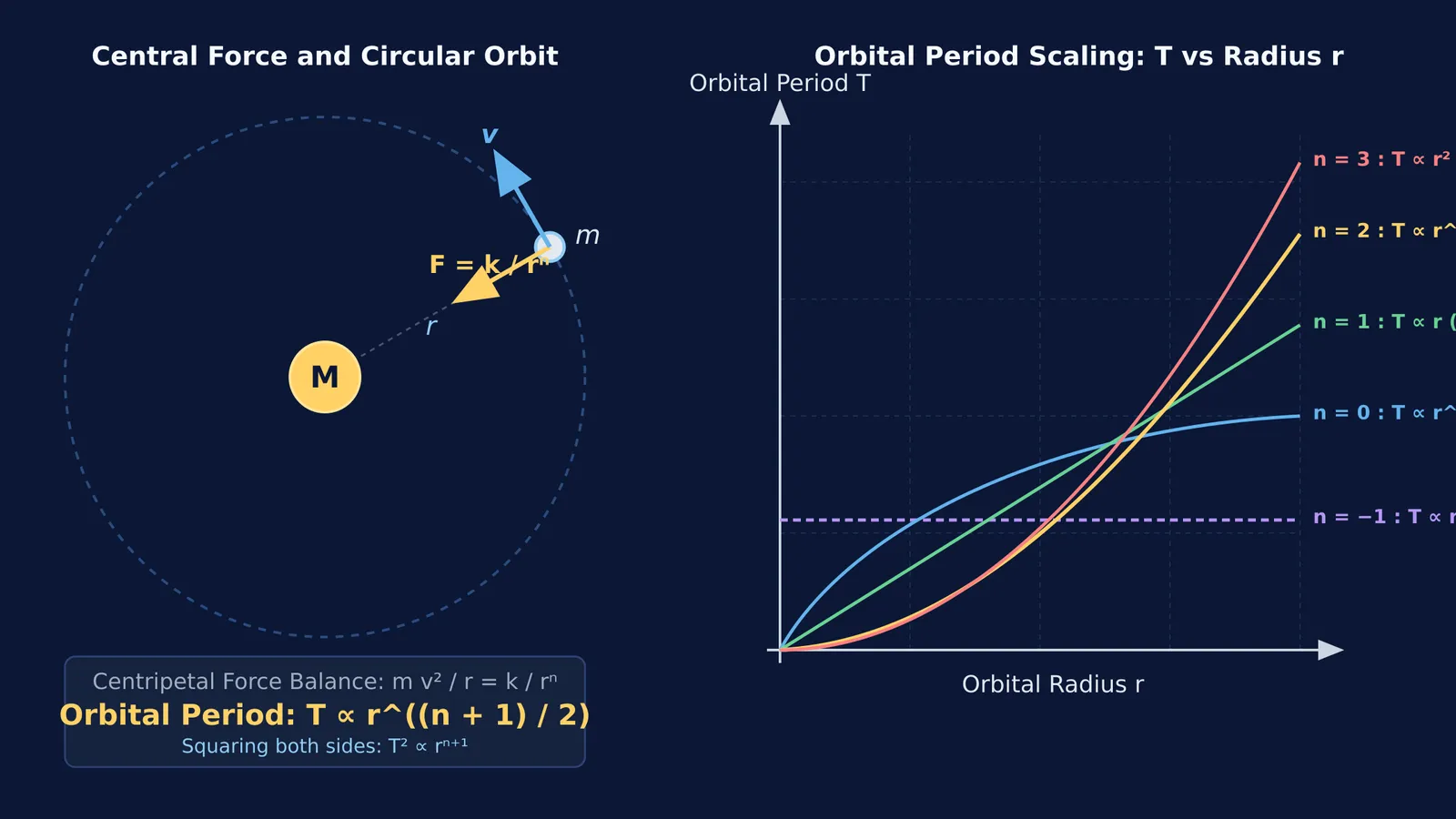
To find this relation, consider a satellite of mass m executing a stable circular orbit of radius r around a central body. Centripetal force is supplied entirely by the inward attraction:
m v² / r = k / rⁿ
Multiplying both sides by r and dividing by m gives v² = k / (m rⁿ⁻¹), which shows that orbital speed scales as:
v = √(k / m) × r^((1 − n) / 2)
Because the satellite completes a circular path of circumference 2πr during one orbital period T, substituting v into T = 2πr / v gives:
T = 2πr / [√(k / m) × r^((1 − n) / 2)] = 2π √(m / k) × r^((n + 1) / 2)
Squaring both sides produces the primary scaling rule:
T² ∝ rⁿ⁺¹
Why does n = 2 recover Kepler's third law?
Setting n = 2 in the generalized formula tests whether our derivation agrees with textbook physics. In the standard NCERT Class 11 Physics gravitation curriculum, Newton's universal law of gravitation states that gravitational force decreases with the square of the separation distance: F = G M m / r².
Substituting n = 2 into T ∝ r^((n + 1) / 2) yields:
T ∝ r^((2 + 1) / 2) = r^(3/2)
Squaring both sides gives T² ∝ r³, which is precisely Kepler's third law of planetary motion, also known as the Harmonic Law. Observational data collected over centuries confirms this exact power law. As detailed in NASA's orbital mechanics foundations and recorded in NASA planetary fact sheets, Mercury orbits the Sun at an average semi-major axis of 0.387 astronomical units with a period of 88.0 days, whereas Saturn orbits at 9.537 astronomical units with a period of 10,747 days (10,756 sidereal days). Calculating (10,756 / 88.0)² gives approximately 14,940, while (9.537 / 0.387)³ yields 14,976, verifying T² ∝ r³ to high precision.
You can explore further nuances of planetary paths in our guide on Kepler's second law and areal velocity and our breakdown of orbital speed, energy, and escape speed.
How do you solve general power-law orbit problems in JEE Main?
Examiners test this relation across diverse values of n in competitive physics problems. Having a systematic three-step procedure prevents calculation errors under exam pressure:
Identify the force exponent: Express the attractive central force as F(r) = k / rⁿ. Be cautious with wording; if a question states that acceleration varies inversely as r³, then n = 3.
Balance centripetal force: Set m v² / r = k / rⁿ, which yields orbital speed v ∝ r^((1 − n) / 2).
Compute orbital period: Divide circumference 2πr by speed v to establish T ∝ r^((n + 1) / 2).
This framework resolves several standard exam cases immediately:
Constant force (n = 0): Speed increases as v ∝ r^(1/2), yielding T ∝ r^(1/2).
Inverse-linear force (n = 1): Speed is constant (v ∝ r⁰), producing a flat rotation curve and linear period T ∝ r.
Inverse-square force (n = 2): Speed falls as v ∝ r⁻¹/², recovering Kepler's law T ∝ r^(3/2).
Inverse-cube force (n = 3): Speed falls as v ∝ 1/r, yielding T ∝ r².
Hooke's law (n = −1): Force F ∝ r yields constant period T ∝ r⁰, matching simple harmonic motion.
When practicing varied power-law problems, stepping through algebraic substitutions requires checking where each power of r shifts between orbital speed and time period. The Fermi Problem Library provides worked problems with a step-by-step solver that explains the reasoning rather than printing an answer, helping you spot sign errors in radial exponents.
What happens to orbit stability when the force law changes?
While circular orbits can be calculated for any index n, real trajectories face radial perturbations. In 1873, French mathematician Joseph Bertrand proved that only two central force laws produce closed, non-precessing bound orbits for all initial conditions: the inverse-square law (n = 2) and Hooke's linear restoring force (n = −1), as analyzed in the American Journal of Physics.
For any other exponent, small disturbances cause orbits to precess into open rosette patterns. When n ≥ 3, circular orbits become dynamically unstable, causing perturbed satellites to spiral into the center.
Mastering how central potentials govern bound motion connects introductory gravitation with two-body orbits and reduced mass. The Fermi Concept Library maps every concept in physics, chemistry, biology, mathematics and computing, each with its own lesson and its place in the map, placing Keplerian mechanics alongside general central-force dynamics. If you need help untangling non-standard problem setups, Fermi's AI tutor can work out what you already know and build a plan for the session, guiding you through first-principles force balances.


