

On this page
Most gravitation problems let a planet circle a fixed Sun. That works because the Sun is so much heavier. When two bodies have similar masses, such as two stars, neither stays still, and the single-body formulas give the wrong period. This post shows how two-body orbits work, introduces reduced mass, works a full example with numbers, and lists the traps.
Do two stars orbit each other or a point between them?
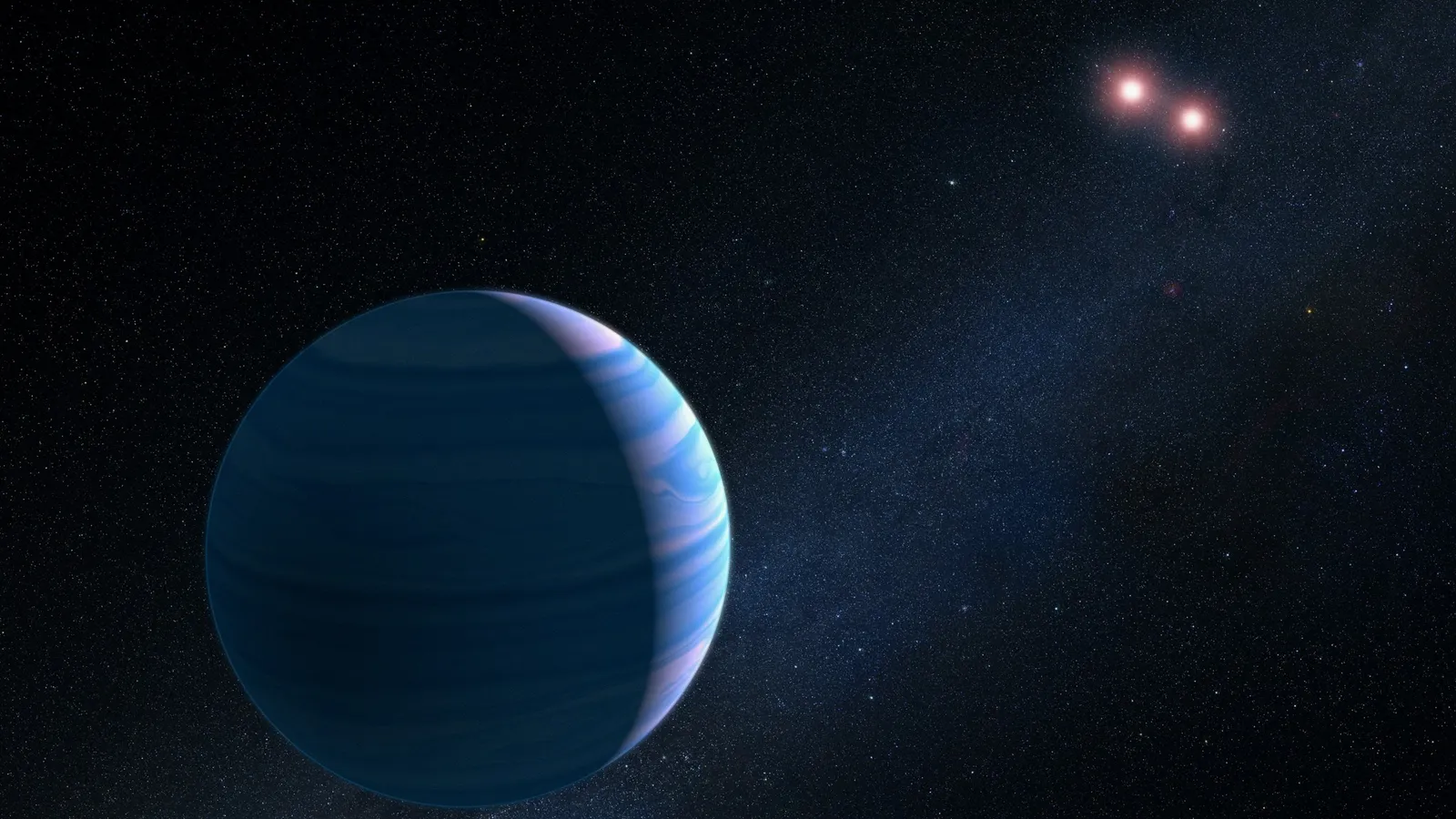
Neither star orbits the other. OpenStax Astronomy explains that each star pulls on the other, so both orbit a point between them, the centre of mass, which is always closer to the more massive star. OpenStax University Physics adds that both bodies move in the same-shaped path about the common centre of mass, and the ratio of the path sizes is the inverse of the ratio of their masses.
The force on each star is the same size, Gm1m2/r². A review of research on gravity by Kavanagh and Sneider (2006) lists the belief that gravitational forces between objects are not equal and opposite among the misconceptions it found "surprisingly widespread, even among university students and teachers".
Is this in the syllabus?
Binary stars are not named in the JEE (Main) 2026 syllabus or the JEE (Advanced) 2026 brochure. Both list Kepler's laws and satellite or planetary motion in circular orbits, and both list centre of mass; two-body problems combine those ideas. NCERT's Gravitation chapter has an exercise (7.20) with two stars falling towards each other. Check your exam year's syllabus.
What are the equations?
Let the stars have masses m1 and m2, separation r, and move in circles at the same angular speed ω.
Orbit radii: r1 = m2r/(m1 + m2) and r2 = m1r/(m1 + m2). They add up to r.
For star 1, gravity provides the centripetal force: m1ω²r1 = Gm1m2/r². Substituting r1 gives ω² = G(m1 + m2)/r³.
Period: T² = 4π²r³/[G(m1 + m2)]. It is Kepler's third law with the total mass.
Reduced mass. Define μ = m1m2/(m1 + m2). Then μω²r = Gm1m2/r² gives the same ω. The relative motion behaves like a single body of mass μ circling a fixed centre at distance r. When one mass is much larger, μ is almost the small mass and you recover the usual planet formula.
Worked example: an unequal binary
Two stars of 3.0 × 10³⁰ kg and 1.0 × 10³⁰ kg are 1.5 × 10¹¹ m apart. Take G = 6.67 × 10⁻¹¹ N m² kg⁻².
Radii: r1 = (1/4) × 1.5 × 10¹¹ = 3.75 × 10¹⁰ m and r2 = (3/4) × 1.5 × 10¹¹ ≈ 1.13 × 10¹¹ m.
ω² = 6.67 × 10⁻¹¹ × 4.0 × 10³⁰/(3.375 × 10³³) ≈ 7.91 × 10⁻¹⁴, so ω ≈ 2.81 × 10⁻⁷ rad/s.
T = 2π/ω ≈ 2.23 × 10⁷ s, about 259 days.
Speeds: v1 = ωr1 ≈ 10.5 km/s and v2 = ωr2 ≈ 31.6 km/s.
Reduced mass: μ = 3.0 × 1.0/4.0 × 10³⁰ = 7.5 × 10²⁹ kg.
Check: m1v1 ≈ 3.16 × 10³⁴ and m2v2 ≈ 3.16 × 10³⁴ kg m/s. The momenta are equal and opposite, so the centre of mass stays at rest, as it should. If you had treated the heavy star as fixed and used only its mass, T would come out √(4/3) times too long, about 299 days.
Energy splits the same way. The total is −Gm1m2/(2r), and the kinetic energies are in the ratio KE1/KE2 = m2/m1, so here the lighter star carries three-quarters of the kinetic energy.
How do astronomers weigh stars with this?
In units of astronomical units, years and solar masses, the period law becomes D³ = (M1 + M2)P². OpenStax Astronomy applies it to Sirius and its faint companion: separation about 20 AU, period about 50 years, so 8000 = (M1 + M2) × 2500 and the pair has about 3.2 times the Sun's mass. This is the same law as above, written in units that make the constants equal 1 for the Earth and Sun.
Which mistakes cost marks?
Using r instead of r1 or r2 as the orbit radius.
Using one mass instead of m1 + m2 in Kepler's third law.
Thinking the lighter star feels a smaller force.
Forgetting that both stars share the same period and ω.
A practice routine
Derive T² = 4π²r³/[G(m1 + m2)] from the force on one star.
Redo the worked example with equal 2.0 × 10³⁰ kg stars. You should get the same period, since the total mass is unchanged, with both stars at about 21 km/s.
Solve NCERT exercise 7.20 using energy conservation.
Revise single-body orbits in our post on satellite problems, and read how Kepler found his laws.
When a link between centre of mass and orbits is not clear, the Fermi Concept Library covers every concept in physics, chemistry, biology, mathematics and computing, each with its own lesson.
Before your next gravitation test, find r1, r2 and T for one binary of your own choice and check that m1v1 = m2v2.


