On this page
In 1982 Daniel Tsui, Horst Störmer and Arthur Gossard published a short letter in Physical Review Letters, Two-Dimensional Magnetotransport in the Extreme Quantum Limit. It reported a step in electrical resistance that existing theory could not explain. Their abstract reads: "A quantized Hall plateau of ρxy=3h/e², accompanied by a minimum in ρxx, was observed at T<5 K in magnetotransport of high-mobility, two-dimensional electrons, when the lowest-energy, spin-polarized Landau level is 1/3 filled."
Here is what that means, and how to check it with Class 12 physics.
What is the Hall effect, and where do the steps come from?
The Nobel Prize press release for 1998 starts with Edwin Hall in 1879. Pass a current along a thin plate in a magnetic field, and the moving charges are pushed sideways, so a voltage appears across the plate. Hall resistance is that sideways voltage divided by the current.
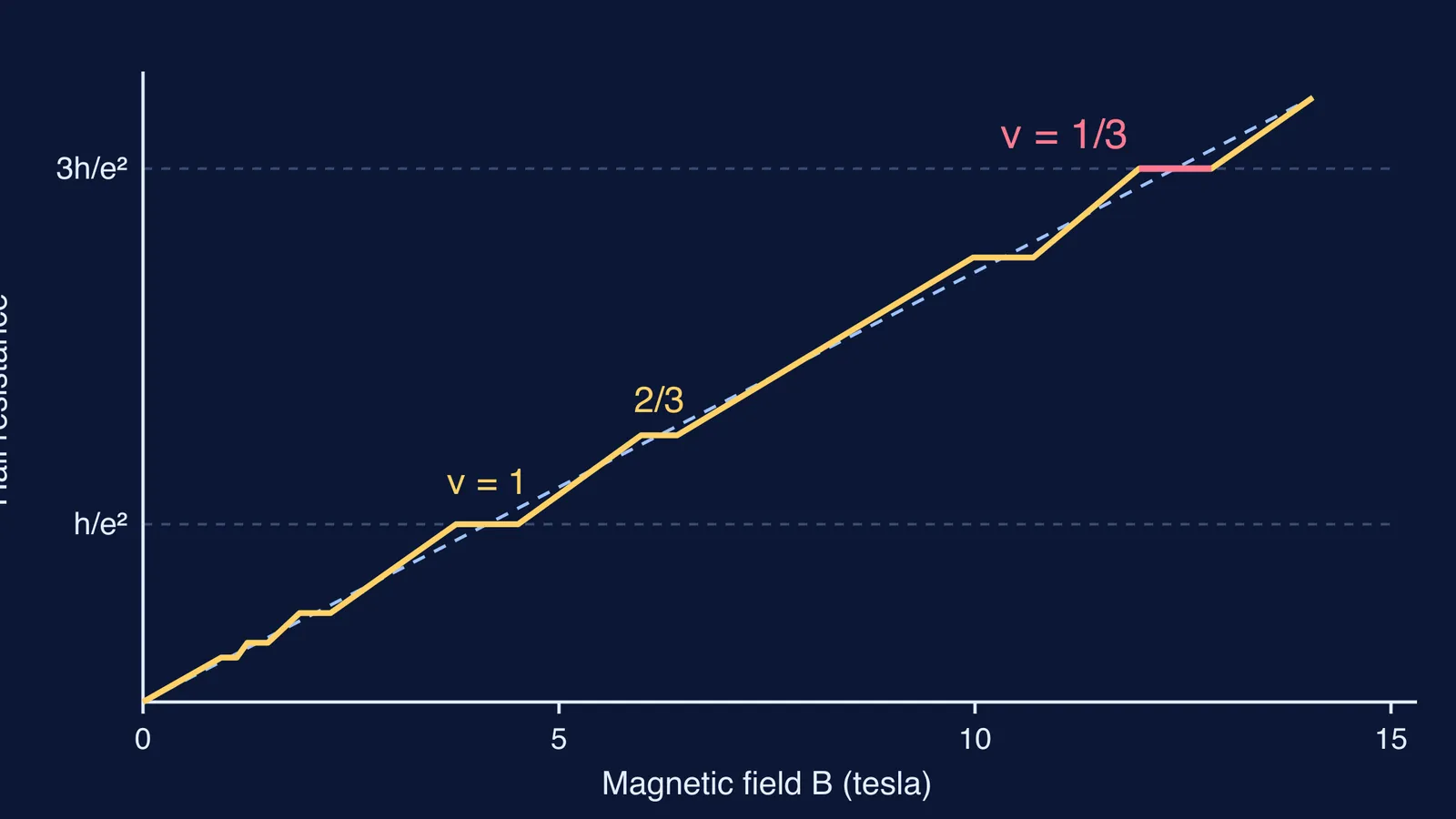
Normally the Hall resistance rises in a straight line with the field. See the sideways push on one charge in charged particles moving in a magnetic field.
The same press release explains that in 1980 Klaus von Klitzing found something odd in thin electron layers near absolute zero. The Hall resistance climbed in flat steps, each equal to h/e² divided by a whole number, and ordinary resistance dropped away on each step. The von Klitzing constant h/e² is exactly 25 812.807 45... ohms, according to NIST's CODATA 2022 values.
What did Daniel Tsui and Horst Störmer discover in 1982?
Using lower temperatures and stronger magnetic fields, Störmer, Tsui and co-workers found "a new step in the Hall resistance which was three times higher than von Klitzing's highest", says the Nobel press release. The step sat at 3h/e², which is h/e² divided by one-third, so it was called the fractional quantum Hall effect. More steps followed, between and above the integers, each h/e² divided by a fraction.
How did Robert Laughlin explain the fractional quantum Hall effect?
In 1983 Robert Laughlin proposed wave functions describing "the condensation of a two-dimensional electron gas into a new state of matter", in his letter Anomalous Quantum Hall Effect. The Nobel press release describes this state as a quantum fluid, related to those in superconductors and liquid helium. In the press release's picture, at the one-third step each electron captures three flux quanta of the field, forming a composite particle.
Add an electron to this fluid and it produces quasiparticles carrying a fraction of an electron's charge, created by the electrons moving together. Laughlin, Störmer and Tsui shared the 1998 Nobel Prize in Physics "for their discovery of a new form of quantum fluid with fractionally charged excitations". For another quantum fluid, read about Leon Cooper's electron pairs.
Worked example: where would the one-third step appear?
You only need two formulas and the exact constants h = 6.626 070 15 × 10⁻³⁴ J s and e = 1.602 176 634 × 10⁻¹⁹ C from NIST (elementary charge). Take an imagined electron sheet with n = 1.0 × 10¹⁵ electrons per square metre.
Classical Hall resistance of a sheet: R = B/(ne).
Filling factor, how full the lowest orbits are: ν = nh/(eB).
Full filling, ν = 1: B = nh/e = 4.14 T.
One-third filling: B is three times larger, 12.4 T.
Plateau height at ν = 1/3: R = 3h/e² = 3 × 25 812.8 Ω, about 77.4 kΩ.
Check with the classical formula at 12.4 T: R = 12.4/(1.0 × 10¹⁵ × 1.602 × 10⁻¹⁹), about 77.4 kΩ.
The straight line and the step meet exactly at one-third filling, as in the diagram above; around that field, the resistance stays flat. If picturing the orbits is the hard part, the Fermi Simulation Lab has interactive simulations for ideas that are easier to see than to read.
What can students learn from Daniel Tsui's path?
In his Nobel autobiography, Tsui writes that he grew up in a village in Henan, China, and that his parents never had the chance to learn to read and write. He left for Hong Kong in early 1951 and began formal schooling at the sixth-grade level, at first without knowing Cantonese. He went on to Augustana College in Illinois and a PhD at the University of Chicago.
On choosing experiments, he wrote: "I wanted to do tabletop experiments and be allowed to tinker." He moved from Bell Laboratories to teach at Princeton in February 1982, shortly after the discovery. Asked why, he wrote that he still did not know, but mused:"What better way is there to learn than through teaching!"
Try it this week:
Explain the Hall effect aloud to a friend or parent in under two minutes.
Redo the worked example with n = 2.0 × 10¹⁵ per square metre and predict where the one-third step moves.
If a term such as Landau level or flux quantum stops you, the Fermi Concept Library gives each physics concept its own lesson and its place in the map.