On this page
In 1911, Heike Kamerlingh Onnes and his team in Leiden watched the electrical resistance of mercury fall to "practically zero" as they cooled it to about 3 kelvin (IEEE Milestone record). For more than four decades nobody could say why. The missing piece came from Leon Cooper, a 26-year-old theorist, who showed that electrons in a cold metal can bind into pairs. Cooper spent most of his career at Brown University and died in October 2024 aged 94 (Brown University, Physics World).
What did Leon Cooper discover in 1956?
Cooper's two-page paper, "Bound Electron Pairs in a Degenerate Fermi Gas", appeared in Physical Review in November 1956 (Physical Review 104, 1189).
Picture a metal so cold that its electrons fill every energy level up to a top level called the Fermi energy. Treat that filled "Fermi sea" as frozen, add two electrons just above it, and give them a weak attraction. The filled levels below are blocked, so the extra pair can only use the empty levels above. Cooper solved this two-electron problem and found a bound state with energy lower than twice the Fermi energy (Daniel Ralph, Cornell lecture notes).
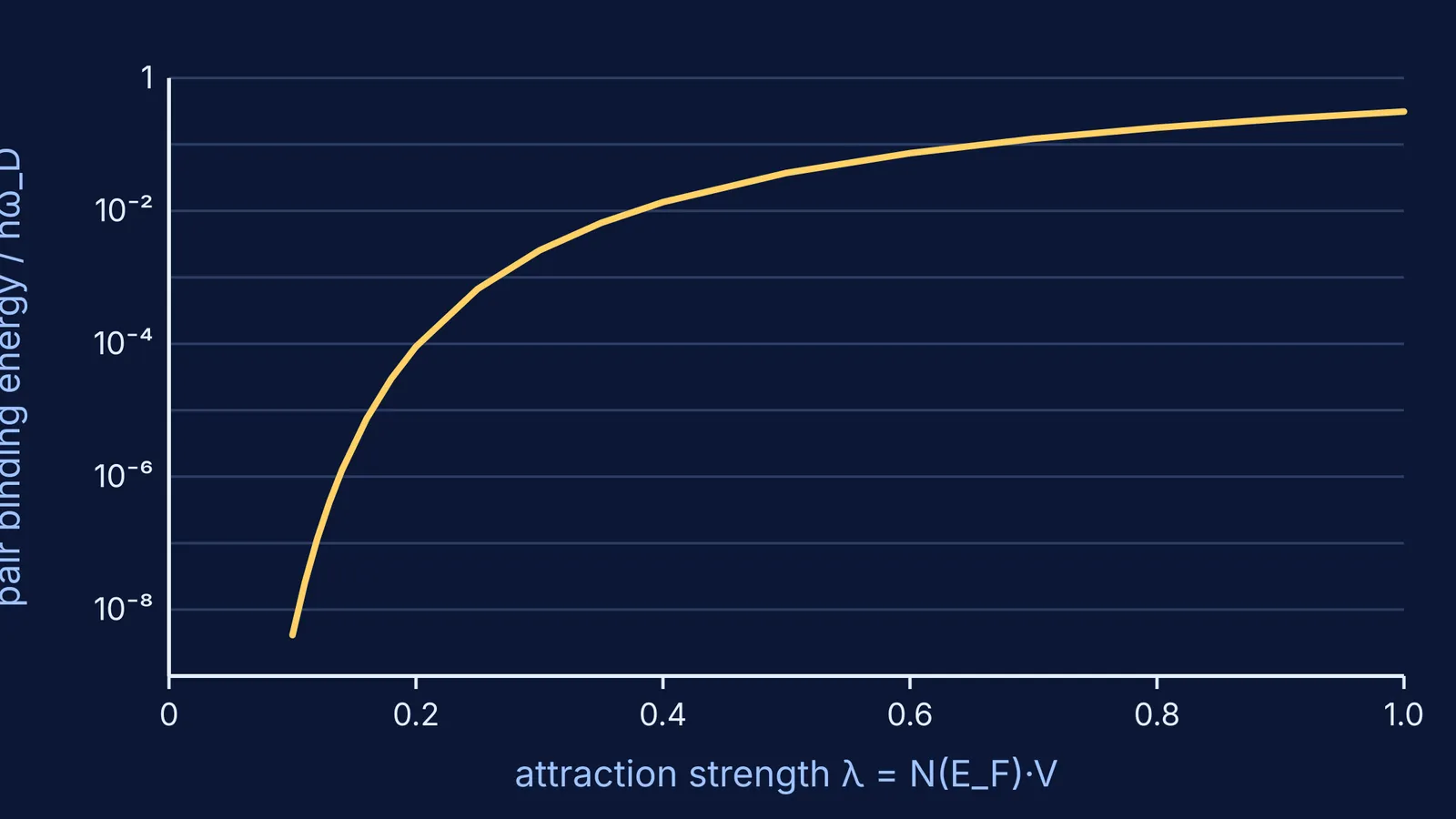
The surprise is in the strength needed. Two electrons alone in empty space need an attraction stronger than some threshold to bind in three dimensions, but Cooper pairs form for an arbitrarily weak attraction (Ralph, Cornell). The chart above plots Cooper's formula: the binding energy shrinks fast as the attraction weakens but never reaches zero.
How can two electrons attract each other?
Electrons are negatively charged, so in a vacuum they always repel. Inside a metal, though, they move through a lattice of positive ions. A passing electron can deform that lattice, and the deformation pulls on a neighbouring electron, pairing the two (Physics World). The ions respond far more slowly than the electrons, so this over-screening by the vibrating ions (phonons) can make the net interaction attractive for electrons passing at different times; whether it beats the ordinary repulsion depends on the material (Ralph, Cornell).
Why do Cooper pairs give zero resistance?
Pairing alone was not the full answer. In 1957 Cooper, John Bardeen and Robert Schrieffer published the complete theory, now called BCS theory (Physical Review 108, 1175). In it, the electrons move together as a single cohort, a condensate, which prevails over thermal fluctuations (Physics World). The three shared the 1972 Nobel Prize in Physics "for their jointly developed theory of superconductivity, usually called the BCS-theory" (same source).
Ordinary electrons lose energy scattering off impurities and vibrating ions, which shows up as resistance and resistivity. Paired electrons in the condensate move through the material without resistance or heating it (Brown University).
The pairs are also large. Ralph estimates that in a superconductor with a critical temperature of a few kelvin, each pair spreads over about 100 nm, so many pairs overlap in the same space (Ralph, Cornell). The same pairs tunnel through thin insulators in the Josephson effect, and zero resistance is only half the story: see why a superconductor is a perfect diamagnet.
Why do superconductors need to be so cold?
Ralph puts the binding energy of a Cooper pair at roughly 1 kelvin times Boltzmann's constant (Ralph, Cornell). Boltzmann's constant is 8.617 × 10⁻⁵ eV per kelvin (NIST CODATA).
Binding energy of one pair: 1 K × 8.6 × 10⁻⁵ eV/K ≈ 0.00009 eV.
Thermal energy scale at room temperature, 300 K: 300 × 8.6 × 10⁻⁵ eV ≈ 0.026 eV.
Ratio: 0.026 ÷ 0.00009 ≈ 300. At room temperature, thermal energy swamps the binding, so pairs cannot survive.
Cool to a few kelvin and the two energies become comparable. That sets the rough temperature scale for conventional superconductors, which is why mercury only lost its resistance near 4 K (IEEE Milestone record).
How do you explain Cooper pairs in four lines?
Use this script in a class presentation, a viva or an interview (figures from Ralph's Cornell notes):
"Electrons repel, but in a metal one electron deforms the lattice of positive ions, and that deformation attracts a second electron."
"Cooper showed in 1956 that, because the filled Fermi sea blocks the lower levels, this pair binds however weak the pull."
"The binding is tiny, about the thermal energy at 1 kelvin, so you need very low temperatures."
"In BCS theory all the pairs move together as one condensate, which flows without resistance."
Three mistakes to avoid:
Saying the electrons stop repelling. The lattice adds an attraction that can outweigh the repulsion.
Picturing the two electrons side by side. Each pair spreads over about 100 nm.
Crediting Cooper alone with the theory. Pairing was his step; the full theory was BCS.
If the Pauli principle or the Fermi energy is the shaky part, the Fermi Concept Library has a lesson for every concept in physics, so you can fill that gap first. To work through the argument step by step, Fermi's AI tutor works out what you already know and builds a plan for the session.