

On this page
In 1962, a 22-year-old graduate student at the University of Cambridge stood up to the most famous physicist in his field and proved him wrong. Brian Josephson had been attending classes taught by the visiting American physicist Philip Anderson, and his habit of quietly approaching the podium after a lecture to point out the lecturer's mathematical errors was already making a strong impression. But it was his own theoretical breakthrough that year that would permanently change our understanding of quantum physics.
Josephson published a paper in *Physics Letters* in July 1962 predicting that pairs of electrons could tunnel through a solid insulator. The idea was fiercely rejected by John Bardeen, the co-inventor of the standard theory of superconductivity, who even added a note to his own paper to declare the effect impossible. Yet, less than a year later, the impossible was observed in a laboratory.
What is the Josephson effect in superconductors?
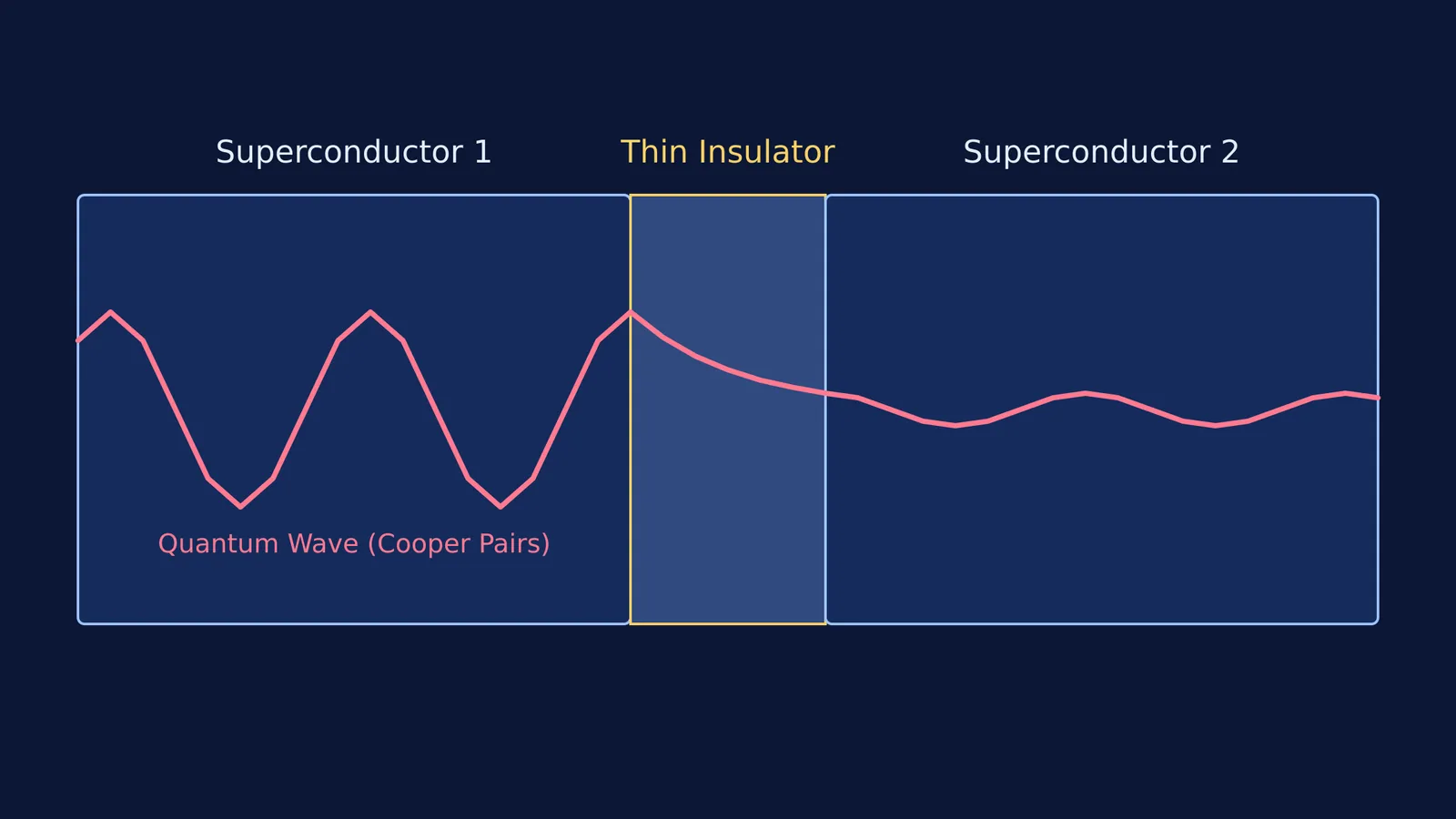
The Josephson effect is a quantum mechanical phenomenon where an electric current flows indefinitely, without any applied voltage, across a thin insulating barrier that separates two superconductors (10.1016/0031-9163(62)91369-091369-0)).
In a normal conductor, an insulator blocks the flow of electrons. But in a superconductor, electrons bind together into "Cooper pairs" that act as a single, coherent quantum wave. Josephson's mathematics showed that this wave does not abruptly stop at an insulating barrier. Instead, it decays exponentially, and if the barrier is thin enough, the wave emerges on the other side. This means the Cooper pairs can tunnel through the insulator, creating a supercurrent with zero electrical resistance.
There are two main parts to the discovery:
The DC Josephson effect: A steady supercurrent flows across the barrier even when the voltage is exactly zero.
The AC Josephson effect: If you apply a constant direct current (DC) voltage across the barrier, the supercurrent oscillates at a precise, very high frequency.
If you find it hard to picture quantum waves crossing solid barriers, the Fermi Simulation Lab has interactive simulations for the ideas that are easier to see than to read.
Why did John Bardeen say it was impossible?
John Bardeen was a giant of physics and the only person to win the Nobel Prize in Physics twice. He had recently co-developed the BCS theory of superconductivity, which explained how single electrons bind into Cooper pairs. When he heard Josephson's prediction, he argued that it was fundamentally flawed because the energy gap that creates superconductivity would not permit pairs to exist inside a dielectric barrier.
In August 1962, Bardeen published a paper on tunnelling in *Physical Review Letters* and added a specific "Note added in proof" at the end of his paper to dismiss Josephson's calculations, stating that "pairing does not extend into the barrier, so that there can be no such superfluid flow" (10.1103/PhysRevLett.9.147). The two men even debated the issue publicly at the Eighth International Conference on Low Temperature Physics in London that September. Josephson politely but firmly defended his equations against the most authoritative voice in the discipline.
Josephson's confidence was vindicated in March 1963, when his former lecturer Philip Anderson, working with John Rowell at Bell Labs, published the first experimental observation of the DC Josephson effect (10.1103/PhysRevLett.10.230). Bardeen eventually conceded he was wrong and went on to nominate Josephson for the 1973 Nobel Prize in Physics, which Josephson won.
If you are stuck on a physics derivation and wondering if your own mathematics is correct, the Fermi Problem Library has worked problems with a step-by-step solver that explains the reasoning rather than printing an answer.
How is the Josephson effect used today?
Because the AC Josephson effect links voltage directly to frequency—using only fundamental constants of nature—it is used by metrology laboratories worldwide to define the standard volt.
The most widespread application, however, is in Superconducting Quantum Interference Devices, or SQUIDs. A SQUID uses one or more Josephson junctions to create a magnetometer so sensitive that it can measure magnetic fields billions of times weaker than the Earth's (10.1103/RevModPhys.65.413). According to a major review in *Reviews of Modern Physics*, SQUIDs are the primary technology behind magnetoencephalography (MEG), a clinical tool that maps brain activity by detecting the tiny magnetic fields produced by firing neurons. They allow neurosurgeons to safely map language and motor areas of the cortex before operating on the brain, ensuring that essential functions are protected during surgery.
The story of the Josephson effect is a reminder of how science advances. Just as earlier physicists like Walther Meissner and superconductors expelling fields reshaped our view of materials, Josephson proved that a rigorous mathematical deduction can overturn the intuition of experts. His work laid the foundation for Leo Esaki and the tunnel diode: quantum tunnelling you can measure, as well as Binnig, Rohrer and the microscope that feels single atoms.


