On this page
How many ions does pure water make? Today you answer with Kw = 1.0 × 10⁻¹⁴ at 25 °C. In January 1893 Wilhelm Ostwald estimated it from a cell with one hydrogen electrode in acid and another in alkali, using Nernst's theory to turn about 0.7 V into the H⁺ concentration of pure water. The paper is "Die Dissociation des Wassers" (The dissociation of water), Zeitschrift für physikalische Chemie volume 11 (1893), pages 521 to 528, presented in Leipzig on 9 January 1893. We read it on the scanned pages at the Internet Archive; numbers were checked against the page images, and translations are ours. For the earlier Ostwald work behind it, see Wilhelm Ostwald and the dilution law.
What did Ostwald get from the conductivity of pure water?
His first route used Friedrich Kohlrausch's purest water, distilled under vacuum, with conductivity 0.25 × 10⁻¹⁰ at 18 °C, or 0.28 at 25 °C, in Kohlrausch's old units. He could not tell whether it came from impurities or from water itself, so he treated it as an upper limit.
He then divided by the conductivity that one equivalent each of H⁺ and OH⁻ would give, 325 + 170 = 495 units:
0.00028 ÷ 495 = 0.6 × 10⁻⁶ normal
In his words, that is "one gram of hydrogen ions in about two million litres of water". We get 5.7 × 10⁻⁷, or 1 g in 1.8 million litres. The modern version, with NCERT's ion values, is in Kw from the conductivity of pure water.
How does a hydrogen cell measure the H⁺ in an alkali?
Ostwald's second route was the gas cell. Two hydrogen electrodes (platinum or palladium, palladium being "preferable for technical reasons") stand one in 1 N acid, the other in 1 N alkali. Ostwald argued that the large voltage means the alkali still holds some H⁺, however little; with none at all, the formula would give an infinite voltage.
The formula he used, built on Nernst's theory, was
π = (RT/ε₀) ln(p″/p′)
where p″ and p′ are the osmotic pressures (in effect, the concentrations) of H⁺ in the acid and in the alkali. With R = 2 calories, 1 calorie = 4.18 × 10⁷ erg and ε₀ = 96 540 coulombs, he got RT/ε₀ = 0.0000867 T volt. Switching to base-10 logs gives 0.0001996 T, which he rounded to 0.0002 T. At 298 K that is 0.0596 V, the 0.059 you use today.
How did he get from 0.7 V to the ions in pure water?
He added one idea: the product [H⁺][OH⁻] is the same in the acid, in the alkali and in pure water, where it equals p², p being [H⁺] in pure water. He assumed acid and alkali equally dissociated, so [OH⁻] in the alkali equals [H⁺] in the acid. The steps, at room temperature:
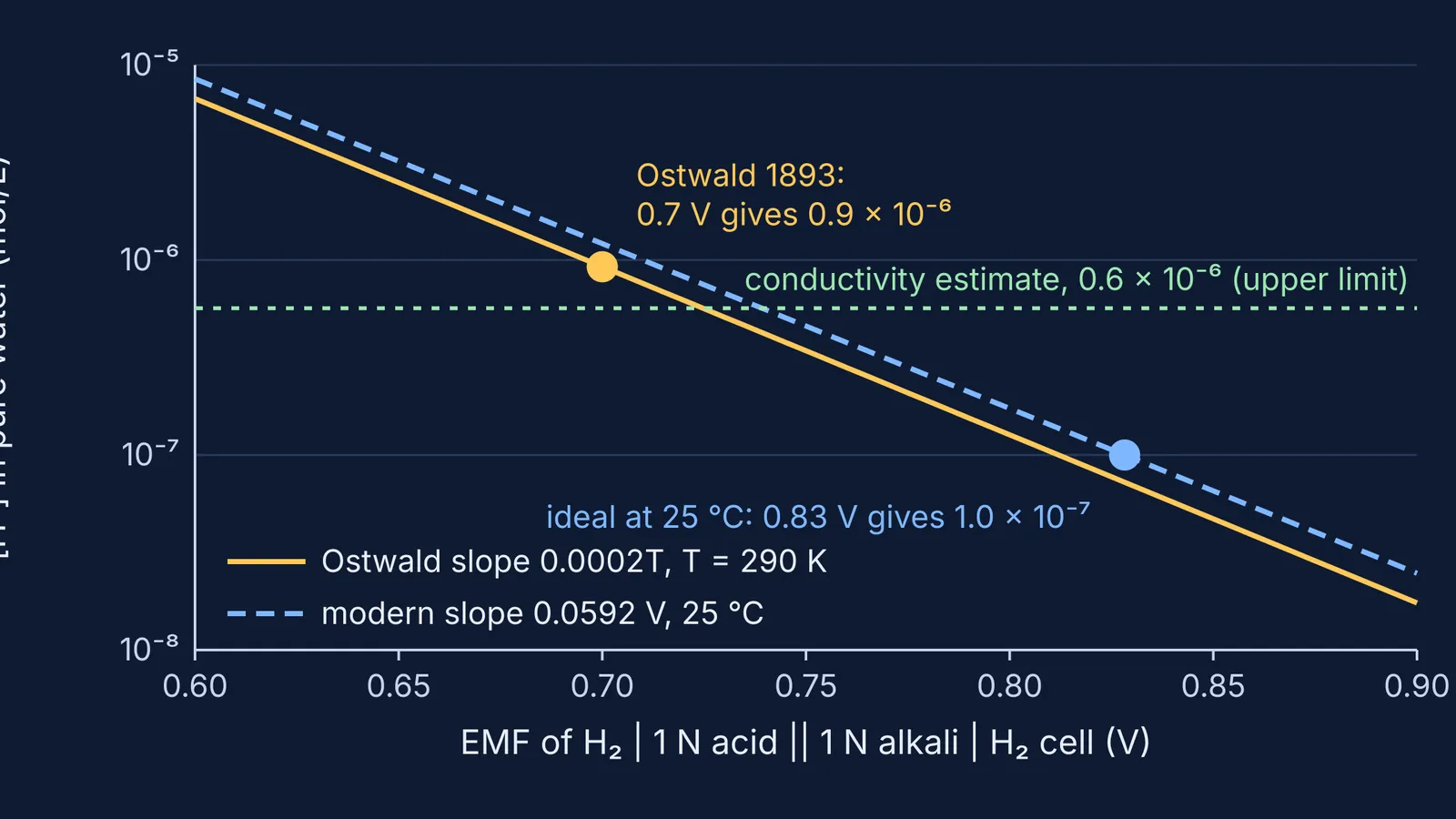
0.7 ÷ 0.058 = 12.07, so [H⁺] in the alkali is 10⁻¹²·⁰⁷ = 8.5 × 10⁻¹³ times that in the acid. His paper prints 8.5 × 10⁻¹³; it reproduces at T = 290 K (17 °C).
Take [H⁺] in the 1 N acid as 1. Then [H⁺] in the alkali is 8.5 × 10⁻¹³ and [OH⁻] in it is 1.
So the product [H⁺][OH⁻] is 8.5 × 10⁻¹³, and pure water has [H⁺] = √(8.5 × 10⁻¹³) = 0.9 × 10⁻⁶.
Two independent methods gave 0.6 and 0.9 × 10⁻⁶, which Ostwald judged "close enough". He concluded that Kohlrausch's water was already showing water's own conductivity. And because the conductivity figure, an upper limit, came out lower, his 0.7 V was probably a little too low. He was right: a larger voltage means a smaller [H⁺].
He called 0.7 V an estimate, keeping "more exact figures" for a study then running in his laboratory. He also gave a figure for 0.75 V that we could not reproduce, so we do not quote it.
What is the modern value for this cell?
The ideal cell at 25 °C, with 1 M solutions and H₂ at 1 bar:
Pt | H₂ | OH⁻(1 M) || H⁺(1 M) | H₂ | Pt
Anode, in the alkali: ½H₂ + OH⁻ → H₂O + e⁻
Cathode, in the acid: H⁺ + e⁻ → ½H₂
Net: H⁺(acid) + OH⁻(alkali) → H₂O
Atoms and charge balance; n = 1. Ostwald, too, put the anode in the alkali.
Worked example: EMF from Kw, then Kw from EMF
Part 1. Find the EMF from Kw (25 °C, 2.303RT/F = 0.0592 V).
[H⁺] at the cathode (acid) = 1 M. [H⁺] at the anode (alkali) = 1.0 × 10⁻¹⁴ M.
E = 0.0592 log(1 ÷ 10⁻¹⁴) = 0.0592 × 14 = 0.83 V.
Check: ΔG = −nFE = −1 × 96 485 × 0.828 = −79.9 kJ mol⁻¹. This equals −RT ln(1/Kw) = −8.314 × 298.15 × ln 10¹⁴ = −79.9 kJ mol⁻¹, the free energy of H⁺ + OH⁻ → H₂O at these concentrations.
Ostwald's 0.7 V was about 0.13 V short, which made his [H⁺] about 9 times too high (9.2 × 10⁻⁷ against 1.0 × 10⁻⁷). The 0.83 V is idealised: real 1 M solutions have activity coefficients below 1, and the acid–alkali boundary adds a liquid-junction potential.
Part 2. Find Kw from a measured EMF. A cell has 1 M HCl on one side and 0.10 M NaOH on the other. Treat both as ideal. It reads 0.769 V at 25 °C.
log([H⁺] acid ÷ [H⁺] alkali) = 0.769 ÷ 0.0592 = 12.99, so [H⁺] in the alkali = 10⁻¹²·⁹⁹ ≈ 1.0 × 10⁻¹³ M.
Kw = [H⁺][OH⁻] in the alkali = 1.0 × 10⁻¹³ × 0.10 = 1.0 × 10⁻¹⁴.
More cells like this are in concentration cells: finding the EMF when only concentration differs.
What did Ostwald say about Becquerel's acid–alkali battery?
Becquerel's older "oxygen battery" had platinum in acid and in alkali, and its energy was put down to acid meeting alkali. Ostwald disagreed, writing that salt formation "cannot act electromotively at all". A neutral salt layer soon forms between the liquids, and inserting any salt solution there does not change the voltage. Dissolved oxygen reacting at the electrodes drives it. With O₂ the half-reactions are O₂ + 4H⁺ + 4e⁻ → 2H₂O in the acid and 4OH⁻ → O₂ + 2H₂O + 4e⁻ in the alkali. The net change is again H⁺ + OH⁻ → H₂O per electron, so an O₂ cell and an H₂ cell must give the same voltage. He noted that the values measured for Becquerel's cell lie "somewhat over 0.7 volt".
In your syllabus this sits in Class 12 Electrochemistry (Nernst equation, hydrogen electrode, concentration cells, ΔG = −nFE) and Class 11 Equilibrium (Kw, pH + pOH = 14). The Concept Library covers the Nernst equation and Kw. For JEE electrochemistry numericals, Fermi Test Prep covers JEE Main and Advanced preparation with an AI tutor.
Quick checklist
1893: Ostwald got [H⁺] in pure water as 0.6 × 10⁻⁶ from conductivity (an upper limit) and 0.9 × 10⁻⁶ from a hydrogen cell.
Convert [OH⁻] to [H⁺] before using the Nernst equation for a hydrogen electrode.
Ideal 1 M acid against 1 M alkali at 25 °C: E = 0.0592 × 14 = 0.83 V.
His 0.7 V was an estimate; the real figure is higher, as he suspected.