

On this page
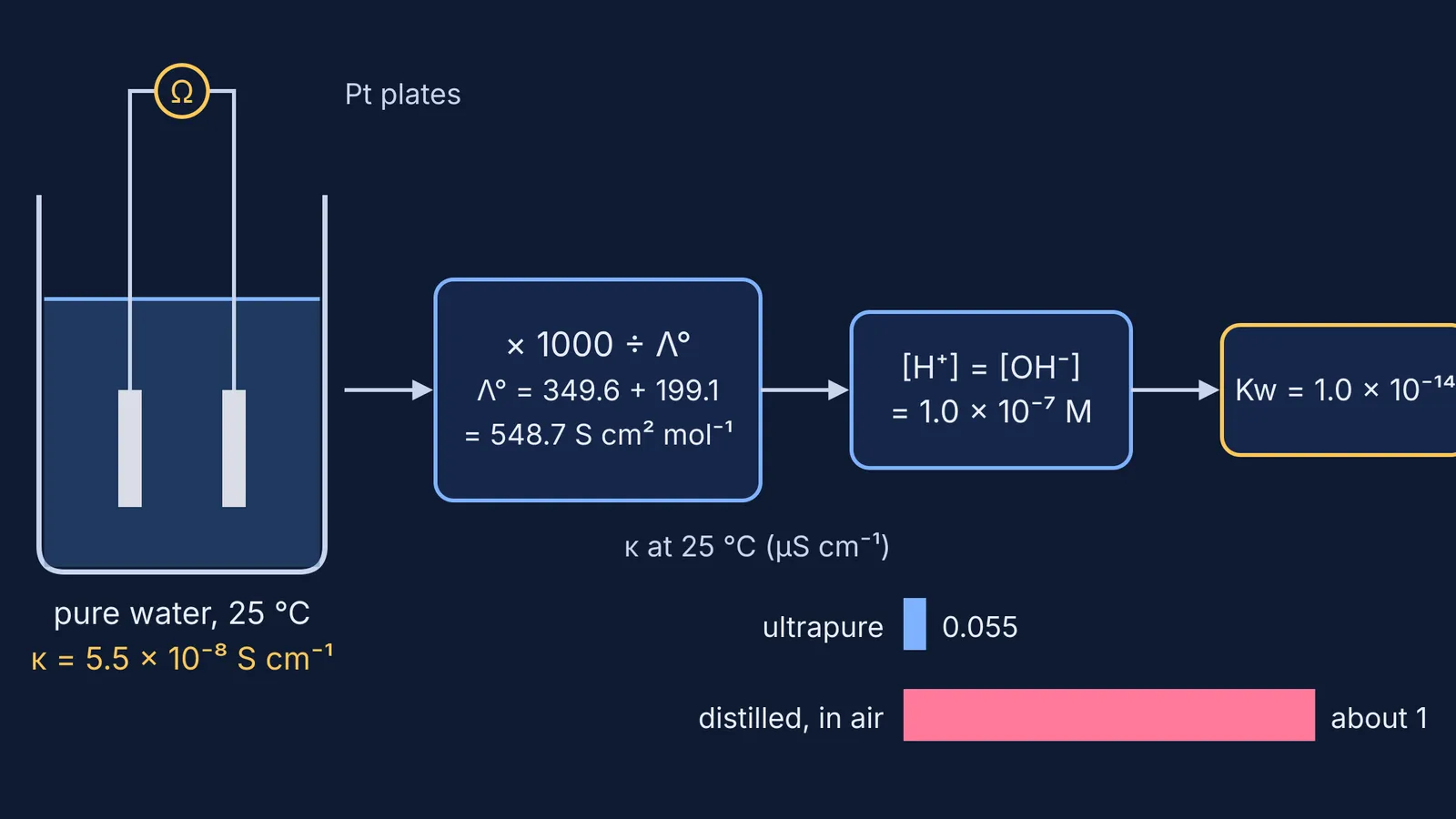
A conductivity meter dipped in very pure water does not read zero. At 25 °C it reads about 5.5 × 10⁻⁸ S cm⁻¹. It comes from the H⁺ and OH⁻ that water makes itself. Combine it with Kohlrausch's law and you can work out the ionic product of water, Kw, from a meter reading. This post shows how, step by step, and explains why ordinary distilled water gives a reading about 18 times higher.
How do you find Λ°m for water using Kohlrausch's law?
NCERT's Electrochemistry chapter (Class 12, Unit 2) asks this as intext question 2.8: suggest a way to find Λ°m for water. You cannot measure it directly. Water is a very weak electrolyte, so you cannot extrapolate its Λm to zero concentration. Kohlrausch's law gets around this: build Λ°m(H₂O) from three strong electrolytes.
Λ°m(H₂O) = Λ°m(HCl) + Λ°m(NaOH) − Λ°m(NaCl)
The Na⁺ and Cl⁻ terms cancel and you are left with λ°(H⁺) + λ°(OH⁻). With NCERT's Table 2.4 values at 298 K:
Λ°m(HCl) = 349.6 + 76.3 = 425.9 S cm² mol⁻¹
Λ°m(NaOH) = 50.1 + 199.1 = 249.2 S cm² mol⁻¹
Λ°m(NaCl) = 50.1 + 76.3 = 126.4 S cm² mol⁻¹
Λ°m(H₂O) = 425.9 + 249.2 − 126.4 = 548.7 S cm² mol⁻¹
Other data tables give slightly different ion values, such as 349.8 for H⁺ and 198.0 for OH⁻. Use the values your question gives. In NCERT-based exams, that means 349.6 and 199.1. If you want the general method first, read molar conductivity and Kohlrausch's law, with worked examples. Why H⁺ and OH⁻ are so far ahead of every other ion is explained in the Grotthuss proton relay.
Why can you use Λ° for water's ions?
Λ° is the molar conductivity at infinite dilution. Pure water is a case where using it is fine. Its H⁺ and OH⁻ are only about 10⁻⁷ M each. At that concentration the ions are so far apart that they hardly affect each other, so Λm and Λ° are effectively equal. That is what lets you divide by 548.7 and trust the answer.
How do you get Kw from the conductivity of pure water?
Here is the full calculation. Ultrapure laboratory water at 25 °C has a resistivity of about 18.2 MΩ cm. Its conductivity is the reciprocal: κ = 1/(18.2 × 10⁶) ≈ 5.5 × 10⁻⁸ S cm⁻¹. There are two correct routes. Pick one and do not mix them.
Route 1: treat the ions as the electrolyte
Write the link between κ and concentration: Λ = κ × 1000/c, so c = κ × 1000/Λ. The 1000 converts mol L⁻¹ to mol cm⁻³ so the units match S cm² mol⁻¹.
Here c is the concentration of H⁺ (which equals that of OH⁻), and Λ is Λ° for H⁺ + OH⁻.
[H⁺] = (5.5 × 10⁻⁸ × 1000)/548.7 = 5.5 × 10⁻⁵/548.7 = 1.0 × 10⁻⁷ mol L⁻¹.
In pure water [OH⁻] = [H⁺], so Kw = [H⁺][OH⁻] = (1.0 × 10⁻⁷)² = 1.0 × 10⁻¹⁴.
Route 2: treat water itself as a weak electrolyte
Take the concentration of water as 55.5 mol L⁻¹ (1000 g ÷ 18 g mol⁻¹). Where that number comes from is in why the molarity of pure water is 55.5 M.
Molar conductivity of water: Λm = κ × 1000/c = 5.5 × 10⁻⁵/55.5 = 9.9 × 10⁻⁷ S cm² mol⁻¹.
Degree of ionisation: α = Λm/Λ°m = 9.9 × 10⁻⁷/548.7 = 1.8 × 10⁻⁹.
[H⁺] = αc = 1.8 × 10⁻⁹ × 55.5 = 1.0 × 10⁻⁷ mol L⁻¹, and Kw = 1.0 × 10⁻¹⁴ again.
Both routes give the same answer because 55.5 cancels out. Route 2 also shows that only about two water molecules in a billion are ionised. The result matches the textbook Kw at 25 °C, which is good evidence that the conductivity is coming from water's own ions and nothing else.
Why does distilled water read about 1 µS cm⁻¹?
Leave freshly distilled water open to the air and its conductivity climbs to about 1 µS cm⁻¹ (1 × 10⁻⁶ S cm⁻¹). That is roughly 18 times the ultrapure value of 0.055 µS cm⁻¹. It has dissolved carbon dioxide from the air:
CO₂ + H₂O ⇌ H⁺ + HCO₃⁻
Water in equilibrium with air settles at a pH of about 5.6, so [H⁺] ≈ [HCO₃⁻] ≈ 2.5 × 10⁻⁶ M. Taking λ°(HCO₃⁻) as about 44.5 S cm² mol⁻¹, the conductivity is κ ≈ 2.5 × 10⁻⁶ × (349.6 + 44.5)/1000 ≈ 1.0 × 10⁻⁶ S cm⁻¹. That accounts for the whole reading.
So if you plug 1 µS cm⁻¹ into Route 1, you get [H⁺] ≈ 1.8 × 10⁻⁶ M and a "Kw" of 3.3 × 10⁻¹², over 300 times too big. The calculation only works for water that is truly pure, kept away from air.
The same issue appears in NCERT's own text, which gives very pure water a conductivity of 3.5 × 10⁻⁵ S m⁻¹ (3.5 × 10⁻⁷ S cm⁻¹). Divide that by 548.7 and Kw comes out near 4 × 10⁻¹³, about 40 times too high. That figure describes water that already holds traces of dissolved ions. For the Kw calculation, use the ultrapure value. This is also why careful Ksp work subtracts the conductivity of the water used, as in solubility and Ksp of AgCl from conductivity.
Does the answer change with temperature?
Yes. The value 5.5 × 10⁻⁸ S cm⁻¹ is for 25 °C only. Ionisation of water is endothermic, so warmer water has more H⁺ and OH⁻, and the ions also move faster. Both effects push κ up steeply as temperature rises. Meters correct readings to 25 °C for this reason. At another temperature you need that temperature's λ° values, and you get that temperature's Kw. This is how the rise of Kw with temperature, described in why neutral pH is not always 7, can be measured.
If you would like more practice combining Kohlrausch sums, α and Kw in one problem, the Fermi Problem Library has a step-by-step solver that explains the reasoning at each step.
What should you write in an exam answer?
For "suggest a way to determine Λ°m of water", give three lines:
Kohlrausch's law: Λ°m(H₂O) = Λ°m(HCl) + Λ°m(NaOH) − Λ°m(NaCl).
All three are strong electrolytes, so their Λ°m values are found by extrapolating Λm against √c to zero concentration.
Λ°m(H₂O) = λ°(H⁺) + λ°(OH⁻) = 548.7 S cm² mol⁻¹ with NCERT data.
If the question then gives κ of pure water, follow Route 2: Λm = κ × 1000/55.5, α = Λm/Λ°m, [H⁺] = 55.5α, Kw = [H⁺]².
Quick checklist
Λ°m(H₂O) = Λ°m(HCl) + Λ°m(NaOH) − Λ°m(NaCl) = 349.6 + 199.1 = 548.7 S cm² mol⁻¹ (NCERT values).
Ultrapure water at 25 °C: κ ≈ 5.5 × 10⁻⁸ S cm⁻¹, resistivity about 18.2 MΩ cm.
[H⁺] = κ × 1000/Λ° = 1.0 × 10⁻⁷ M, so Kw = 1.0 × 10⁻¹⁴.
Via water at 55.5 M: α = 1.8 × 10⁻⁹, giving the same [H⁺].
Keep c and Λ matched; do not mix the two routes.
Distilled water in air reads about 1 µS cm⁻¹ because of dissolved CO₂.
Water conducts very slightly. It is a poor conductor, not a perfect insulator.


