

On this page
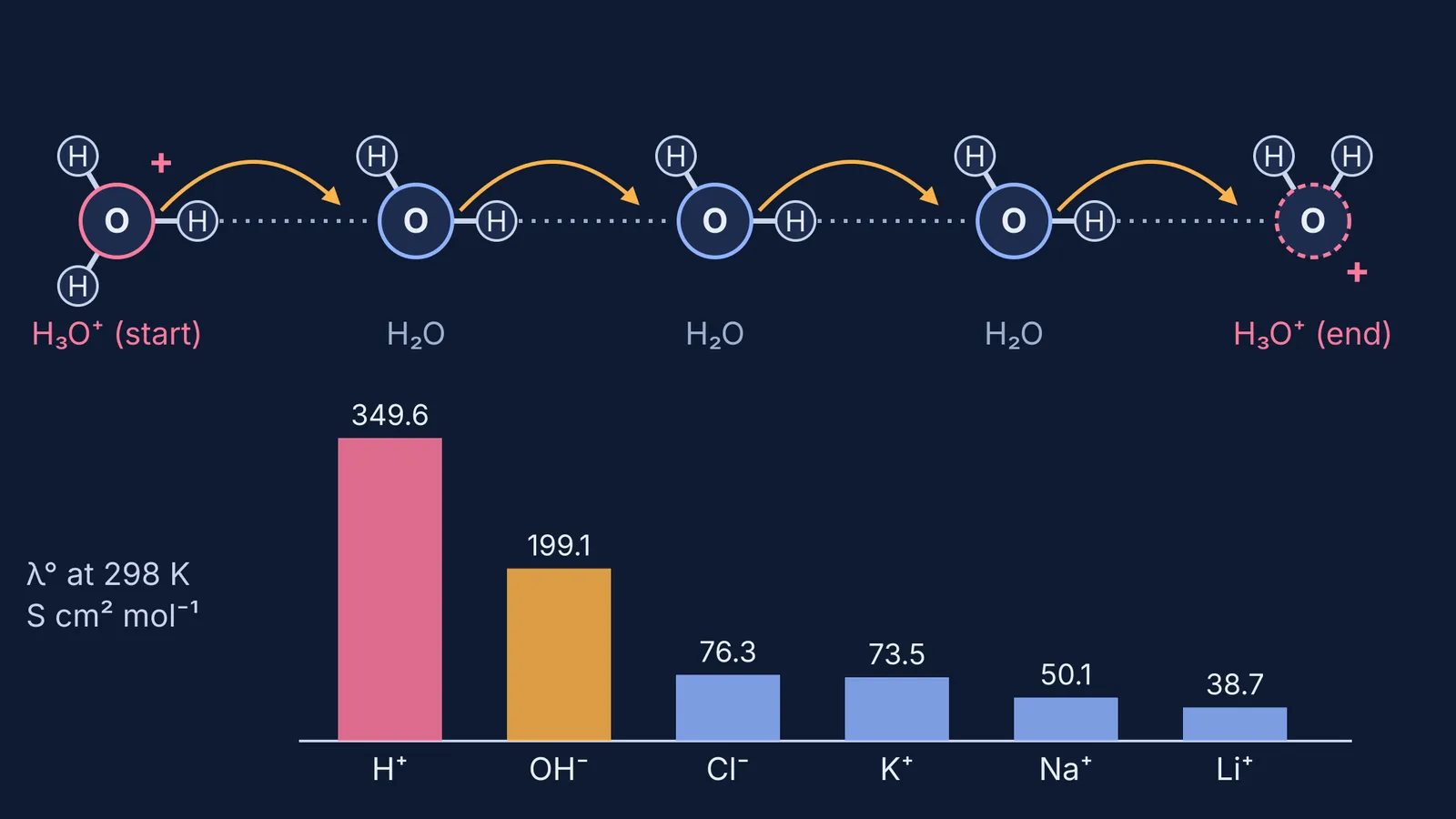
Open the NCERT table of limiting molar conductivities at 298 K and two numbers stand out. H⁺ is listed at 349.6 S cm² mol⁻¹ and OH⁻ at 199.1, while ordinary ions such as K⁺ (73.5), Cl⁻ (76.3) and Na⁺ (50.1) sit far below. H⁺ is almost five times K⁺. This post explains why, and how the same fact shapes the conductometric titration curve of a strong acid.
Why is the molar conductivity of H⁺ so high?
The tempting answer is "because H⁺ is tiny". That answer is wrong. A bare proton never exists in water. It is attached to a water molecule as H₃O⁺, and H₃O⁺ is itself surrounded by hydrogen-bonded water molecules. As a particle, it is about the size of a water molecule, which is roughly the size of K⁺. If H₃O⁺ had to push its way through the solvent like K⁺ does, you would expect a λ° of the same order as K⁺, not nearly five times larger.
Size also points the wrong way in the rest of the table. Among the alkali metals, the smallest ion, Li⁺, is the slowest, because it carries the thickest shell of water with it. That story is told in why the lithium ion has the lowest ionic mobility in water. Something other than size must be at work for H⁺.
How does the Grotthuss mechanism move a proton through water?
Water is a network of molecules held together by hydrogen bonds. Picture a short chain of them, with H₃O⁺ at the left end and the field pulling positive charge to the right.
H₃O⁺ hands one of its protons to the water molecule it is hydrogen-bonded to on its right. The H₃O⁺ becomes an ordinary H₂O.
The receiving molecule is now H₃O⁺. It hands one of its own protons to the next molecule along.
This repeats down the chain. Each step only shifts a proton across one hydrogen bond, a fraction of a nanometre.
After a few steps the positive charge has appeared at the far end of the chain, but no single H₃O⁺ has travelled that distance. The charge moves; the individual ions barely move. That is the key idea, and it is why you should not say that H₃O⁺ "travels quickly". It is a relay: the baton crosses the field while each runner stays near its own spot.
The name comes from Theodor von Grotthuss, who in 1806 proposed a chain of molecules swapping parts to explain conduction during electrolysis, long before ions were understood. The modern picture is different in detail. Chemists now describe "structural diffusion": the proton jump itself is fast, and what sets the pace is the reshuffling of hydrogen bonds around the molecule that will receive the next proton. Grotthuss's name has stuck to the idea, but the mechanism taught today is not exactly what he wrote.
Why does OH⁻ also conduct so fast?
OH⁻ uses the same relay, run in reverse. A water molecule next to OH⁻ hands a proton to it. The OH⁻ becomes H₂O, and the donor water becomes the new OH⁻. Protons step one way, and the negative charge appears one molecule further along in the other direction, which is exactly where the field pulls an anion.
OH⁻ (199.1) is still slower than H⁺ (349.6). The usual explanation is that the hydrogen-bond arrangement around OH⁻ has to change more before each transfer can happen. Treat that as a reasonable account rather than a settled number to memorise. For exams, the fact to remember is the order: H⁺ > OH⁻ > all common ions.
Worked example: HCl against KCl at infinite dilution
Compare the limiting molar conductivity of HCl with that of KCl, using NCERT's 298 K values.
Write Kohlrausch's law for each. Λ°(electrolyte) = λ°(cation) + λ°(anion). The method is set out in molar conductivity and Kohlrausch's law.
HCl. Λ°(HCl) = λ°(H⁺) + λ°(Cl⁻) = 349.6 + 76.3 = 425.9 S cm² mol⁻¹.
KCl. Λ°(KCl) = λ°(K⁺) + λ°(Cl⁻) = 73.5 + 76.3 = 149.8 S cm² mol⁻¹.
Ratio. 425.9 / 149.8 ≈ 2.84.
Interpret. The anion is the same in both, so the whole difference comes from the cation. HCl conducts about 2.8 times better than KCl at infinite dilution, and H⁺ alone carries 349.6 / 425.9 ≈ 82% of the current in dilute HCl.
The same arithmetic gives Λ°(NaOH) = 50.1 + 199.1 = 249.2 S cm² mol⁻¹, against Λ°(NaCl) = 50.1 + 76.3 = 126.4. Swapping Cl⁻ for OH⁻ roughly doubles the value.
Why is the HCl versus NaOH conductometric curve V-shaped?
When you titrate HCl with NaOH and follow the conductance, the reaction in solution is H⁺ + OH⁻ → H₂O. Na⁺ and Cl⁻ are spectators. So before the endpoint, each mole of NaOH added removes one mole of H⁺ and puts one mole of Na⁺ in its place.
Before the endpoint: fast H⁺ (349.6) is replaced by slow Na⁺ (50.1). The ionic contribution falls by about 349.6 − 50.1 = 299.5 S cm² per mole of NaOH added, so the conductance drops steeply.
At the endpoint: the solution is just NaCl, and the conductance is at its minimum.
After the endpoint: extra NaOH adds both Na⁺ and OH⁻, about 50.1 + 199.1 = 249.2 S cm² per mole, so the conductance rises again.
That is the V. The two arms are not equally steep: 299.5 against 249.2 per mole, ignoring dilution, so the falling arm is the steeper one. Both steep slopes come from the relay mechanism, the falling arm because H⁺ is lost and the rising arm because OH⁻ is gained. The full set of curve shapes, including weak acids and precipitation titrations, is in conductometric titration curves.
If you want to try more questions that combine λ° values, Kohlrausch's law and titration curves, the Fermi Problem Library has a step-by-step solver that explains the reasoning, not just the final number.
What should you write in an exam answer?
A two-mark "why" question needs three points:
H⁺ exists as H₃O⁺, which is not especially small, so size does not explain its conductivity.
The proton is transferred from H₃O⁺ to a neighbouring hydrogen-bonded water molecule, and on along the chain (Grotthuss mechanism).
The positive charge therefore moves through the solution much faster than any ion could move by drifting through the solvent. OH⁻ conducts fast by the same relay in reverse.
Quick checklist
λ° at 298 K (NCERT): H⁺ 349.6, OH⁻ 199.1, Cl⁻ 76.3, K⁺ 73.5, Na⁺ 50.1 S cm² mol⁻¹.
The reason is proton relay through hydrogen bonds, not small size.
The charge moves; the individual ions barely move.
OH⁻ uses the same relay in reverse and is the second-fastest ion.
Λ°(HCl) = 425.9 and Λ°(KCl) = 149.8, a ratio of about 2.8.
In HCl versus NaOH, H⁺ is replaced by Na⁺ before the endpoint, giving the steep falling arm of the V.


