

On this page
Lithium forms the smallest ion in Group 1, so you might expect Li⁺ to zip through water fastest. It is the slowest, because in water an ion never travels alone.
Why does the smallest alkali ion move the slowest?
Size in a crystal and size in water are different things. In Shannon's table of effective ionic radii, Li⁺ has a radius of 76 pm and Cs⁺ a radius of 167 pm (Shannon's radii, tabulated on Wikipedia).
Because the same +1 charge sits on a much smaller sphere, Li⁺ has the highest charge density in the group. Its field near the surface grips the negative oxygen ends of nearby water molecules tightly. A 2012 X-ray scattering and infrared study by Johan Mähler and Ingmar Persson found that the hydrated lithium ion is four-coordinate, and that it is "more strongly hydrated, most probably with a second hydration shell present". Sodium, potassium, rubidium and caesium ions, by contrast, were weakly hydrated with a single shell (Inorganic Chemistry, abstract on PubMed).
So when you apply a voltage, Li⁺ pulls its bound water along. The moving unit is large, and a larger object feels more drag at the same speed. Cs⁺ holds its water loosely, so what moves is closer to the bare ion. To picture the water shells forming, see what happens to salt when it dissolves in water, ion by ion.
What do the conductivity numbers show?
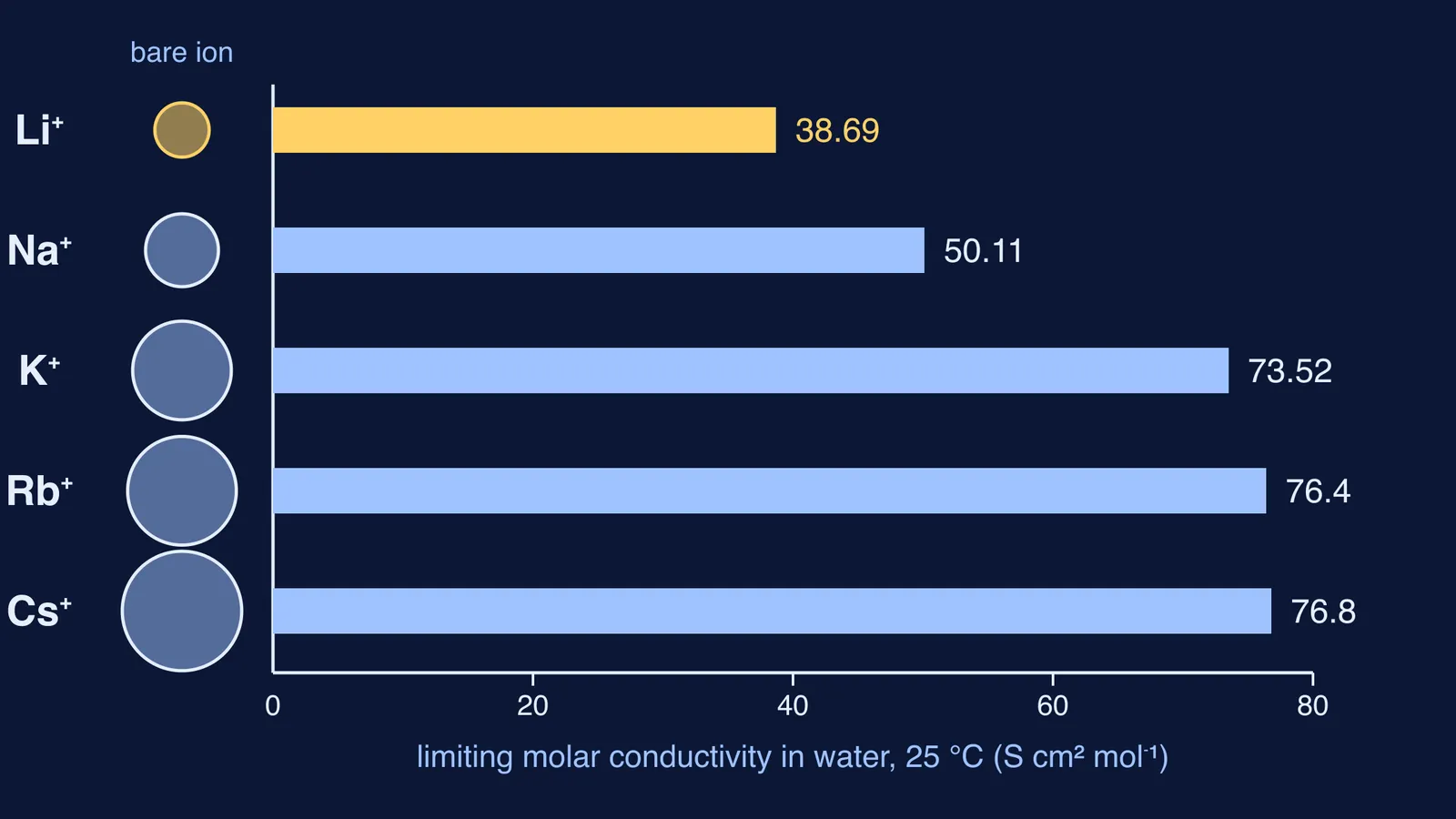
Chemists measure how easily an ion moves through its limiting molar conductivity, λ°: the share of conductivity carried by one mole of that ion at infinite dilution. At 25 °C, the values in water are (table from Adamson's Textbook of Physical Chemistry, reproduced on Wikipedia)):
Li⁺: 38.69 S cm² mol⁻¹
Na⁺: 50.11 S cm² mol⁻¹
K⁺: 73.52 S cm² mol⁻¹
Rb⁺: 76.4 S cm² mol⁻¹
Cs⁺: 76.8 S cm² mol⁻¹
Li⁺ carries current about half as well as Cs⁺: 38.69 divided by 76.8 is 0.50. Notice too that Rb⁺ and Cs⁺ are almost tied; the same hydration study found both have only a very weak effect on the water structure. If the unit S cm² mol⁻¹ confuses you, read where the factor of 1000 in molar conductivity comes from.
Ionic mobility, u, is λ° divided by the Faraday constant, F = 96,485 C mol⁻¹ (NIST CODATA value). For Li⁺, u = 3.869 × 10⁻³ S m² mol⁻¹ ÷ 96,485 C mol⁻¹ = 4.0 × 10⁻⁸ m² V⁻¹ s⁻¹. In a field of 100 V m⁻¹, Li⁺ drifts about 4 micrometres per second; Cs⁺ manages about 8.
How big is a lithium ion in water? A worked estimate
You can turn the conductivity into a size. Treat the moving ion as a sphere in a viscous liquid. At steady drift, the electric force on it equals the Stokes drag, 6πηrv. For a +1 ion, rearranging gives r = F² ÷ (6π η N_A λ°).
Inputs for Li⁺: λ° = 3.869 × 10⁻³ S m² mol⁻¹, F = 96,485 C mol⁻¹, N_A = 6.022 × 10²³ mol⁻¹, and the viscosity of water η = 0.89 × 10⁻³ Pa s (NIST Chemistry WebBook lists 0.893 mPa s at 298 K).
Denominator: 6π × 0.89 × 10⁻³ × 6.022 × 10²³ × 3.869 × 10⁻³ = 3.91 × 10¹⁹.
Numerator: F² = 9.31 × 10⁹.
Divide: r = 2.38 × 10⁻¹⁰ m, or 238 pm.
That is about three times the bare radius of 76 pm from Shannon's table. The same steps for Na⁺ give 184 pm against a bare 102 pm.
One warning: for K⁺, Rb⁺ and Cs⁺ the formula gives 120 to 125 pm, smaller than the bare ions. Stokes' law treats water as a smooth liquid, which is crude at molecular scale, so trust the trend, not exact radii.
How do you write this in an exam?
A four-line answer:
Li⁺ has the smallest ionic radius in Group 1, so it has the highest charge density.
It attracts and holds water molecules most strongly, so it is the most heavily hydrated alkali ion.
Hydrated Li⁺ is the largest moving unit, so it meets the most resistance from the solvent.
So mobility in water follows Li⁺ < Na⁺ < K⁺ < Rb⁺ < Cs⁺, the reverse of the hydrated-size order.
Two traps to avoid:
Do not blame mass. Li⁺ is the lightest ion in the group, so mass cannot explain its slowness.
Keep "ionic radius" (the bare ion) and "hydrated radius" (the ion with its water) as separate words in your answer.
Ion mobility also explains why a galvanic cell's salt bridge usually uses KCl.
If the gap is the idea of hydration itself, the Fermi Concept Library gives every chemistry concept its own lesson and its place in the map. If conductivity numericals are where you slip, the Fermi Problem Library has worked problems with a step-by-step solver that explains the reasoning rather than printing an answer.
Next time you see "Li⁺ has the lowest mobility", picture the ion with its coat of water, and the answer writes itself.


