

On this page
Carrageenan is the gelling agent made from red seaweeds, listed on food labels as INS 407. Chemically it is a chain of galactose units, many of them carrying a sulphate ester. How much sulphate it carries decides which type it is, and the Bureau of Indian Standards measures that with the same barium sulphate weighing you meet in the Carius method. This post works through the standard, IS 16147:2014 (Carrageenan, Food Grade), which we read on the scanned copy at the Internet Archive. Its foreword says it is based on the JECFA specification of 2007.
What is carrageenan, according to BIS?
The foreword defines it as a hydrocolloid from certain red seaweeds (class Rhodophyceae), with genera such as Eucheuma, Chondrus, Gigartina and Hypnea among the commercial sources. It consists "mainly of the ammonium, calcium, magnesium, potassium and sodium sulphate esters of galactose and 3,6-anhydrogalactose polysaccharides". The two sugars alternate along the chain, "linked α-1,3 and β-1,4".
BIS names three main types:
Kappa: D-galactose-4-sulphate alternating with 3,6-anhydro-D-galactose. One sulphate per two sugars.
Iota: the same, except the anhydro sugar is also sulphated at carbon 2. Two sulphates per two sugars.
Lambda: D-galactose-2-sulphate alternating with D-galactose-2,6-disulphate. Three sulphates per two sugars.
The standard adds that real samples form "a continuum of intermediate compositions" between kappa and iota. So the counts above describe ideal chains.
BIS tells the types apart with potassium chloride. Dissolve the sample in hot water, add KCl, reheat and cool. A short-textured ("brittle") gel means mostly kappa, a compliant ("elastic") gel mostly iota, and no gel mostly lambda. An infrared check backs this up: ester sulphate absorbs at 1220–1260 cm⁻¹, 3,6-anhydrogalactose at 928–933 cm⁻¹ and galactose-4-sulphate at 840–850 cm⁻¹.
How is galactose related to glucose and to 3,6-anhydrogalactose?
D-galactose has the same formula as D-glucose, C₆H₁₂O₆, and differs only in the arrangement at carbon 4. In a Fischer projection the C-4 OH of D-glucose points right and that of D-galactose points left. Two sugars that differ at just one stereocentre are epimers, so D-galactose is the C-4 epimer of D-glucose. If you mix up epimers and anomers, see the difference between epimers and anomers.
3,6-Anhydrogalactose is galactose that has lost one water molecule between its C-3 OH and C-6 OH. The two oxygens become one bridging O, which makes an intramolecular ether. Count the ring it closes: C-3, C-4, C-5, C-6 and the O, a five-membered ring on top of the usual pyranose ring. In the chain, a galactose residue is C₆H₁₀O₅ (162.14 g mol⁻¹) and an anhydro residue is C₆H₈O₄ (144.13 g mol⁻¹), one H₂O less.
How does BIS measure sulphate in carrageenan?
Annex G states the principle in one line: "Hydrolyzed sulphate groups are precipitated as barium sulphate." In outline:
Wash and dry the sample, then boil a weighed portion with dilute (0.2 N) HCl. The acid cuts the ester bonds and frees sulphate: R–OSO₃⁻ + H₂O → R–OH + H⁺ + SO₄²⁻.
Add hydrogen peroxide and keep heating "until the solution becomes completely clear".
Add BaCl₂ to the hot solution: Ba²⁺ + SO₄²⁻ → BaSO₄↓.
Filter, ash the paper at 800 °C and weigh the white BaSO₄.
Both equations balance in atoms and charge (−1 on each side of the first; 0 overall in the second). The calculation is
% SO₄ = W₂ × 100 × 0.4116 ÷ W₁
where W₂ is the mass of BaSO₄ and W₁ the mass of sample. The factor is just a ratio of molar masses: SO₄/BaSO₄ = 96.06 ÷ 233.39 = 0.4116. The requirement (Table 2) is 15–40% sulphate as SO₄²⁻.
This is the sulphur half of the Carius method, reported as sulphate instead of sulphur. The NCERT version is covered in estimating carbon, hydrogen, halogens and sulphur.
How much sulphate should kappa, iota and lambda carry?
Work out each ideal repeat unit (two sugars) as the sodium salt. Each sulphate ester swaps an O–H hydrogen for –SO₃Na, which adds SO₃Na − H = 102.04 g mol⁻¹.
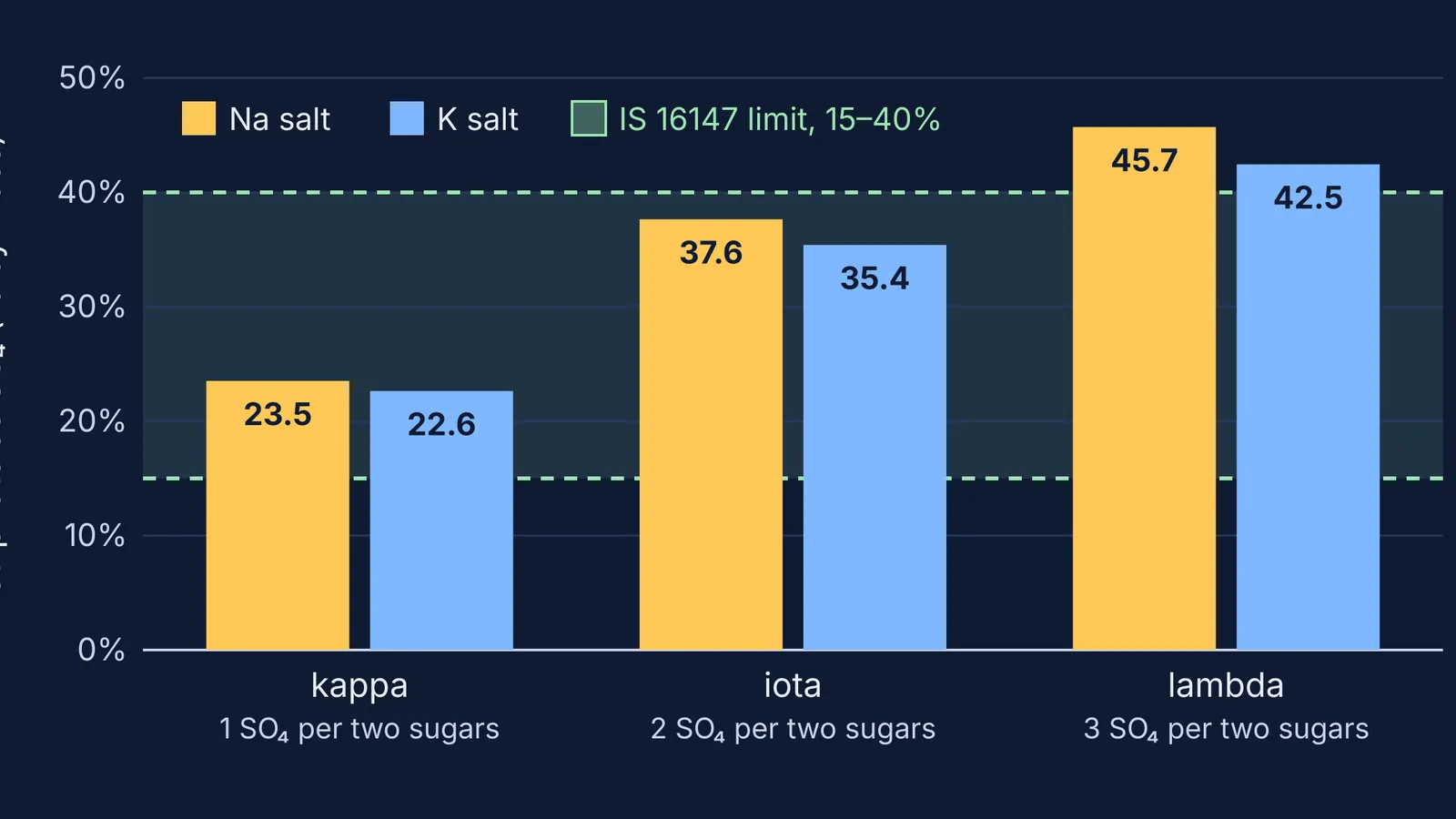
Kappa, C₁₂H₁₇NaO₁₂S: 162.14 + 144.13 + 102.04 = 408.3 g mol⁻¹. % SO₄ = 96.06 ÷ 408.3 × 100 = 23.5%.
Iota, C₁₂H₁₆Na₂O₁₅S₂: 306.27 + 2 × 102.04 = 510.3 g mol⁻¹. % SO₄ = 2 × 96.06 ÷ 510.3 × 100 = 37.6%.
Lambda, C₁₂H₁₇Na₃O₁₉S₃: 2 × 162.14 + 3 × 102.04 = 630.4 g mol⁻¹. % SO₄ = 3 × 96.06 ÷ 630.4 × 100 = 45.7%.
As potassium salts the figures drop to 22.6%, 35.4% and 42.5%, because K is heavier than Na. These are theoretical values for perfect chains. Real carrageenan is a mixture of salts and of types. A perfectly sulphated lambda chain would sit above the 40% ceiling, so lambda-rich material that meets the limit must be less sulphated than the ideal chain or mixed with other types.
Worked example: from BaSO₄ mass to sulphates per repeat unit
A dried sample of 1.000 g gives 0.550 g of BaSO₄.
% SO₄. 0.550 × 100 × 0.4116 ÷ 1.000 = 22.6%. That is inside the 15–40% limit.
Moles. 0.550 ÷ 233.39 = 2.36 mmol of sulphate per gram.
Sulphates per two sugars. Assume a kappa-type backbone (306.27) as the sodium salt with n sulphates per repeat. Then 96.06n ÷ (306.27 + 102.04n) = 0.226, which gives n = 0.226 × 306.27 ÷ (96.06 − 0.226 × 102.04) = 0.95.
Type. Close to one sulphate per two sugars, so mostly kappa. Confirm with the KCl test: it should give a brittle gel.
Try one yourself: 0.800 g of sample gives 0.700 g of BaSO₄. You should get 36.0% SO₄ and about 1.9 sulphates per two sugars, which points to iota. The Fermi Problem Library has a step-by-step solver that explains the reasoning, if you want to check gravimetric problems like this one line by line.
In your syllabus this sits in Class 11 Organic Chemistry (quantitative analysis): sulphur as BaSO₄ and the gravimetric factor. Class 12 Biomolecules: D-galactose, epimers, glycosidic links and polysaccharides. Class 12 Alcohols, Phenols and Ethers: ethers, here formed inside one molecule. The BaCl₂ identity test in the standard is the same reaction as the barium chloride test for sulphate in salt analysis.
Quick checklist
Carrageenan: sulphated galactose and 3,6-anhydrogalactose from red seaweeds.
Kappa has 1, iota 2 and lambda 3 sulphates per two sugars.
% SO₄ = mass of BaSO₄ × 100 × 0.4116 ÷ mass of sample; 0.4116 = 96.06/233.39.
Ideal sodium salts: kappa 23.5%, iota 37.6%, lambda 45.7% SO₄. BIS limit: 15–40%.
D-galactose is the C-4 epimer of D-glucose.
The 3,6-anhydro bridge is an intramolecular ether that closes a five-membered ring.