On this page
Write 2H₂O₂ → 2H₂O + O₂ and it is tempting to call the reaction second order. In 1899 G. Bredig and R. Müller von Berneck showed that it is not, at least when platinum is the catalyst. Their colloidal platinum made the decomposition so clean that the order could be read straight off a burette. The same paper showed that traces of certain substances "poison" the platinum the way they poison enzymes. The paper is "Über anorganische Fermente. I. Über Platinkatalyse und die chemische Dynamik des Wasserstoffsuperoxyds" (On inorganic ferments. I. On platinum catalysis and the chemical dynamics of hydrogen peroxide), Zeitschrift für physikalische Chemie volume 31 (1899), from page 258. We read it on the scanned pages at the Internet Archive; translations are ours. For your syllabus this is Class 12 Chemical Kinetics: the first-order integrated law, half-life, order versus the balanced equation, and catalysts.
Why was H₂O₂ decomposition so hard to measure before 1899?
Hydrogen peroxide decomposes on almost anything. The authors list what earlier workers had found the rate to depend on: the size and nature of the vessel, the surface between gas and liquid, traces of manganese and other stray catalysts, and light. With all of these acting at once, the rate equation was a sum of unknown terms, and no single order could be fixed.
Their answer was to swamp the disturbances. Bredig's colloidal platinum, a deep black-brown liquid made by sparking platinum wire under water (the method is described in Bredig's arc method for metal sols), behaves like an enormous number of tiny platinum walls. Add enough of it and the effect of the glass wall or a gas bubble "disappears" next to it. The rate then depends on the platinum alone.
How did they follow the reaction?
All runs were at 25.00 °C in an Ostwald thermostat. They mixed the platinum liquid with dilute H₂O₂, took 2 cm³ samples at timed intervals and titrated each with dilute KMnO₄ (0.0015 mol per litre), on the basis that 2 KMnO₄ correspond to 5 H₂O₂. The titre is therefore proportional to the H₂O₂ still left. They preferred this to collecting the oxygen gas, because the gas can stay supersaturated in the liquid. This is the same method you use in the practical, explained in first-order kinetics of H₂O₂ decomposition by KMnO₄ titration.
What order did they find, and why was it a surprise?
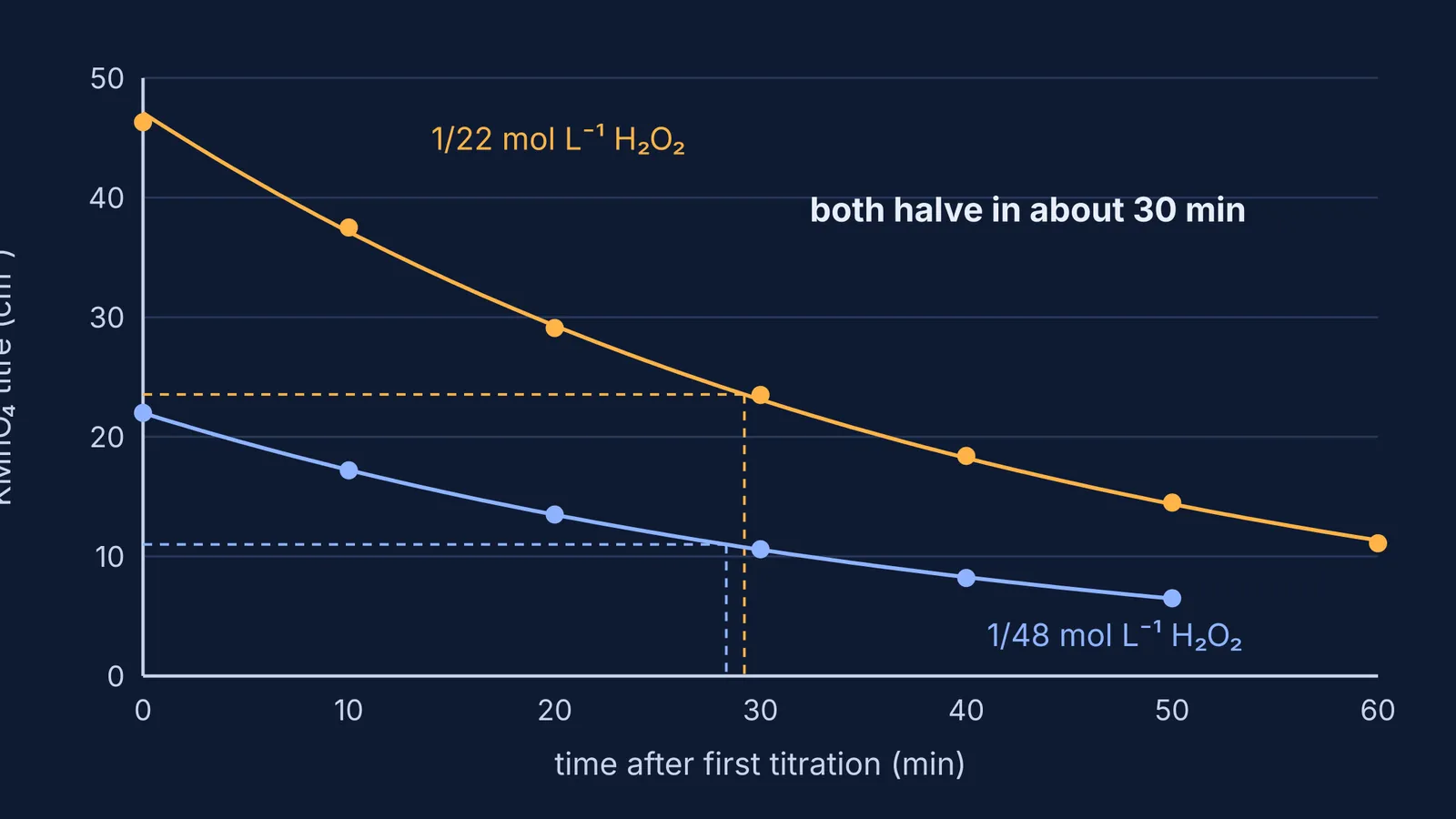
Every run fitted the first-order equation k₁ = (1/t) ln(a/(a − x)). In Table 7, all 23 runs gave "a satisfactory first-order constant", and parallel flasks agreed. Table 9 used van 't Hoff's second test: change the starting concentration and see whether k changes. With 1/22 and 1/48 mol per litre of H₂O₂ and the same platinum, about half of the peroxide was gone after 30 minutes in both (they quote 51% and 48%). Equal fractions in equal times, whatever you start with, is the mark of first order.
Their conclusion, in bold type in the paper: the decomposition of hydrogen peroxide into water and oxygen under the catalytic influence of platinum "is, in acid and neutral solution, a reaction of the first order".
Then the surprise: "This result directly contradicts the usual molecular decomposition equation 2H₂O₂ = 2H₂O + O₂; we must rather write H₂O₂ = H₂O + O." They suggested that the slow, measurable step might be the release of oxygen atoms on the platinum, with the atoms pairing up to O₂ almost instantly. They called the question "not yet ripe for decision". Treat it as their guess, not the modern mechanism. The lesson that has lasted is the one in order vs molecularity: order is found by experiment, not read from the balanced equation.
Worked example: k and half-life from their own titres
Table 7 (1/44 mol per litre H₂O₂, platinum liquid aged one day, flask 1). KMnO₄ titres in cm³:
t = 0 min: 22.2
t = 10 min: 15.4
t = 20 min: 10.65
t = 30 min: 7.1
t = 40 min: 4.5
t = 50 min: 3.0
Use titres for concentrations. The titre is proportional to [H₂O₂], so a/(a − x) = V₀/Vₜ.
Compute (1/t) log₁₀(V₀/Vₜ). At 10 min: log₁₀(22.2/15.4)/10 = 0.0159. The other times give 0.0160, 0.0165, 0.0173 and 0.0174 min⁻¹. The paper prints 0.016, 0.016, 0.017, 0.017, 0.017.
Convert to k. k = 2.303 × 0.0166 ≈ 0.038 min⁻¹ (average of the five values).
Half-life. t½ = 0.693/k = 0.693/0.038 ≈ 18 min.
Sanity check. In 50 min the titre fell to 3.0/22.2 = 13.5% of its start, which is about 2.9 half-lives. That fits 50/18.
Test second order. Compute (1/Vₜ − 1/V₀)/t. It rises from 0.0020 at 10 min to 0.0058 at 50 min, almost threefold. So the data are not second order.
The first-order values also creep up by about 9%. The authors noticed this with freshly diluted platinum and explained it: the colloid takes time to spread evenly through the water, and runs with platinum that had stood longer gave steadier constants.
Try one yourself: a titre falls from 20.0 to 5.0 cm³ in 40 minutes. Two halvings in 40 minutes means t½ = 20 min, and k = 0.693/20 = 0.035 min⁻¹. For more practice of this kind, the Fermi Problem Library has a step-by-step solver that explains the reasoning.
How little platinum does it take?
Very little. By Table 5, one gram-atom of platinum still catalysed noticeably when spread through "about 70 million litres", acting on "the more than millionfold amount" of H₂O₂. Worked out: 195.08 g of platinum in 7 × 10⁷ L is about 2.8 micrograms per litre. Against 1/50 mol per litre of H₂O₂ in that run, the mole ratio is 1.4 million to one. The authors warn these are orders of magnitude only.
How were the platinum and enzymes "poisoned" alike?
Chapter XIV is titled "The poisoning of platinum as with ferments". Michael Faraday had found that hydrogen sulphide or carbon disulphide vapour stops platinum from catalysing a hydrogen–oxygen mixture, and Schönbein had found the same kind of loss in plant extracts that decompose H₂O₂. Bredig and Müller von Berneck showed that hydrogen sulphide, mercury(II) chloride and hydrogen cyanide all slow their platinum sol sharply.
The cyanide results read most like enzyme work. Even with one mole of HCN spread through a million litres, the rate constant was clearly lower; only at ten million litres did it return to its normal value. Over time the constant rose again: the platinum "recovers" from the "poisoning". They guessed the HCN had been oxidised, but left that to further work. The platinum sol never coagulated with HCN, while it did flocculate with H₂S, so the cyanide effect was not simply the colloid falling apart.
Quick checklist
Titre of KMnO₄ is proportional to [H₂O₂] left, so k = (2.303/t) log(V₀/Vₜ).
Bredig's Table 7 gives k ≈ 0.038 min⁻¹ and t½ ≈ 18 min.
Second-order "constants" from the same data nearly triple: not second order.
Order comes from experiment; the balanced equation has coefficient 2.
A catalyst poison is a substance that, in tiny amounts, blocks a catalyst. H₂S, HgCl₂ and HCN did this to platinum as they do to enzymes.
H₂O₂ = H₂O + O was the authors' tentative idea, not today's mechanism.