On this page
Bredig's arc method is the standard Class 12 answer to "how is gold sol made?", and the two ideas to get across are vaporisation and condensation. Below is what happens in the beaker and how it differs from hydrolysis. If you first need to place a sol among other mixtures, start with our guide to telling a true solution, colloid and suspension apart.
How does Bredig's arc method prepare gold sol?
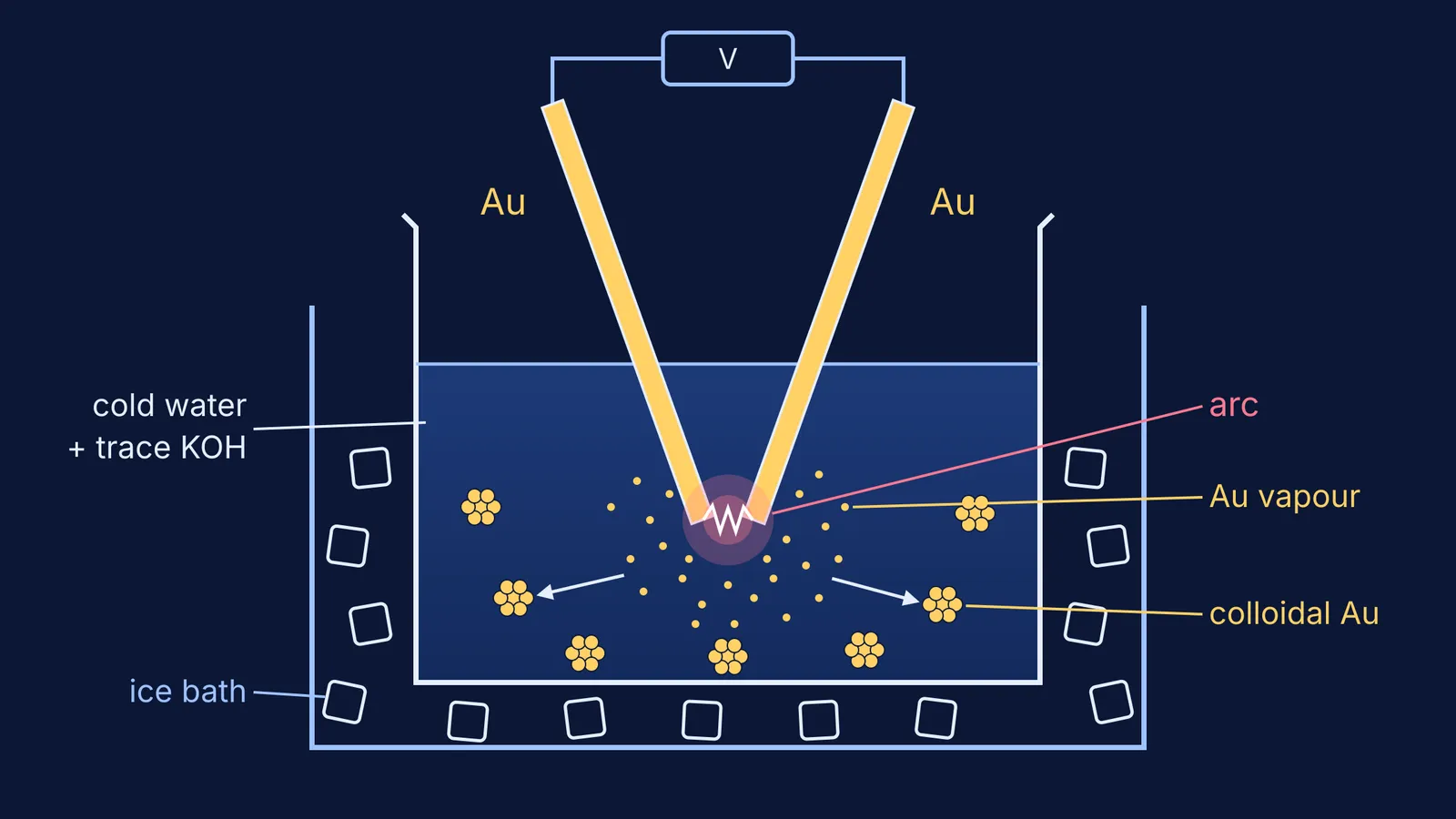
The standard description of Bredig's arc method runs in four steps:
Two gold electrodes are dipped in water that contains a trace of potassium hydroxide as a stabiliser, and the vessel is kept cold in an ice bath.
The electrode tips are brought close together and an electric arc is struck between them.
The intense heat of the arc vaporises a little of the gold at the tips.
The gold vapour meets cold water, cools at once and condenses into particles of colloidal size, which stay dispersed as a gold sol.
The same source notes that the method does not suit organic liquids as the medium, because considerable charring occurs.
Georg Bredig invented and refined the technique between 1898 and 1900 at the University of Leipzig, under Wilhelm Ostwald, to make colloidal metals for use as catalysts, according to the Science History Institute.
Why is Bredig's arc both dispersion and condensation?
A dispersion method breaks large particles down to colloidal size, while a condensation (aggregation) method builds colloidal particles up from smaller ones, as this summary of colloid preparation methods puts it.
Bredig's arc does both. It starts with a bulk metal rod and tears metal off it, which is dispersion. But the particles in the final sol are not chips of the rod: they grow from metal atoms in the vapour as it cools, which is condensation.
Modern arc-discharge methods use the same principle. In a 2022 RSC Advances study, Jankowski and colleagues struck an alternating-current arc between gold wires 2 mm thick in distilled water. Their particles averaged 5.7 nm after a two-minute discharge and 8.4 nm after five minutes, while the water warmed to about 56 °C and 67 °C. The authors note that physical methods like this give stable colloids despite the absence of organic stabilisers.
How is Bredig's arc different from hydrolysis and other chemical methods?
Chemical methods start with a dissolved salt. A reaction makes an insoluble product, and if conditions are right the product forms as colloidal particles instead of a precipitate.
Hydrolysis is the textbook example. When concentrated ferric chloride solution is added to hot water, FeCl3 + 3H2O → Fe(OH)3 + 3HCl, and colloidal iron oxide particles give the liquid a cherry-red colour, as the IIIT Hyderabad virtual lab on preparing sols describes. You may meet this sol again in the lyophilic and lyophobic sol practical.
Gold can be made chemically too, by reduction. In the Turkevich method, a solution of chloroauric acid (HAuCl4) is brought to the boil and trisodium citrate is added quickly; the citrate reduces the gold and also stabilises the particles. A 2020 study in KONA used it to make gold particles of 15 to 30 nm and reported that sizes from 10 to 150 nm can be reached by lowering the citrate-to-gold ratio from 4 to 0.5.
Here is how the two routes compare:
Starting material: Bredig's arc uses a solid metal; hydrolysis and reduction use a dissolved salt.
What makes the particles: the heat of the arc, then cooling; versus a chemical reaction in solution.
What else ends up in the sol: a trace of KOH in the arc method; reaction by-products such as HCl in hydrolysis.
Typical products: metal sols such as gold, silver and platinum; versus hydroxide sols by hydrolysis and metal sols by reduction.
Sol particles carry charge, and why added ions can make them clump is covered in our piece on the Hardy-Schulze rule.
How should you write this in an exam?
For a three-mark question on preparing gold sol, this answer covers the usual points:
Name it: electrical disintegration, or Bredig's arc method.
Set-up: two gold electrodes in water with a trace of KOH, cooled in an ice bath.
Process: an arc is struck; its heat vaporises the metal; the vapour condenses in cold water into colloidal particles.
Classify it: the method involves both dispersion and condensation.
Before you finish, check that you have:
written "vaporises" and "condenses", not "melts" and "dissolves"
named the stabiliser (KOH) and the cooling (ice bath)
not called hydrolysis a dispersion method; it builds particles up, so it is condensation
If the dispersion and condensation methods still blur together, the Fermi Concept Library gives each chemistry concept its own lesson and shows where it sits in the map. To practise, the Fermi Problem Library has worked problems with a step-by-step solver that explains the reasoning rather than printing an answer.