

On this page
A lyophobic sol stays dispersed because its particles carry the same charge and push each other away. Add enough salt and they clump and settle. Two scientists showed that the charge of one ion matters enormously.
What is the Hardy-Schulze rule?
The Hardy-Schulze rule says that a colloid is coagulated by the ion carrying charge opposite to its particles, and that this ion's coagulating power rises very steeply with the size of its charge.
Hans Schulze published his study of arsenic sulphide in water, "Schwefelarsen in wässriger Lösung", in the Journal für praktische Chemie in 1882 (DOI record). According to J. Theodoor G. Overbeek's historical review The rule of Schulze and Hardy (Pure and Applied Chemistry, 1980), Schulze found that the coagulating power of salts on arsenic sulphide and other sols increased very strongly with the charge of the cations.
William Bate Hardy, of Gonville and Caius College, Cambridge, published A preliminary investigation of the conditions which determine the stability of irreversible hydrosols in the Proceedings of the Royal Society of London in 1900. Overbeek credits Hardy with widening the statement to positively charged particles, where the anion's charge matters, and with putting a number on it: the coagulating concentrations of ions with charge 1, 2 and 3 fall in the ratio 1 : x : x², with x about 1/30 to 1/40.
The critical coagulation concentration is the electrolyte concentration above which a dispersion is destabilised by rapid particle aggregation (Galli and colleagues, arXiv). Coagulating power runs the other way: the less of an ion you need, the more powerful it is.
Why does a higher charge coagulate so much more strongly?
The explanation came decades later from DLVO theory, named after Derjaguin, Landau, Verwey and Overbeek, as Overbeek's 1980 review describes. Two particles feel a van der Waals attraction and a repulsion from their overlapping electric double layers. More ions, or ions of higher charge, shorten the reach of that repulsion and lower the energy barrier. Once the barrier is small compared with thermal energy, particles that meet stick.
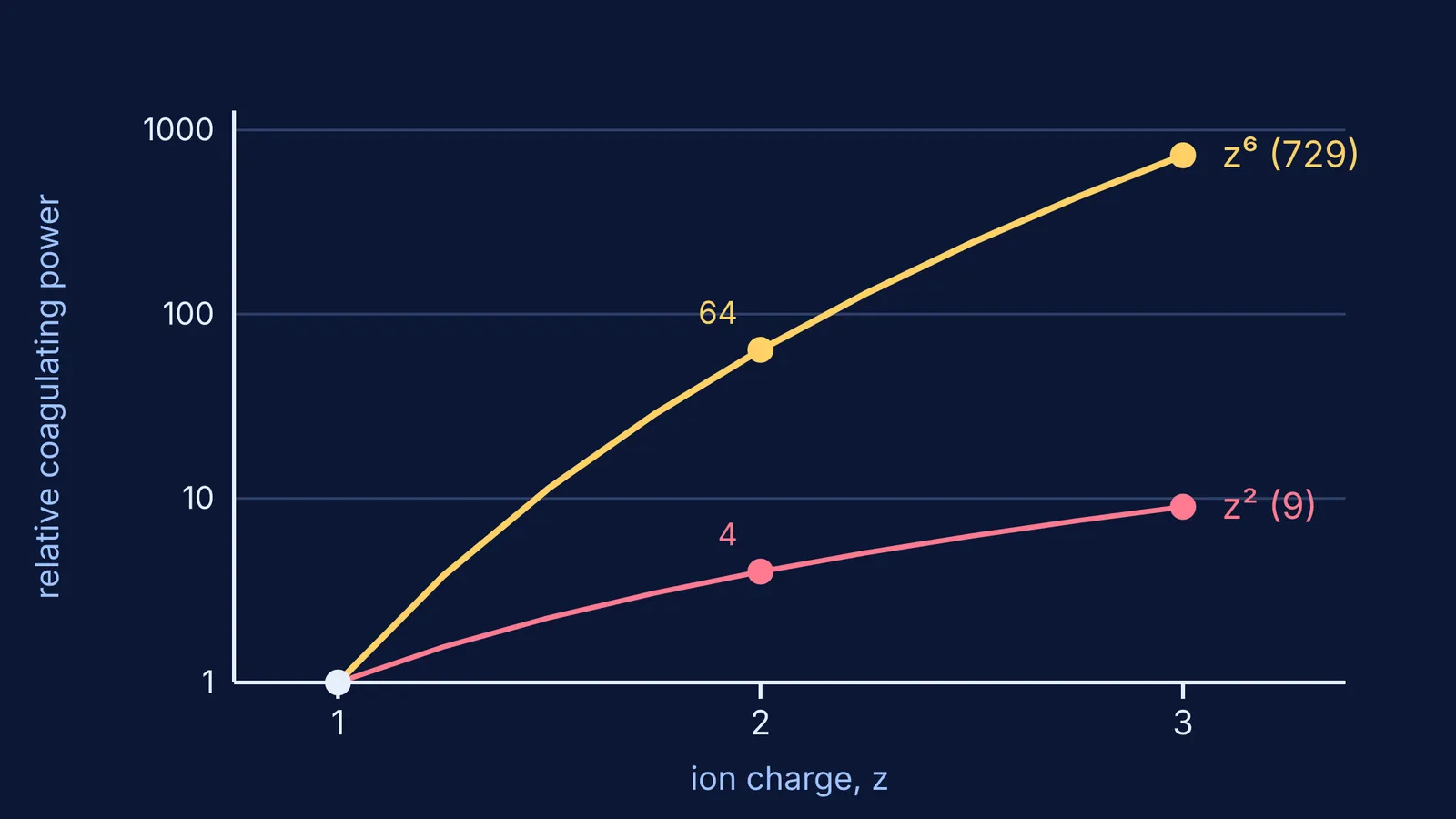
At high surface potential this theory gives c × z⁶ = constant, so the coagulating concentrations for ions of charge 1, 2 and 3 should be in the ratio 1 : 1/64 : 1/729 (Overbeek, 1980). At low surface potential the same review gives 1 : 1/4 : 1/9, an inverse-square rule. Overbeek himself argues that real surface potentials are usually too low for the z⁶ limit. He lists typical coagulation concentrations of 10 to 200 mM for monovalent ions, 0.2 to 2 mM for divalent ions and 0.1 mM or less for trivalent ions.
How do you rank electrolytes using the Hardy-Schulze rule?
Use four steps:
Find the sign of the charge on the colloid particles.
In each electrolyte, pick out the counter-ion, the one with the opposite sign.
Rank by the counter-ion's charge: higher charge means greater coagulating power and a smaller coagulating concentration.
If two counter-ions have the same charge, the rule alone cannot separate them, so do not guess.
Worked example 1: a negative sol. Schulze's arsenic sulphide sol was coagulated by cations, so its particles are negative. Compare NaCl, BaCl₂ and AlCl₃. The counter-ions are Na⁺, Ba²⁺ and Al³⁺, so the coagulating power is AlCl₃ > BaCl₂ > NaCl.
Now put numbers on it. Suppose 50 mM NaCl just coagulates the sol. The ideal z⁶ ratio from Overbeek predicts about 50 ÷ 64 ≈ 0.78 mM for BaCl₂ and 50 ÷ 729 ≈ 0.069 mM for AlCl₃. Both sit inside his typical ranges, though real sols rarely reach the ideal ratio exactly.
Worked example 2: a positive sol, the case Hardy added. Compare NaCl, Na₂SO₄ and Na₃PO₄. Na⁺ has the same sign as the particles, so it does not decide the order. The counter-ions are Cl⁻, SO₄²⁻ and PO₄³⁻, so the order is Na₃PO₄ > Na₂SO₄ > NaCl.
Is the Hardy-Schulze rule still in the Class 12 syllabus?
In the CBSE Chemistry curriculum for 2025-26, the Class XII theory paper has ten units, from Solutions to Biomolecules, and none of them is surface chemistry. The practical syllabus still opens with Surface Chemistry: preparing one lyophilic and one lyophobic sol, with arsenous sulphide, ferric hydroxide and aluminium hydroxide listed as lyophobic examples, and dialysing the sol you made.
So a CBSE student may meet Schulze's sol at the lab bench rather than in the theory paper. Other boards and exams differ, so check your current official syllabus.
Where can you read more about colloids?
Read how John Tyndall used a light beam to show a colloid is there, how Richard Zsigmondy's ultramicroscope counted gold particles, and how J. C. Ghosh explained strong electrolytes in solution.
If double layers and counter-ions still feel fuzzy, the Fermi Concept Library gives every concept in chemistry its own lesson and its place in the map, so you can see what colloid stability builds on. For practice, the Fermi Problem Library has worked problems with a step-by-step solver that explains the reasoning rather than printing an answer.
Find the particle's charge first, then let the counter-ion's charge do the work.


