On this page
The colloids practical asks you to make two sols: a lyophilic one such as starch or egg albumin, and a lyophobic one such as ferric hydroxide. One forms by mixing the substance into water; the other only if you add ferric chloride solution to boiling water, a drop at a time. Here is NCERT's procedure, what to record, and the reasoning the viva asks for.
Is the sol experiment still in the Class 12 chemistry practical?
Yes, in CBSE's 2026-27 Class XII chemistry curriculum. Its practical syllabus opens with "Preparation of one lyophilic and one lyophobic sol": starch, egg albumin and gum, and aluminium hydroxide, ferric hydroxide and arsenous sulphide, followed by dialysis of that sol (CBSE Chemistry curriculum 2026-27). The practical exam carries 30 marks, 6 of them for a content-based experiment. Syllabi change, so check the current one on CBSE Academic.
What is the difference between a lyophilic and a lyophobic sol?
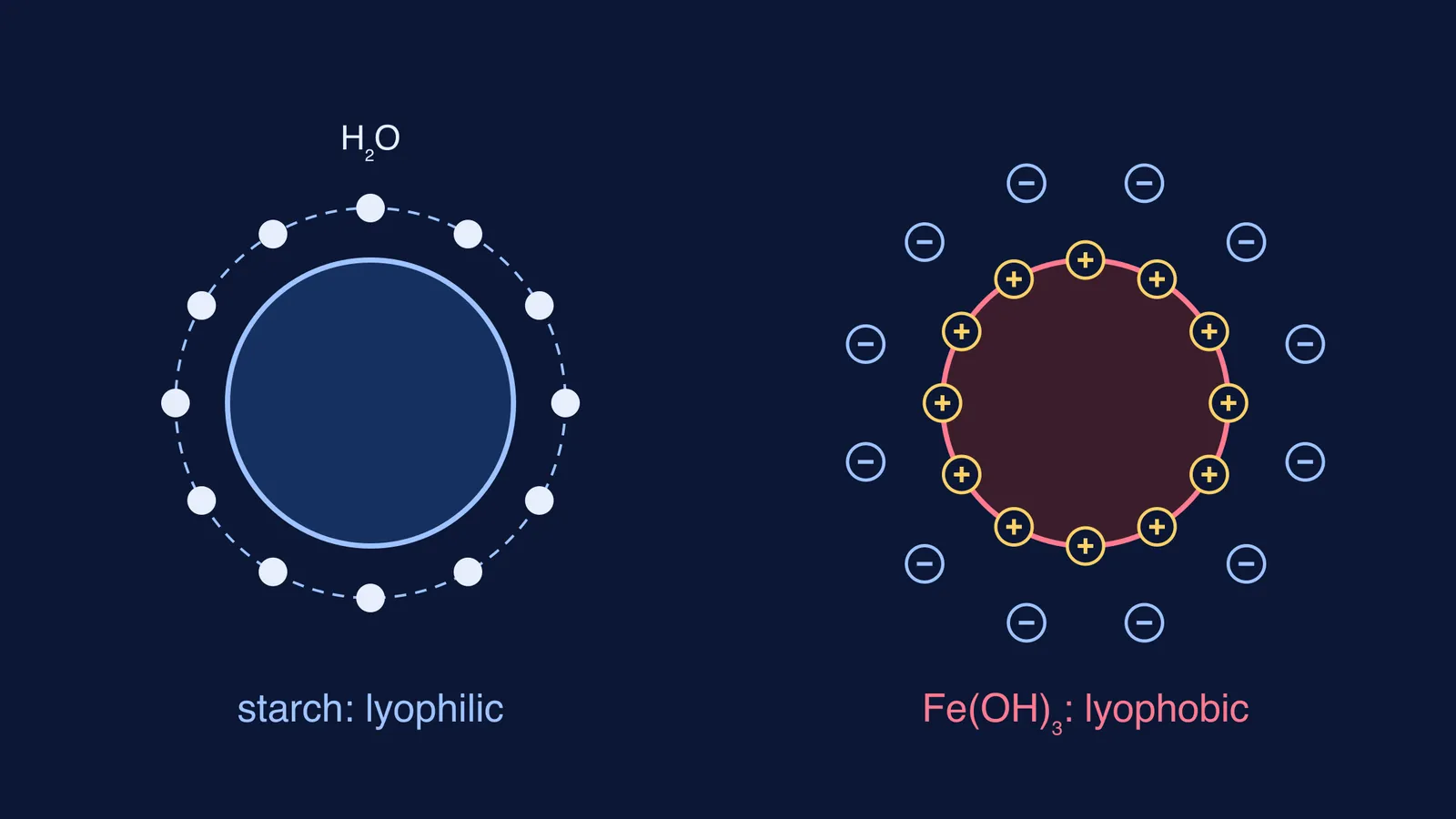
A sol is a colloid in which a solid is dispersed in a liquid, and colloidal particles are 10⁻⁹ to 10⁻⁶ m across: larger than simple molecules, small enough to stay suspended (NCERT Laboratory Manual, Chemistry Class XII, Unit 1). Lyophilic means solvent attracting and lyophobic means solvent repelling.
That difference decides the method. In NCERT's words, the stability of lyophilic sols is "primarily due to the solvation of colloidal particles by the solvent whereas lyophobic sols are stabilised by the charge on the colloidal particles." So a lyophilic sol forms by simple mixing; a lyophobic sol needs a special method.
How do you prepare starch sol and egg albumin sol?
The quantities below are from Experiment 1.1 of the NCERT lab manual. For starch (or gum) sol:
Boil 100 mL of distilled water in a 250 mL beaker.
Make a paste of 500 mg of starch in hot water.
Pour the paste into the boiling water with constant stirring.
Keep boiling and stirring for 10 minutes, then compare the sol with the paste you started from.
For egg albumin sol:
Prepare 100 mL of 5% (w/v) sodium chloride solution in a 250 mL beaker.
Break an egg into a porcelain dish and pipette out the albumin (the white).
Pour it into the salt solution and stir well.
NCERT's precaution for starch, gum and ferric chloride: pour the paste or solution gradually into the boiling water with constant stirring, because adding too much may cause precipitation.
How do you prepare ferric hydroxide sol?
From the same NCERT experiment:
Boil 100 mL of distilled water in a 250 mL beaker, add 2 g of ferric chloride and stir well.
Boil 100 mL of distilled water in a second 250 mL beaker.
Pour 10 mL of the ferric chloride solution into it drop by drop, stirring all the time.
Keep the water boiling until a brown sol forms.
In boiling water ferric chloride hydrolyses: FeCl₃ + 3H₂O → Fe(OH)₃ + 3HCl. NCERT notes that ferric chloride added to excess hot water gives a positively charged sol, and added to sodium hydroxide solution a negatively charged one. The viva explanation: the particles carry the same charge, so they repel one another and, as NCERT puts it, stay suspended without coagulating.
Ions of opposite charge can undo this: when they neutralise a particle's charged outer layer, the particles aggregate and precipitate (LibreTexts, Colloids/13%3A_Properties_of_Solutions/13.06%3A_Colloids)).
What should you write under Observations?
Record what you actually saw:
Starch sol: compare it with the paste you started from, as NCERT suggests.
Ferric hydroxide sol: note the colour change as the drops go in; NCERT's endpoint is a brown sol.
Optional, with your teacher's permission: shine a torch through each sol and through salt solution. Colloid particles scatter a light beam, the Tyndall effect; a solution's particles do not (LibreTexts, Colloids/13%3A_Properties_of_Solutions/13.06%3A_Colloids)).
Result: "A lyophilic sol of starch and a lyophobic sol of ferric hydroxide were prepared."
Which viva questions come up, and how do you answer them?
These five draw on the theory and discussion questions in the NCERT manual.
Why can starch sol be made by stirring? Starch attracts water, and the water around each particle keeps the sol stable.
Why not ferric hydroxide sol? Its particles repel the solvent; the sol forms by hydrolysis and stays stable through charge.
Why is your ferric hydroxide sol positive? It was made in excess hot water; made in sodium hydroxide, it would be negative.
Why drop by drop? Adding ferric chloride in excess may cause precipitation.
How would you purify the sol? By dialysis (Experiment 1.2): in a parchment bag hung in distilled water, changing the water every half hour until tests show no sodium or chloride ions.
If charge on a colloid feels like a rule you are memorising, the Fermi Concept Library has its own lesson for every concept in chemistry, so you can trace charge and coagulation to the ideas underneath. For written questions, the Fermi Problem Library has worked problems with a step-by-step solver that explains the reasoning rather than printing an answer.
Before your practical, read Unit 1 of the NCERT manual once, then write the five viva answers from memory.