

On this page
Order and molecularity both seem to count reactants, so they are easy to mix up in board and JEE answers. Order tells you how the rate changes when you change a concentration. Molecularity tells you how many particles meet in one collision. Keep those two questions apart.
What is the order of a reaction?
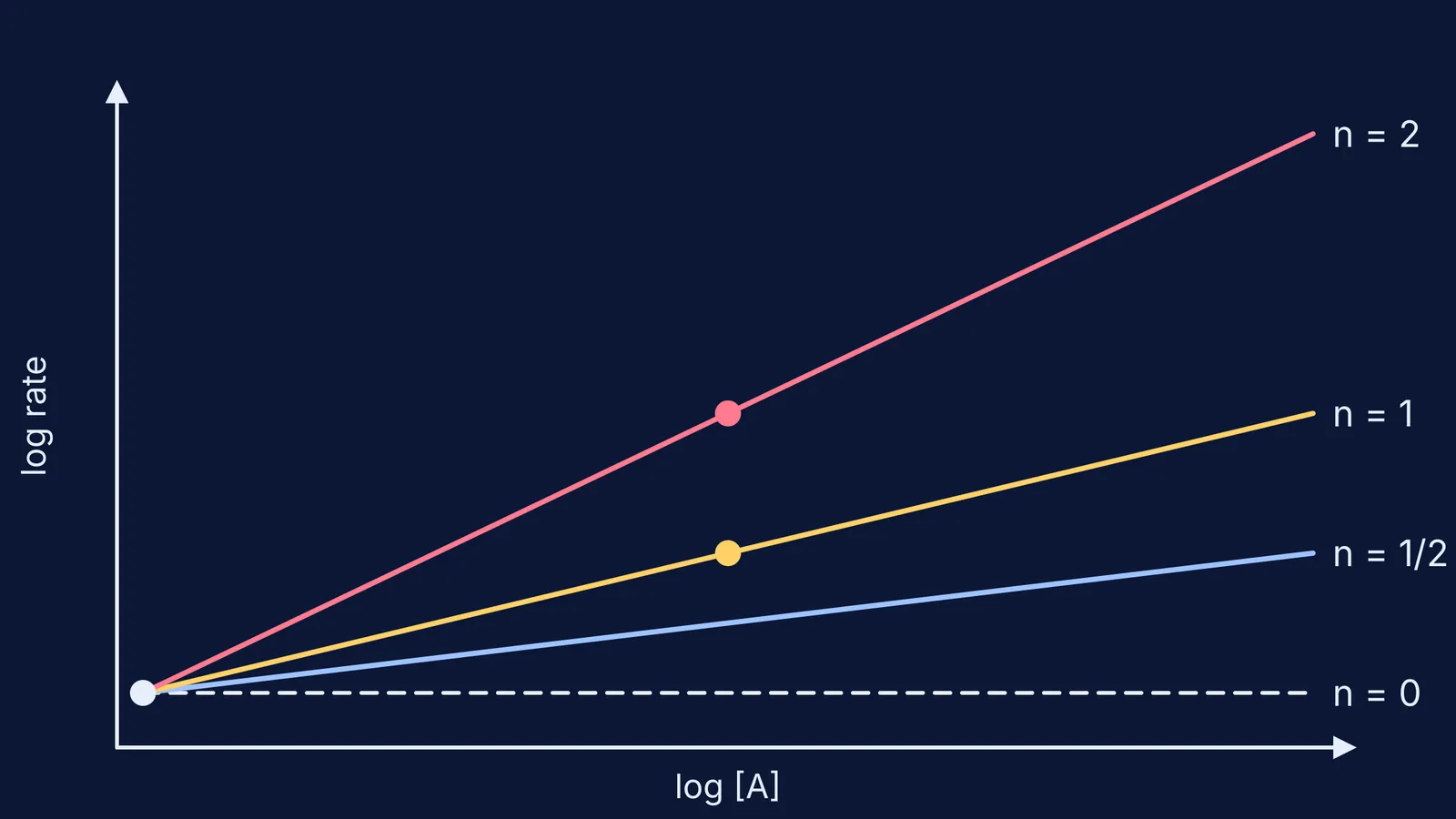
The NCERT Class 12 chapter on chemical kinetics defines order as the sum of the powers of the concentration of the reactants in the rate law expression (NCERT Chemistry Part I, Unit 3). The same chapter says the rate law cannot be predicted from the balanced equation and must be determined experimentally.
For 2NO + O2 → 2NO2, NCERT's Table 3.2 shows that doubling [NO] at fixed [O2] raises the initial rate four times, from 0.096 to 0.384 mol L⁻¹ s⁻¹, while doubling [O2] at fixed [NO] only doubles it (NCERT). So rate = k[NO]²[O2], second order in NO, first order in O2 and third order overall. Unsure what k means? See the difference between rate of reaction and rate constant.
What is molecularity?
NCERT defines molecularity as the number of reacting species (atoms, ions or molecules) taking part in an elementary reaction, which must collide simultaneously to bring about the reaction (NCERT). Its examples:
Unimolecular: NH4NO2 → N2 + 2H2O
Bimolecular: 2HI → H2 + I2
Termolecular: 2NO + O2 → 2NO2
Molecularity is a theoretical count, not a measurement.
What is the difference between order and molecularity of a reaction?
NCERT's conclusions boil down to three contrasts (NCERT):
Where it comes from: order is an experimental quantity; molecularity is read off an elementary step in the mechanism you propose.
What values it takes: order can be zero or even a fraction; molecularity cannot be zero or a non-integer.
Where it applies: order applies to elementary and complex reactions; molecularity applies only to elementary reactions, and for a complex reaction it has no meaning.
For a complex reaction, NCERT adds, the slowest step sets the order.
How can order be zero or a fraction?
Because order is measured, it reports whatever the rate actually does. Examples from NCERT (Unit 3):
Zero order: ammonia decomposing on a hot platinum surface at high pressure. The surface is saturated with gas molecules, so adding more ammonia does not change the rate: rate = k. Our post on zero-order reactions, their graph and half-life goes further.
Fractional order: CHCl3 + Cl2 → CCl4 + HCl has rate = k[CHCl3][Cl2]^1/2, so the overall order is 1.5.
An exponent of zero for a reactant: in the hydrolysis of ethyl acetate, NCERT lists rate = k[CH3COOC2H5]¹[H2O]⁰. Later it explains why: the reaction is really second order, but water is in such large excess that its concentration barely changes, so it behaves as pseudo first order.
A fractional order can never come from one elementary step, since half a molecule cannot collide.
Why does molecularity rarely exceed three?
NCERT notes that the probability of more than three molecules colliding and reacting simultaneously is very small, and even termolecular reactions are very rare and slow (NCERT). LibreTexts goes further: there are no known elementary reactions involving four or more molecules (LibreTexts, Elementary Reactions/Kinetics/03%3A_Rate_Laws/3.02%3A_Reaction_Mechanisms/3.2.01%3A_Elementary_Reactions)).
NCERT's example: KClO3 + 6FeSO4 + 3H2SO4 looks tenth order but is actually second order, so it must happen in several steps.
How do you check whether a step is elementary?
Run four checks on any reaction you are given:
Is the measured order a whole number from 1 to 3? If it is 0 or 1.5, the overall equation cannot be one elementary step.
Do the exponents match the coefficients? For an elementary step they must; LibreTexts tabulates rate laws whose exponents match each step's molecularity (LibreTexts/Kinetics/03%3A_Rate_Laws/3.02%3A_Reaction_Mechanisms/3.2.01%3A_Elementary_Reactions)). 2NO + O2 passes; CHCl3 + Cl2 fails on Cl2.
Are more than three particles on the left? Then expect a multi-step mechanism.
Does the proposed mechanism add up and fit the rate law? The steps must sum to the overall equation, intermediates must cancel, and the slow step must give the measured rate law.
The iodide-catalysed decomposition 2H2O2 → 2H2O + O2, in alkaline medium, has the measured rate law rate = k[H2O2][I⁻] (NCERT). The proposed steps are:
H2O2 + I⁻ → H2O + IO⁻ (slow)
H2O2 + IO⁻ → H2O + I⁻ + O2 (fast)
Add them and IO⁻ and I⁻ cancel, leaving 2H2O2 → 2H2O + O2. NCERT calls both steps bimolecular; the slow first step is rate determining, so it predicts rate = k[H2O2][I⁻], which matches. The overall reaction has order 2; molecularity belongs to each step, not to the whole reaction. A match supports a mechanism but does not prove it.
For more practice, see our guide on finding the rate law from a reaction mechanism.
If you keep losing marks by reading orders off coefficients, the Fermi Problem Library has worked problems with a step-by-step solver that explains the reasoning rather than printing an answer. If the gap is the idea of a rate law itself, the Fermi Concept Library gives each concept its own lesson and its place in the map.


