

On this page
A mechanism question either gives you elementary steps and asks for the rate law, or gives you a rate law from experiment and asks which mechanism fits. Both come down to the same three moves.
Why can you write a rate law straight from an elementary step?
An elementary reaction is one step that happens exactly as written, which is why its rate law can be read off its equation (OpenStax Chemistry 2e, section 12.6).
Unimolecular, A → products: rate = k[A]
Bimolecular, A + B → products: rate = k[A][B]
Bimolecular, 2A → products: rate = k[A]²
This works only for elementary steps. For an overall equation, the coefficients tell you nothing about the order; you need experimental data, as in finding order from initial rates.
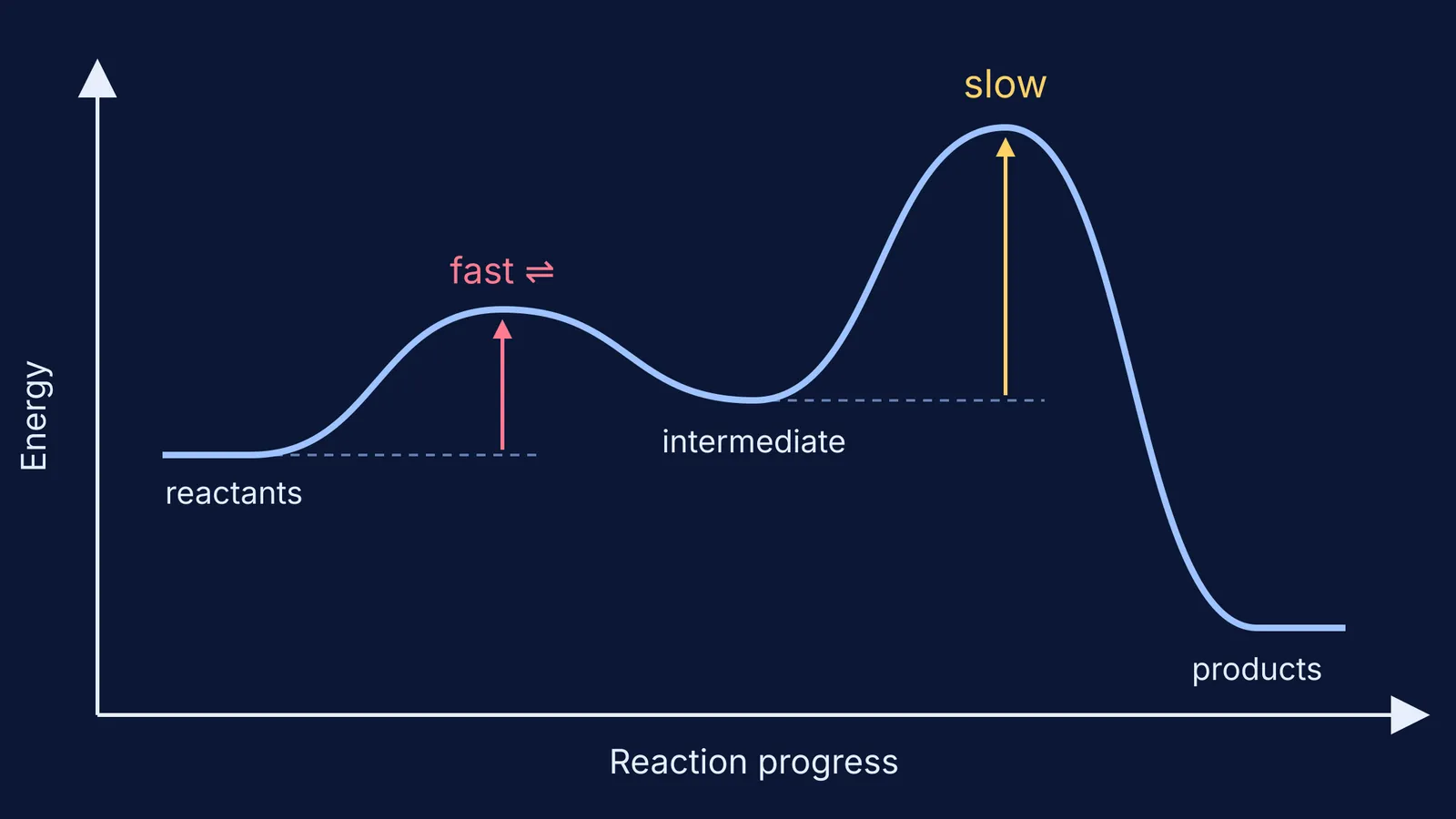
The rate-determining step is the slowest step of a reaction, and it sets the rate of the overall reaction (LibreTexts, Rate Determining Step/Kinetics/03%3A_Rate_Laws/3.02%3A_Reaction_Mechanisms/3.2.03%3A_Rate_Determining_Step)).
How do you find the rate law from a reaction mechanism?
Use this three-step method every time.
Find the slow step and write its rate law from its own equation.
Check that rate law for intermediates, species made in one step and used up in a later one. They cannot appear in the final answer, because the rate law of an overall reaction is not written in terms of intermediate concentrations.
If there is an intermediate, and the steps before the slow one are fast and reversible, set forward rate equal to reverse rate for the fast step, solve for the intermediate, and substitute.
Step 3 is the pre-equilibrium approximation: it assumes the reactants and intermediate of the fast first step stay in dynamic equilibrium, which requires that step to be faster than the steps after it (LibreTexts, Pre-equilibrium Approximation/Kinetics/03%3A_Rate_Laws/3.02%3A_Reaction_Mechanisms/3.2.02%3A_Pre-equilibrium_Approximation)).
Worked example: 2NO + Cl2 → 2NOCl
This two-step mechanism is proposed in OpenStax Chemistry 2e, section 12.6:
Step 1 (fast, reversible): NO + Cl2 ⇌ NOCl2
Step 2 (slow): NOCl2 + NO → 2NOCl
Move 1. The slow step is bimolecular, so rate = k2[NOCl2][NO].
Move 2. NOCl2 is made in step 1 and used in step 2, so it is an intermediate. It has to go.
Move 3. Step 1 is at equilibrium, so its forward and reverse rates are equal: k1[NO][Cl2] = k−1[NOCl2]. Solving gives [NOCl2] = (k1/k−1)[NO][Cl2].
Substitute into the slow-step law: rate = k2(k1/k−1)[NO][Cl2][NO] = k[NO]²[Cl2], where k = k1k2/k−1.
The answer is second order in NO, first order in Cl2 and third order overall, and the observed k combines three constants.
How do you check whether a mechanism matches the rate data?
Run the three moves on each proposed mechanism and compare its predicted rate law with the experimental one. A mechanism that predicts the wrong rate law is ruled out. A mechanism that predicts the right one is a reasonable candidate, which is the word OpenStax uses for a match, not a proof.
A good test case is NO2 + CO → NO + CO2. If it happened in one step, the rate would be k[NO2][CO]. But below 225 °C, experiment gives rate = k[NO2]², and a two-step mechanism fits: NO2 + NO2 → NO3 + NO (slow), then NO3 + CO → NO2 + CO2 (fast) (OpenStax, section 12.6). CO enters only after the slow step, so it is missing from the rate law.
Sometimes two mechanisms predict the same law. A single termolecular step, 2NO + Cl2 → 2NOCl, would also give k[NO]²[Cl2], so the rate law alone cannot choose between them. Termolecular steps are uncommon, because three particles colliding at once is less than one thousandth as likely as two colliding, yet OpenStax lists this reaction as one that appears to involve termolecular steps (OpenStax, section 12.6).
Use this quick checklist for a match-the-mechanism question:
Do the steps add up to the overall equation, with intermediates cancelling?
Is the slow step's rate law, after removing intermediates, the same as the data?
Do any species enter only after the slow step? They should be missing from the rate law.
What should you practise next?
Take five mechanism problems from your textbook exercises or past JEE Main papers and write the three moves as labelled lines, even when the answer looks obvious. Then learn how orders show up in data with integrated rate law graphs.
If you keep landing on an answer with an intermediate still in it, the Fermi Problem Library has worked problems with a step-by-step solver that explains the reasoning rather than printing an answer, so you can see which move you skipped. If the fuzzy part is equilibrium constants themselves, the Fermi Concept Library gives each concept in chemistry its own lesson.


