On this page
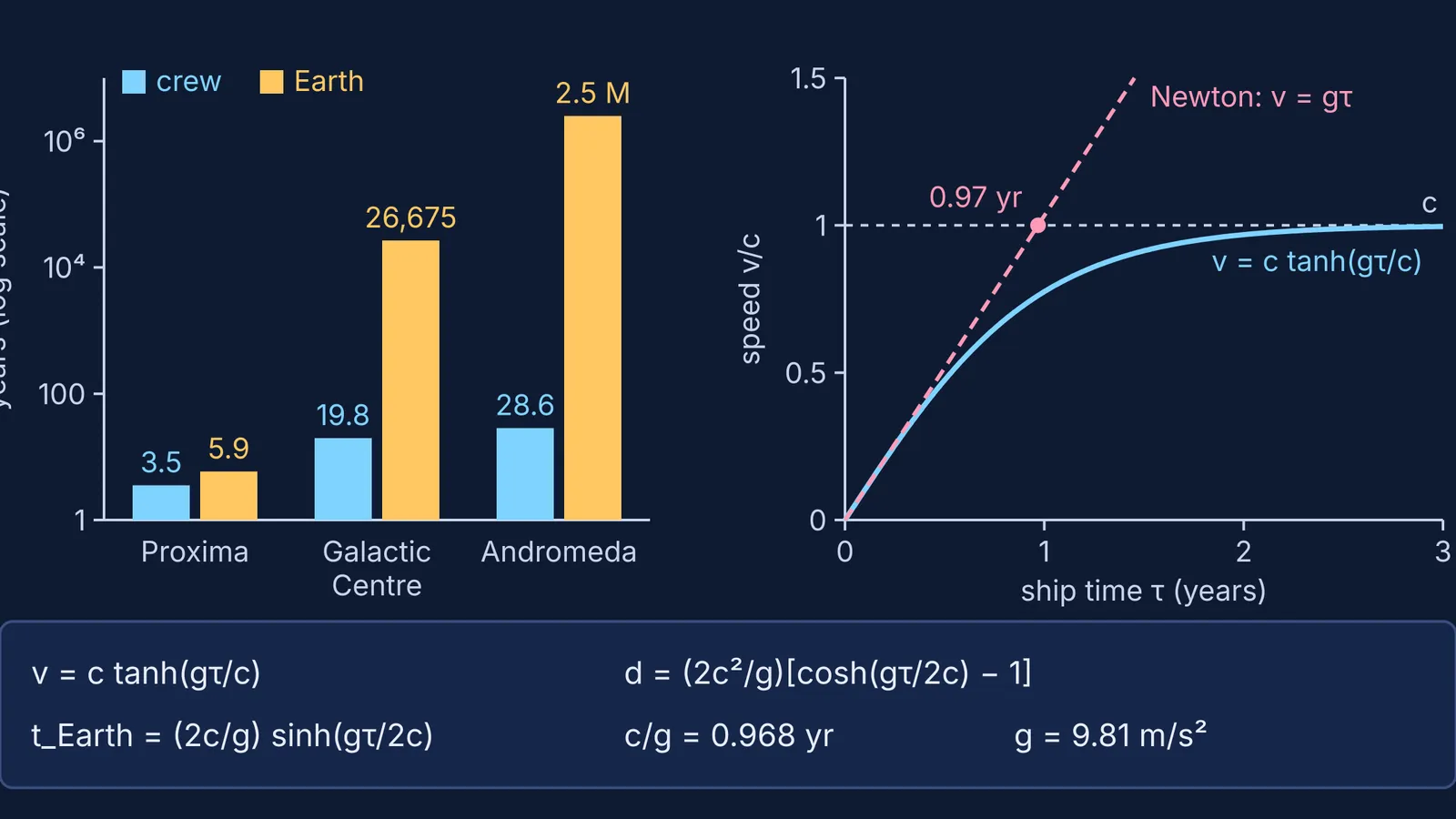
Imagine a spaceship whose engine pushes just hard enough that the crew feel their normal weight, 1 g, the whole way. It speeds up for the first half of the trip, turns round and slows down for the second half. Special relativity says the crew could reach the nearest star in about 3.5 years of their own time, the centre of our galaxy in about 20 years, and the Andromeda galaxy in under 29 years. Meanwhile 26,675 years or 2.5 million years pass on Earth. This post shows where those numbers come from and why Newton's formulas give nonsense here.
The formulas in this post are beyond the NCERT syllabus and are not needed for JEE Main or NEET. Treat them as results to explore, not as exam material.
What does accelerating at 1 g mean in relativity?
"1 g" here is the acceleration the crew feel. An accelerometer on board reads 9.81 m/s² at every moment, and a person standing on the floor weighs what they weigh on Earth. Physicists call this constant proper acceleration.
It is not dv/dt measured from Earth. As the ship's speed approaches c, the acceleration that Earth measures falls towards zero, by a factor of γ³ when the push is along the motion. The crew keep feeling 1 g, but from Earth the ship gains speed more and more slowly and never reaches c.
The natural time scale is c/g = 299,792,458 ÷ 9.81 = 3.06 × 10⁷ s, which is 0.968 years. By coincidence, 1 g is very close to 1 light-year per year squared.
How does speed grow with the ship's own time?
Let τ be the time on the ship's clock, its proper time. The result, worked out in Müller, King and Adis in the American Journal of Physics, is
v = c tanh(gτ/c)
The one-line reason: in the ship's own frame, each small tick dτ adds g dτ/c to a quantity called rapidity, φ, and rapidities simply add along a line (this is velocity addition, written in a form that adds). Speed is v = c tanh φ, so φ = gτ/c. If tanh is new to you, sinh, cosh and tanh covers the functions.
Because tanh never exceeds 1, v never reaches c. After 1 year of ship time the speed is 0.775c; after 2 years, 0.968c; after 3 years, 0.996c. Newton's v = gτ would cross c at 0.968 years and keep going.
The same paper gives the distance and Earth time while accelerating from rest:
Distance covered: x = (c²/g)[cosh(gτ/c) − 1]
Time on Earth: t = (c/g) sinh(gτ/c)
Lorentz factor: γ = cosh(gτ/c)
For a trip that accelerates for the first half and decelerates for the second, each half covers d/2. So the total distance d and total ship time τ satisfy d = (2c²/g)[cosh(gτ/2c) − 1], and Earth time is (2c/g) sinh(gτ/2c).
Worked example: how long does a 1 g trip to Proxima Centauri take?
Proxima Centauri is the nearest star to the Sun. Its parallax in ESA's Gaia Data Release 3 is 768.07 milliarcseconds, which gives 1.302 parsecs, or 4.25 light-years. Take g = 9.81 m/s², c = 2.998 × 10⁸ m/s and 1 light-year = 9.461 × 10¹⁵ m.
Half distance. d/2 = 2.12 ly = 2.01 × 10¹⁶ m.
Peak Lorentz factor. At the midpoint, γ = cosh(gτ/2c) = 1 + g(d/2)/c² = 1 + 9.81 × 2.01 × 10¹⁶ ÷ (8.99 × 10¹⁶) = 3.19.
Ship time for half the trip. gτ/2c = arccosh(3.19) = 1.83. So τ/2 = 1.83 × 0.968 years = 1.77 years.
Total ship time. τ = 3.54 years. The crew age about 3.5 years.
Earth time. t = 2 × 0.968 × sinh(1.83) = 5.87 years.
Top speed. v = c tanh(1.83) = 0.950c, reached at the midpoint.
Newton's answer. With d/2 = ½gt², the trip takes 2√(d/g) = 4.06 years and the top speed is 2.09c. That is impossible, and it shows where Newton's formulas break.
Units check: g × distance ÷ c² is (m/s² × m) ÷ (m/s)², which has no units, as an argument of cosh must.
How far can you go in a human lifetime at 1 g?
The same formulas give the two longer trips. Because cosh grows exponentially, ship time grows only as the logarithm of distance once the trip is long.
Centre of the Milky Way. The GRAVITY Collaboration measured the distance to the Galactic Centre as 8,178 parsecs, about 26,670 light-years, from the orbit of the star S2 around the black hole Sgr A*. At 1 g, the crew age 19.8 years. Earth ages about 26,675 years, and the peak γ is about 13,800.
Andromeda galaxy. NASA gives its distance as 2.5 million light-years. At 1 g, the crew age 28.6 years while about 2.5 million years pass on Earth. The peak γ is about 1.3 million.
A trip to Andromeda is 590,000 times as far as Proxima, but it takes only about 8 times as much ship time. The rest is time dilation: from Earth, the ship spends most of the trip moving at just under c, and its clock runs very slowly.
Could a real rocket do this?
No. This is a calculation about spacetime, not a mission plan. Holding 1 g for years needs an enormous amount of energy. Even a perfect rocket that turned its fuel entirely into a light beam would need a starting mass many times its final mass, and the ratio grows exponentially with the rapidity reached. No known engine comes close. At γ in the thousands, each atom of interstellar gas would also strike the ship as high-energy radiation, which is a separate and serious problem.
For scale, ISRO's interplanetary missions, such as Mangalyaan, coast for most of their journey after short engine burns and reach speeds far below 1 percent of c. They are the trips we can make today; how Mangalyaan reached Mars shows the orbit maths that works at those speeds.
To explore proper time, rapidity and the Lorentz factor one idea at a time, the Fermi Concept Library covers every concept in physics. The twin paradox worked at 0.8c is the constant-speed version of this trip.
Quick checklist
1 g means the acceleration the crew feel, constant proper acceleration, not dv/dt seen from Earth.
v = c tanh(gτ/c): speed approaches c but never reaches it.
c/g = 0.968 years; 1 g is about 1 light-year per year squared.
Accelerate then decelerate: d = (2c²/g)[cosh(gτ/2c) − 1], Earth time (2c/g) sinh(gτ/2c).
Proxima Centauri at 4.25 ly: 3.54 years on board, 5.87 years on Earth, top speed 0.950c.
Galactic Centre: 19.8 years on board. Andromeda: 28.6 years.
Newton's formulas give 2.09c on the Proxima trip, which is impossible.