

On this page
Sine and cosine come from a circle. Their hyperbolic cousins, sinh and cosh, come from the exponential function, and they turn up wherever eˣ and e⁻ˣ appear together, including in a chain hanging between two hooks. Here is how to build them, the one identity you need, and the hanging chain it explains.
What are sinh and cosh?
The hyperbolic sine is sinh x = (eˣ − e⁻ˣ)/2, and the hyperbolic cosine is cosh x = (eˣ + e⁻ˣ)/2 (NIST DLMF §4.28).
So cosh is the average of eˣ and e⁻ˣ, and sinh is half their difference. Adding them gives cosh x + sinh x = eˣ, the next equation in the same DLMF section.
A few facts follow straight from the definition:
cosh 0 = 1 and sinh 0 = 0.
cosh is even, cosh(−x) = cosh x, and never less than 1, so its graph is a U.
sinh is odd, sinh(−x) = −sinh x, and takes every real value.
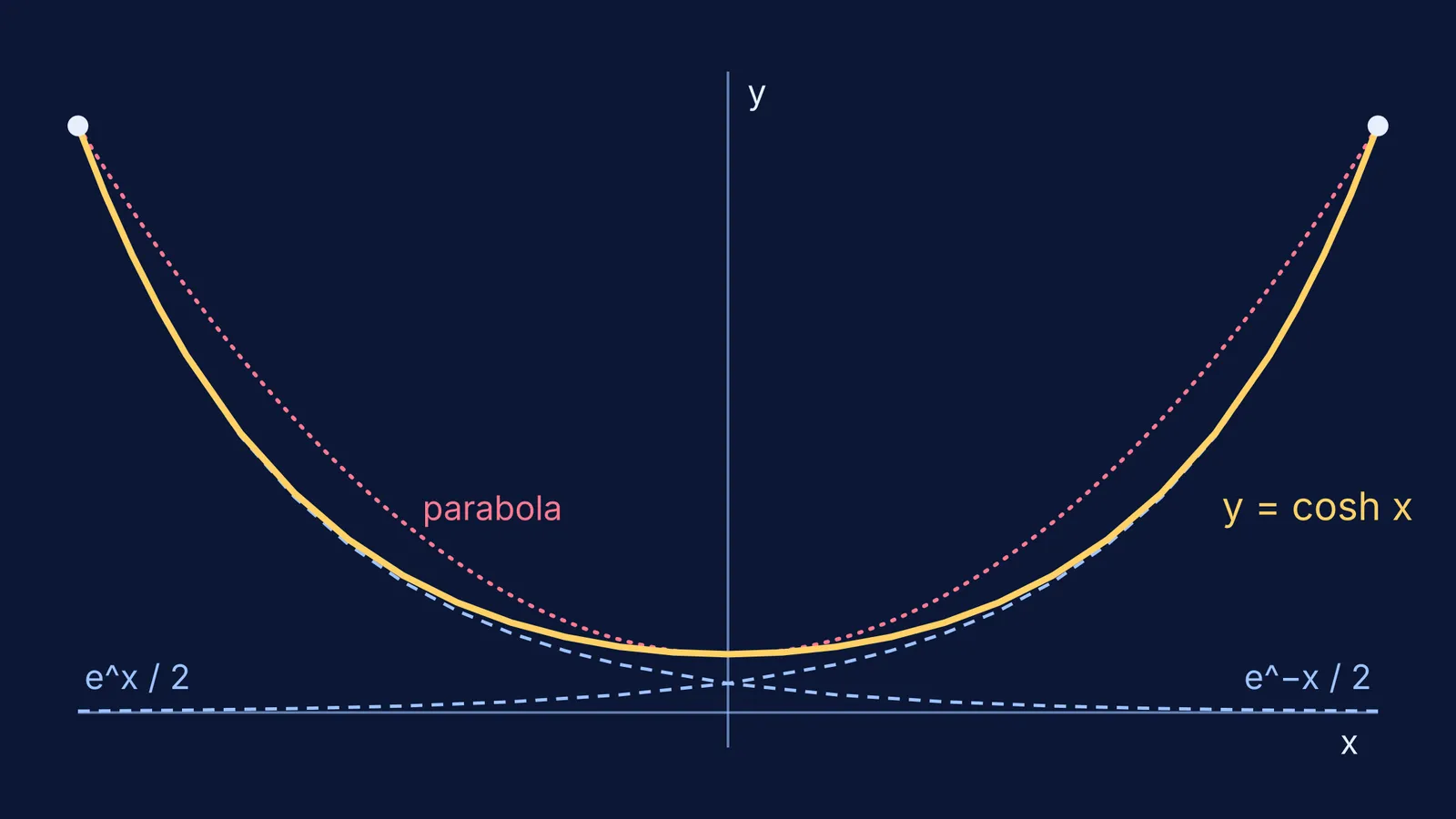
For large positive x, e⁻ˣ is tiny, so both are close to eˣ/2. In the diagram above, cosh hugs eˣ/2 on the right and e⁻ˣ/2 on the left.
For why eˣ is its own derivative, our post on why the derivative of eˣ is eˣ draws the tangents.
Why is cosh² − sinh² = 1, and why are they called hyperbolic?
The key identity is cosh²x − sinh²x = 1, equation 4.35.11 in the DLMF identities section.
The proof is one line: (cosh x + sinh x)(cosh x − sinh x) = eˣ · e⁻ˣ = 1, and the left side multiplies out to cosh²x − sinh²x.
Compare cos²t + sin²t = 1, which puts (cos t, sin t) on the circle x² + y² = 1. The minus sign changes the curve: the points (cosh t, sinh t) form the right half of the unit hyperbola x² − y² = 1 (Wikipedia: Hyperbolic functions). That is where the name comes from. The same article records that Vincenzo Riccati formally introduced the functions in 1757.
Our unit-circle explanation of why e^(iπ) = −1 tells the circular half of this story. If the hyperbola itself is hazy, start with why |PS − PS′| = 2a for a hyperbola.
What are the derivatives and integrals of sinh and cosh?
There is no minus sign anywhere:
d/dx sinh x = cosh x and d/dx cosh x = sinh x (DLMF §4.34).
∫ sinh x dx = cosh x + C and ∫ cosh x dx = sinh x + C (DLMF §4.40).
Differentiating (eˣ + e⁻ˣ)/2 gives (eˣ − e⁻ˣ)/2. With the chain rule, d/dx cosh(x/a) = (1/a) sinh(x/a), which the hanging chain needs.
Why does a hanging chain make a cosh curve?
In Two New Sciences (1638), Galileo wrote that a hanging cord is only approximately a parabola, and Joachim Jungius proved it is not one in work published in 1669 (Wikipedia: Catenary). In 1691, Leibniz, Huygens and Johann Bernoulli found the equation in answer to a challenge from Jakob Bernoulli (MacTutor History of Mathematics). The curve is called the catenary, from the Latin catena, chain.
The derivation:
Put the lowest point on the y-axis. Let w be the weight per metre and T₀ the horizontal tension at the bottom.
The piece from the bottom to a point P, arc length s, is held by T₀ sideways, its weight ws down, and the tension T at P along the chain.
Balance: T cos θ = T₀ and T sin θ = ws, so dy/dx = tan θ = s/a, with a = T₀/w.
Differentiate, using ds/dx = √(1 + (dy/dx)²). With p = dy/dx, a dp/dx = √(1 + p²).
Try p = sinh(x/a): a dp/dx = cosh(x/a) = √(1 + sinh²(x/a)) by the identity, and p = 0 at the bottom.
Integrate: y = a cosh(x/a), choosing the constant so the lowest point sits at height a.
That is the standard catenary on MathWorld.
In the diagram, the yellow curve is this chain with a = 1 and supports at x = ±3; the pink dashed parabola passes through the same lowest point and supports. The parabola sits higher on both arms: close, but not the same shape.
Three quick checks to try
If sinh x = 3/4, find cosh x. Answer: cosh²x = 1 + 9/16 = 25/16, and cosh is positive, so cosh x = 5/4.
Solve cosh x = 5/4. Answer: with u = eˣ, 2u² − 5u + 2 = 0, so u = 2 or 1/2 and x = ±ln 2.
Integrate cosh x from 0 to ln 2. Answer: sinh(ln 2) = (2 − 1/2)/2 = 3/4.
If a step will not come out, the Fermi Problem Library has worked problems with a step-by-step solver that explains the reasoning rather than printing an answer. The Fermi Concept Library gives every concept in mathematics its own lesson and its place in the map.
Next time you see a chain between two posts, you are looking at y = a cosh(x/a).


