

On this page
Every Class 11 student meets Wöhler's 1828 result: ammonium cyanate, NH₄OCN, turns into urea, CO(NH₂)₂. In 1895 James Walker and Fred. J. Hambly of University College, Dundee asked how fast. One molecule rearranging into another should be first order. The data said second order, and their explanation, that an ammonium ion has to meet a cyanate ion, became a test of Arrhenius's ionic theory.
The paper is J. Walker and F. J. Hambly, "Transformation of Ammonium Cyanate into Urea", J. Chem. Soc. Trans. 67 (1895) 746–767 (DOI 10.1039/CT8956700746; scan on the Internet Archive). Measured numbers and quotes below come from that scan, checked against the page images. Wöhler's own paper is covered in Friedrich Wöhler's urea synthesis and what it really showed; this post is about the kinetics, and it is history, not a lab method.
How did they measure the reaction while it was running?
Liebig and Wöhler (1830) had noted that the change is gradual at a gentle heat. The trick was that silver nitrate "has no action on urea", while cyanate gives a silver salt "practically insoluble in cold water". At set times they poured a 5 c.c. sample into excess silver nitrate, filtered off the silver cyanate and titrated the leftover Ag⁺ with thiocyanate (Volhard's method).
They also found the reaction is reversible: decinormal urea at 100 °C gave back about 4.4% cyanate, so the end point at 100 °C is about 95% urea. A side reaction turned about 4% of the cyanate into ammonium carbonate, so the rate calculations used a "practical" end point of 91.6%.
Why was the reaction not first order?
For a first-order change, (1/t) log A/(A − x) stays constant, where A is the amount that can react and x the amount changed at time t. Their run at 50.1 °C gave 0.00206 at 45 minutes and 0.00101 at 600 minutes. In their words, the expression "instead of being constant, sinks steadily to half its original value."
Then they tried the second-order form, (1/t) × x/(A − x). Over the same run it stayed between 0.00502 and 0.00549, with no steady drift. They wrote: "Here, then, is distinct evidence that for the production of urea the interaction of two molecules is necessary."
Worked example 1: their constant and the half-life
For rate = k(A − x)², integration gives 1/(A − x) − 1/A = kt. Rearranged: (1/t) × x/(A − x) = kA. So their "constant" is k multiplied by the starting concentration, not k itself.
Check one row at 50.1 °C: t = 107 min, x = 8.3, A − x = 14.6. Then 8.3 ÷ (107 × 14.6) = 0.00531. The paper prints 0.00529.
At half reaction, x = A − x, so x/(A − x) = 1 and t½ = 1/(kA). That is 1 ÷ their constant.
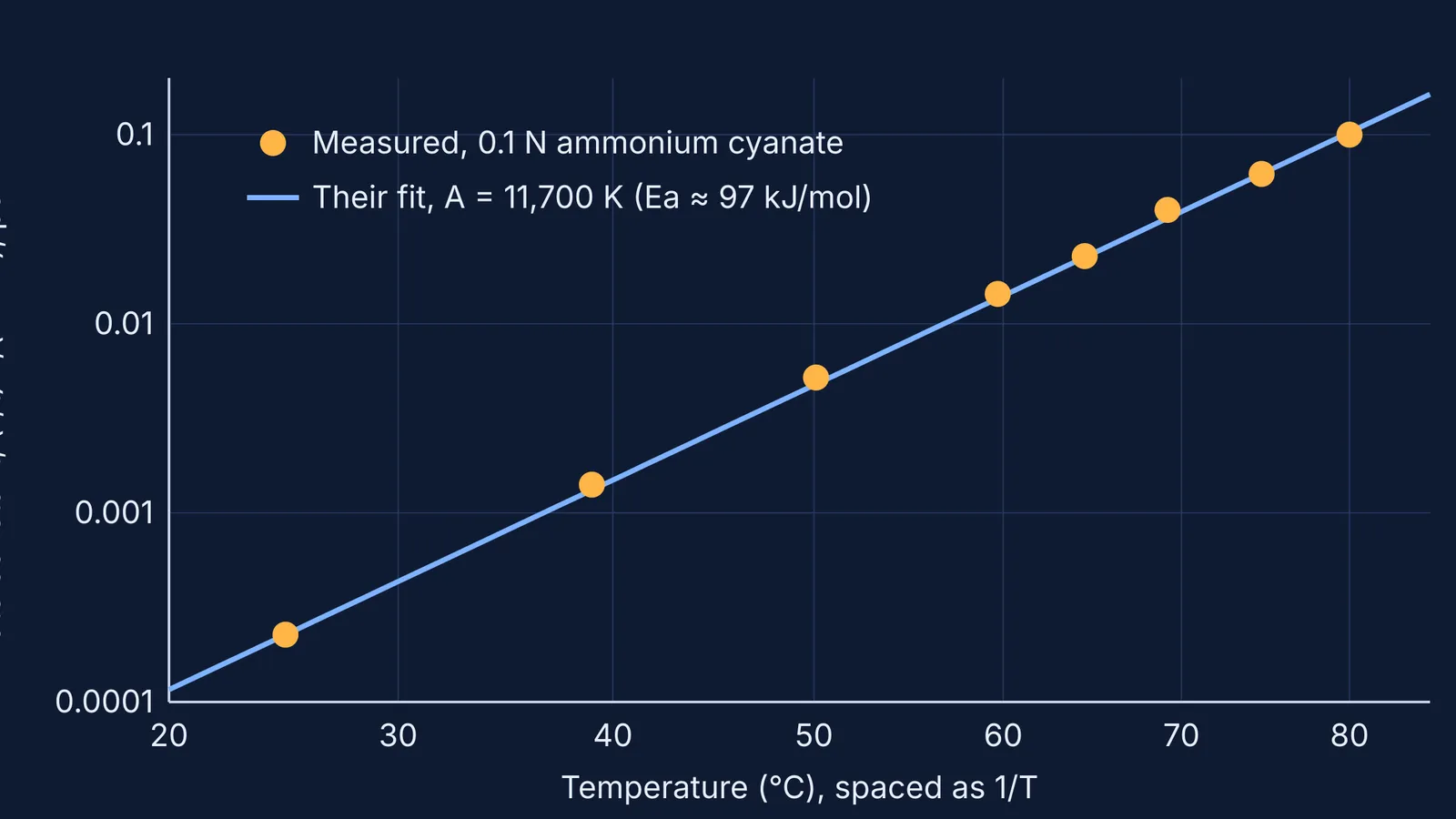
At 80 °C the constant is 0.100 min⁻¹, so t½ = 10 min. At 25 °C it is 0.000227, so t½ = 4,405 min, or 3.06 days. The paper says half is changed "in 10 or 12 minutes" at 80 ° and "three days" at 25 °.
To get k itself, divide by the concentration that can react, 0.1 × 0.916 = 0.0916 mol L⁻¹. At 80 °C, k = 0.100 ÷ 0.0916 ≈ 1.09 L mol⁻¹ min⁻¹, the units of a second-order rate constant.
What did dilution show?
If two particles must meet, halving the concentration should halve their constant and double t½. At 49.8 °C, 0.05 N cyanate gave 0.00289 against 0.00520 for 0.1 N at 50.1 °C. So t½ went from 192 to 346 minutes, 1.8 times longer, close to the predicted 2. Near 60 °C the constants for 0.05, 0.1 and 0.2 N were 0.0082, 0.0144 and 0.0255. That is 1 : 1.76 : 3.11, not the ideal 1 : 2 : 4 (the 0.1 N run was at 59.7 °C, the others at 60.1 °C). They said so: the fifth-normal constant should be four times the twentieth-normal one but is "only little more than three times as great".
Which two particles have to meet?
They listed three options: two NH₄OCN molecules, ammonia and cyanic acid formed by the action of water, or the ions NH₄⁺ and OCN⁻. To decide, they added other salts at 74.7 °C.
Potassium sulphate (no shared ion) lowered the constant slightly, from 0.062 to 0.056.
Ammonium sulphate (extra NH₄⁺) sped it up a lot. The value rose to 0.097, then 0.195, and half the cyanate was gone in 10 minutes instead of nearly 20.
Potassium cyanate (extra OCN⁻) gave an acceleration "of the same order".
Ammonia at 49.4 °C acted like an indifferent substance, because NH₃ in water gives very few NH₄⁺ ions.
In their view no other theory could explain all four, even qualitatively. Their conclusion: "the reacting molecules are ammonium ions, NH₄, and cyanic ions, CNO". This also explains the imperfect dilution ratio. A more dilute solution is more fully dissociated, so conductivity put the 0.2 N to 0.05 N ion ratio at 3.3, not 4, and 0.0082 × 3.3 = 0.0270, close to the 0.0255 found.
NH₄⁺ + OCN⁻ → CO(NH₂)₂ balances: 2 N, 4 H, 1 C, 1 O and zero charge on each side. One caution: a rate law cannot by itself prove a mechanism. A fast proton transfer, NH₄⁺ + OCN⁻ ⇌ NH₃ + HNCO, followed by NH₃ and HNCO combining, gives the same rate law, because [NH₃][HNCO] stays proportional to [NH₄⁺][OCN⁻]. This is the gap between order and molecularity.
How strongly does temperature speed it up?
Between 25.0 and 80.0 °C their constant rose from 0.000227 to 0.100, more than 400-fold. They fitted the formula of van 't Hoff and Arrhenius, which in log form reads ln(C₁/C₀) = A(T₁ − T₀)/(T₀T₁), with A = 11,700. That A is Ea/R in today's notation, so this is the two-temperature Arrhenius equation you use in Class 12.
Worked example 2: activation energy
From their fit: Ea = 11,700 K × 8.314 J mol⁻¹ K⁻¹ = 97.3 kJ mol⁻¹.
From the two end points alone: ln(0.100/0.000227) = ln 440.5 = 6.088.
1/298.15 − 1/353.15 = 5.224 × 10⁻⁴ K⁻¹.
Ea = 8.314 × 6.088 ÷ 5.224 × 10⁻⁴ = 96.9 kJ mol⁻¹.
Using kA instead of k is fine, because A was 0.1 N at every temperature and cancels in the ratio.
If this algebra trips you up, the Fermi Problem Library has a step-by-step solver that explains the reasoning at each line.
Where does this come up in JEE and NEET?
Class 12 Chemical Kinetics: the second-order integrated law, t½ and [A]₀, order vs molecularity, and Ea from two temperatures. Class 11: Wöhler's synthesis. The general half-life rule for any order is in half-life and initial concentration for any reaction order. Their paper cites the rate laws of Harcourt and Esson's 1866 permanganate work. For JEE-style practice on these numericals, Fermi Test Prep covers JEE Main and Advanced preparation with an AI tutor.
Quick checklist
1895: ammonium cyanate → urea is second order, not first.
Their constant (1/t) × x/(A − x) equals k[A]₀; t½ is its reciprocal.
Halving the concentration roughly doubled t½.
Extra NH₄⁺ or OCN⁻ sped it up; K₂SO₄ and NH₃ did not. Their meeting pair: NH₄⁺ + OCN⁻.
Ea is about 97 kJ mol⁻¹ from their data.
A rate law fits a mechanism; it does not prove one.