On this page
Dissolve potassium cyanide, sodium carbonate or sodium acetate in water and the solution turns basic. Your textbook calls this salt hydrolysis and gives you h = √(Kh/c). In 1893 John Shields put the first careful numbers on it, and he did it with a kinetics experiment: he let the salt solution saponify ethyl acetate and timed how fast it went. The paper is "Über Hydrolyse in wässerigen Salzlösungen" (On hydrolysis in aqueous salt solutions), Zeitschrift für physikalische Chemie volume 12 (1893), from page 167, reprinted from the Stockholm Academy's Bihang (supplement). We read it on the scanned pages at the Internet Archive; translations are ours. For your syllabus it is Class 11 Equilibrium (hydrolysis of salts, Kh = Kw/Ka, pH of salt solutions), measured with Class 12 kinetics.
Why is a solution of KCN basic at all?
Shields starts from the puzzle. KCN is made of equal amounts of acid and base, and when it hydrolyses, KOH and HCN still form in equal amounts. So why should the solution be alkaline rather than neutral? His answer used Arrhenius's theory of ions: KOH is far more dissociated than HCN, so its OH⁻ ions dominate. "If hydrocyanic acid were as strongly dissociated as hydrochloric acid at the same dilution, a solution of potassium cyanide would be just as neutral as a solution of potassium chloride appears to us."
He did the work at Stockholm's Högskola, at the suggestion of Svante Arrhenius, whom he thanks in the paper. For the theory he was building on, see Svante Arrhenius and the idea that salts split into ions.
How could ester saponification measure hydrolysis?
The free alkali in a KCN or soda solution is far too little to titrate directly. Shields wrote that it was generally taken to be "outside the limits of sensitivity of ordinary analysis". But OH⁻ ions saponify ethyl acetate, and they do it much faster than H⁺ ions do, so even a trace of free alkali gives a measurable rate.
The reaction is second order: rate = k[ester][OH⁻]. For KOH at 24.2 °C he took k = 6.22 from earlier work. If the salt solution saponifies the ester more slowly than KOH of the same strength would, the ratio tells you how much OH⁻ is really free. He then applied mass action to KOH + HCN ⇌ KCN + H₂O, ignoring degrees of dissociation, to get A² = K(C − A), where A is the free alkali and C the salt concentration.
He also checked that the ester itself did not upset the equilibrium. With about 0.1 M KCN and ester at 0.487, 0.2005 and 0.1013 mol per litre, he found 1.13%, 1.20% and 1.18% hydrolysed: no trend.
What did he find?
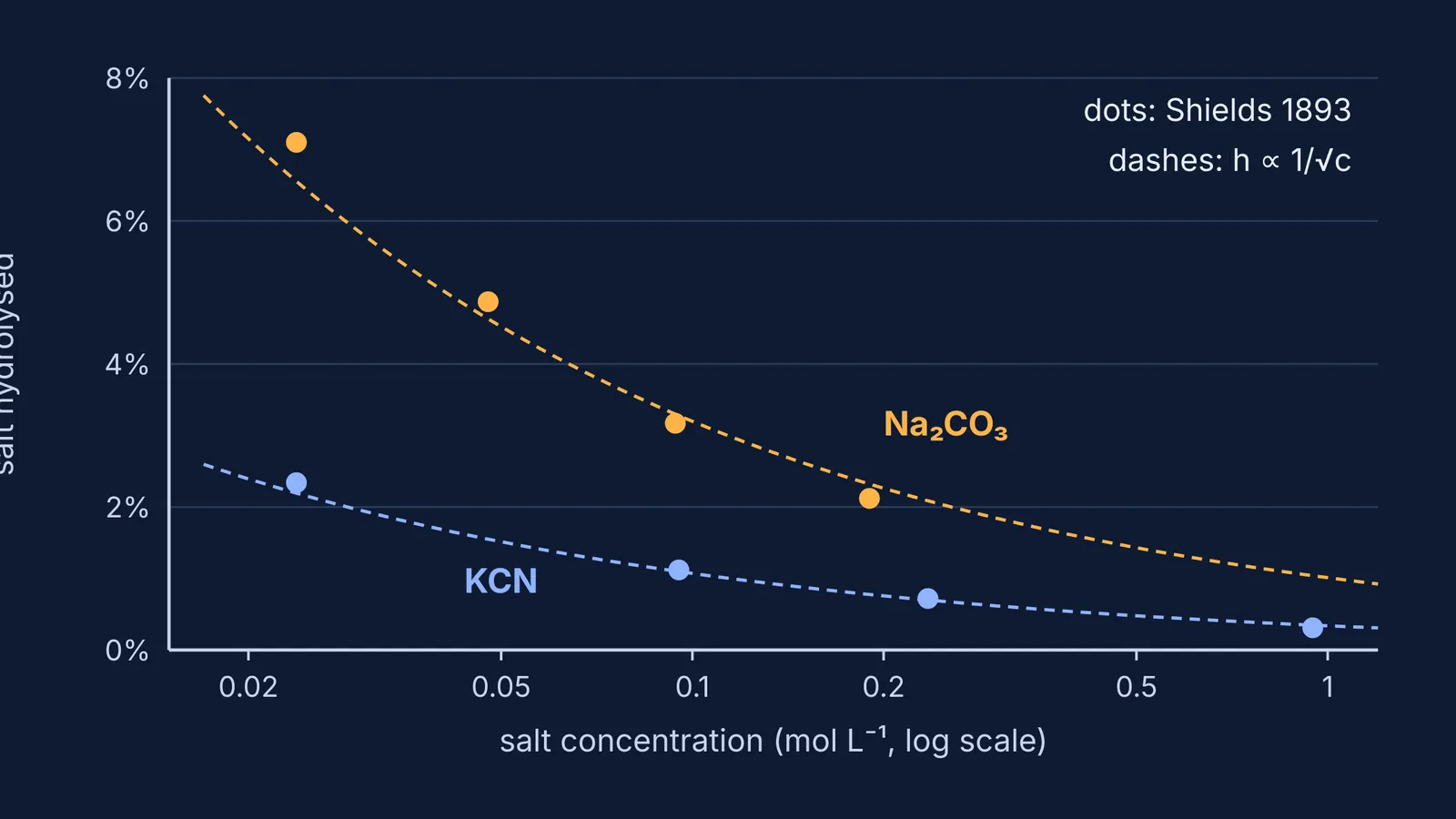
His summary table (percent of the salt hydrolysed, 24–25 °C):
KCN: 0.31% at 0.9474 M, 0.72% at 0.2348 M, 1.12% at 0.0952 M, 2.34% at 0.0238 M
Na₂CO₃: 2.12% at 0.19 M, 3.17% at 0.094 M, 4.87% at 0.0477 M, 7.10% at 0.0238 M
Potassium phenoxide, C₆H₅OK: 3.05% at 0.0962 M, 6.69% at 0.0195 M
Borax: 0.92% at 0.0293 M
Sodium acetate: 0.008% at 0.0952 M
Read down each salt and you can see the rule he drew: "the amount of free alkali present in the salt solutions is approximately proportional to the square root of the salt concentration". He derived it from mass action: when the hydrolysed part is small, A = √(KC). Divide by C and you have today's h = √(Kh/c). He also noted the rule fits more closely in dilute solution: between his two strongest KCN solutions it was off by about 13%, and between the most dilute ones by about 4%.
His numbers corrected older guesses. From heats of neutralisation, people had concluded that sodium cyanide solution was four-fifths split into acid and base; he found about 1% for 0.1 M potassium cyanide. H. Rose had said dilute borax is "almost completely" split; Shields found under 1%.
Worked example: check his sodium acetate result
Use NCERT's values: Ka(CH₃COOH) = 1.74 × 10⁻⁵ and Kw = 1.0 × 10⁻¹⁴ (both from the NCERT Class 11 Equilibrium chapter). Shields's solution was 0.0952 M.
Hydrolysis constant. CH₃COO⁻ + H₂O ⇌ CH₃COOH + OH⁻, so Kh = Kw/Ka = 1.0 × 10⁻¹⁴ / 1.74 × 10⁻⁵ = 5.7 × 10⁻¹⁰.
Degree of hydrolysis. h = √(Kh/c) = √(5.7 × 10⁻¹⁰ / 0.0952) = 7.8 × 10⁻⁵, or 0.0078%. Shields measured 0.008%.
pH. [OH⁻] = ch = 0.0952 × 7.8 × 10⁻⁵ = 7.4 × 10⁻⁶ M. pOH = 5.13, so pH = 8.87. The shortcut pH = 7 + ½(pKa + log c) = 7 + ½(4.76 − 1.02) gives the same.
Run it backwards. His free alkali, 7.98 × 10⁻⁶ M, gives Kh = A²/(c − A) = 6.7 × 10⁻¹⁰. Multiply by Ka and you get Kw ≈ 1.2 × 10⁻¹⁴. Shields did not write it this way; this is our check, and it lands close to the modern value from a rate experiment that ran for about four weeks.
The same method with NCERT's Ka values gives 1.46% for 0.0952 M KCN (he found 1.12%), 2.8% for 0.0962 M phenoxide (3.05%) and 4.3% for 0.094 M Na₂CO₃ using Ka₂ of carbonic acid (3.17%). Same size, not the same numbers. He set degrees of dissociation aside and worked at 24.2 °C, so treat his values as approximate rather than as errors to fix.
For more salt hydrolysis practice, the Fermi Problem Library has a step-by-step solver that explains the reasoning. For the full method with ammonium salts too, see how to find the pH of a salt solution from Ka and Kb.
What happened with trisodium phosphate?
Na₃PO₄ saponified the ester almost as fast as pure NaOH. Shields concluded that "at least 98%" of one sodium in 0.01905 M Na₃PO₄ was present as free NaOH, by Na₃PO₄ + H₂O → Na₂HPO₄ + NaOH, and that "one is hardly justified in saying that trisodium phosphate exists in dilute solution".
Now try the textbook formula, with NCERT's Ka₃ = 4.2 × 10⁻¹³ for phosphoric acid. Kh = 1.0 × 10⁻¹⁴ / 4.2 × 10⁻¹³ = 0.024. Then h = √(0.024/0.01905) = 1.12, or 112%, which is impossible. The approximation 1 − h ≈ 1 has broken. Solve h²c/(1 − h) = Kh properly and you get h ≈ 66%.
So modern data give about two-thirds, and Shields reported at least 98%. Do not treat this as his mistake. His 98% came from extrapolating a falling curve back to time zero, and he ignored dissociation; the gap is an open question we cannot settle here. The exam point is clear, though: check h before you trust √(Kh/c).
If you are revising hydrolysis for JEE, Fermi Test Prep covers JEE Main and Advanced preparation with an AI tutor. Borax, one of Shields's salts, has its own story in why borax solution is basic.
Quick checklist
Salts of weak acids give basic solutions because OH⁻ from water is left unpaired.
Kh = Kw/Ka; h = √(Kh/c); pH = 7 + ½(pKa + log c).
Shields measured free OH⁻ by how fast it saponified ethyl acetate (second order).
Free alkali ∝ √(salt concentration): his rule, and today's formula.
0.0952 M sodium acetate: 0.0078% calculated, 0.008% measured, pH about 8.9.
If h comes out large, use the quadratic, never the shortcut.