

On this page
When you dissolve table salt in water, the pH remains 7.00 because neither sodium nor chloride ions react with water. However, dissolving sodium acetate turns the water mildly alkaline, while ammonium chloride turns it distinctly acidic. In competitive examinations like JEE Main, JEE Advanced, and NEET-UG, salt hydrolysis questions test whether you understand equilibrium derivations rather than memorised formulas. Knowing how the hydrolysis constant Kh connects the ion-product Kw to parent dissociation constants Ka and Kb provides a clear foundation for every ionic equilibrium problem.
Why do salt solutions change pH instead of staying neutral?
Pure water autoionises into equal concentrations of hydronium and hydroxide ions according to 2 H2O ⇌ H3O⁺ + OH⁻. At 25 °C, the ion-product constant Kw equals 1.0 × 10⁻¹⁴ mol² L⁻², as documented in benchmark thermodynamic evaluations by Marshall and Franck (1981). When a soluble salt dissolves in water, it dissociates completely into hydrated cations and anions.
As outlined in NCERT Class 11 Chemistry, ions from strong acids or bases (such as Na⁺ or Cl⁻) are extremely weak Brønsted-Lowry conjugates and do not perturb the water equilibrium. In contrast, the conjugate base of a weak acid (such as CH3COO⁻) or the conjugate acid of a weak base (such as NH4⁺) reacts with water in a process termed salt hydrolysis. Anion hydrolysis generates excess OH⁻, raising solution pH above 7.00, while cation hydrolysis produces excess H3O⁺, pulling pH below 7.00.
How do you derive Kh = Kw / Ka and Kh = Kw / Kb?
Consider the anion hydrolysis of sodium acetate in water:
CH3COO⁻(aq) + H2O(l) ⇌ CH3COOH(aq) + OH⁻(aq)
The equilibrium constant is the hydrolysis constant, Kh = [CH3COOH][OH⁻] / [CH3COO⁻]. Multiplying numerator and denominator by [H3O⁺] yields:
Kh = ([CH3COOH] / ([CH3COO⁻][H3O⁺])) × ([H3O⁺][OH⁻])
Because Ka = [CH3COO⁻][H3O⁺] / [CH3COOH] for acetic acid and Kw = [H3O⁺][OH⁻], this simplifies to Kh = Kw / Ka, as shown in OpenStax Chemistry 2e Section 14.3. A smaller Ka produces a larger Kh and greater hydrolysis.
Similarly, for ammonium chloride, the ammonium cation undergoes cation hydrolysis:
NH4⁺(aq) + H2O(l) ⇌ NH3(aq) + H3O⁺(aq)
Its equilibrium expression is Kh = [NH3][H3O⁺] / [NH4⁺]. Multiplying numerator and denominator by [OH⁻] produces Kh = Kw / Kb. Our review of conjugate acid-base pairs: Ka × Kb = Kw examines why conjugate strength varies inversely with parent partner strength.
How do you calculate the pH of sodium acetate and ammonium chloride solutions?
For a 0.10 M sodium acetate solution at 25 °C, parent acetic acid has Ka = 1.8 × 10⁻⁵ (pKa ≈ 4.75), as verified in OpenStax Chemistry 2e. Computing Kh gives:
Kh = Kw / Ka = (1.0 × 10⁻¹⁴) / (1.8 × 10⁻⁵) = 5.56 × 10⁻¹⁰
If h represents the degree of hydrolysis and C = 0.10 M is initial salt concentration, equilibrium concentrations are [CH3COOH] = C × h, [OH⁻] = C × h, and [CH3COO⁻] = C × (1 − h). Because Kh is tiny, 1 − h ≈ 1, giving h = √(Kh / C) = √(5.56 × 10⁻¹⁰ / 0.10) = 7.45 × 10⁻⁵.
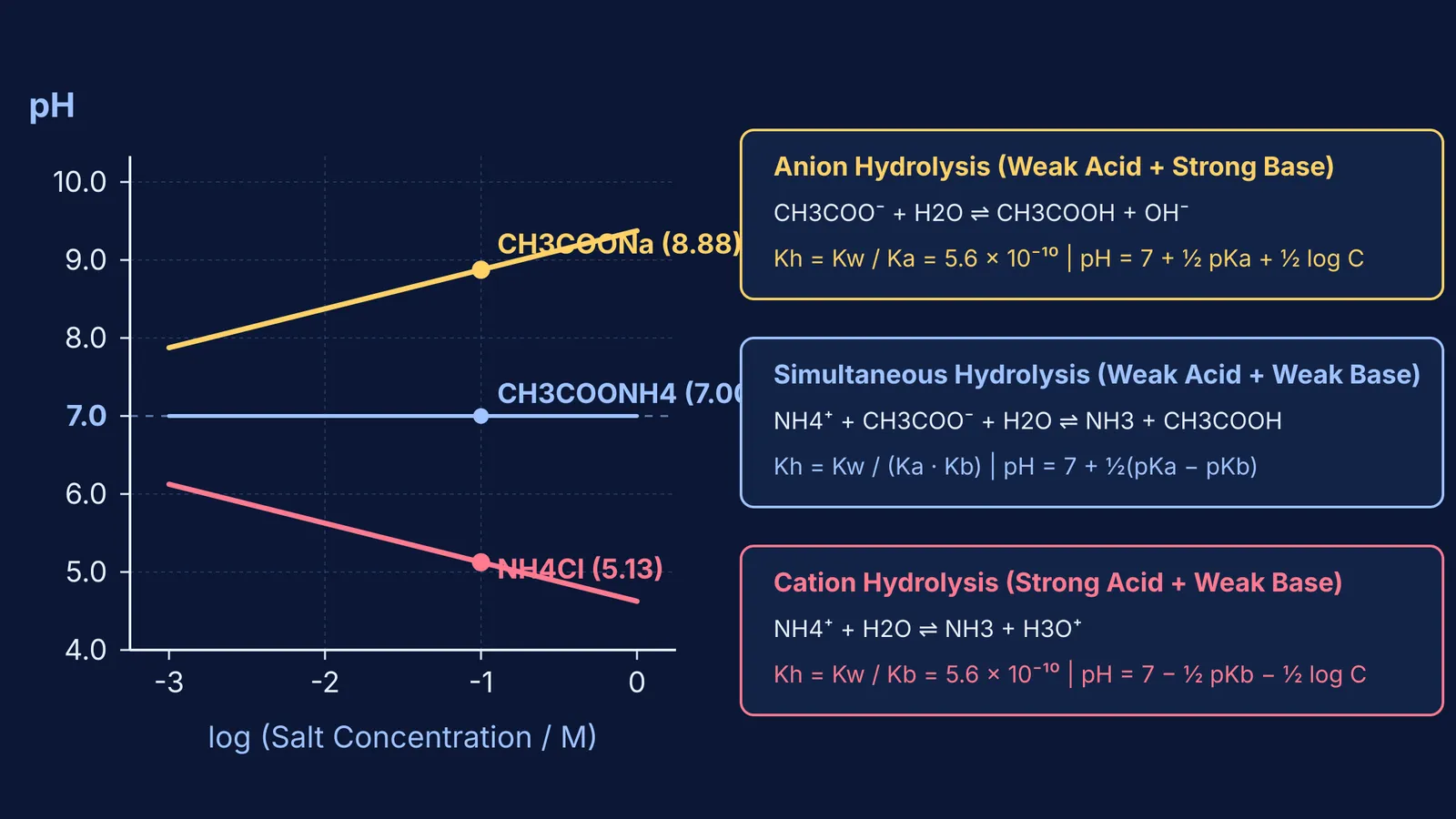
The resulting hydroxide concentration is [OH⁻] = C × h = 7.45 × 10⁻⁶ M. Taking the negative logarithm gives pOH = −log(7.45 × 10⁻⁶) = 5.13, which yields pH = 14.00 − 5.13 = 8.87. Alternatively, the logarithmic formula pH = 7 + 0.5 pKa + 0.5 log C gives pH = 7 + 0.5(4.75) + 0.5(−1.0) = 8.88.
For a 0.10 M ammonium chloride solution with ammonia (Kb = 1.8 × 10⁻⁵, pKb ≈ 4.75):
Hydrolysis constant: Kh = Kw / Kb = (1.0 × 10⁻¹⁴) / (1.8 × 10⁻⁵) = 5.56 × 10⁻¹⁰.
Degree of hydrolysis: h = √(Kh / C) = √(5.56 × 10⁻¹⁰ / 0.10) = 7.45 × 10⁻⁵.
Hydronium concentration: [H3O⁺] = C × h = 7.45 × 10⁻⁶ M.
Solution pH: pH = −log(7.45 × 10⁻⁶) = 5.13.
The master formula pH = 7 − 0.5 pKb − 0.5 log C confirms pH = 7 − 2.38 − (−0.50) = 5.12 to 5.13. The Fermi Problem Library has worked problems with a step-by-step solver that explains the reasoning rather than printing an answer, helping you verify approximations systematically.
What happens to pH when both the acid and base are weak?
When a salt is formed from both a weak acid and a weak base, such as ammonium acetate (CH3COONH4), both ions hydrolyse simultaneously:
NH4⁺(aq) + CH3COO⁻(aq) + H2O(l) ⇌ NH3(aq) + CH3COOH(aq)
In this coupled equilibrium, Kh = Kw / (Ka × Kb). As derived by Kurt Eisemann (1949), the hydronium concentration is given by [H⁺] = √(Kw × Ka / Kb). In logarithmic form, this simplifies to:
pH = 7 + 0.5(pKa − pKb) at 25 °C
Strikingly, salt concentration C cancels out entirely. Whether ammonium acetate is 1.0 M or 0.001 M, its pH remains 7.00 because Ka and Kb are identical (both 1.8 × 10⁻⁵). If Ka exceeds Kb, the solution is acidic; if Kb exceeds Ka, it is basic. The Fermi Concept Library covers every concept in physics, chemistry, biology, mathematics and computing, each with its own lesson and its place in the map, allowing you to trace how coupled equilibria interact.
What common pitfalls occur in salt hydrolysis calculations?
A frequent pitfall in entrance exams is applying 1 − h ≈ 1 when the salt is extremely dilute. As outlined in NCERT Class 11 Chemistry, if salt concentration falls to 10⁻⁶ M or lower, h exceeds 0.05 (5%), requiring the full quadratic solution Kh = C × h² / (1 − h). At extreme dilutions, water autoionisation cannot be neglected, as demonstrated in our analysis of pH of 10⁻⁸ M HCl.
A second error is confusing salt hydrolysis with buffer solutions. Pure sodium acetate hydrolyses to produce a basic pH governed by Kh = Kw / Ka. In contrast, adding acetic acid creates a buffer mixture governed by the Henderson-Hasselbalch equation. For a complete map of these mechanisms, review our guide to ionic equilibrium, buffers and salt hydrolysis before tackling timed mock tests.


