On this page
NCERT's usual third-order example is 2NO + O₂ → 2NO₂, a gas reaction. In 1895, at the Massachusetts Institute of Technology in Boston, Arthur A. Noyes found one in a flask of water. He mixed tin(II) chloride with iron(III) chloride and showed that the rate depends on the square of the iron concentration: rate ∝ [Sn²⁺][Fe³⁺]². As far as he knew, no measured reaction had followed a third-order law before.
The paper is A. A. Noyes, "Die Geschwindigkeit der Reaktion zwischen Zinnchlorür und Eisenchlorid. Eine Reaktion dritter Ordnung" (the rate of the reaction between stannous chloride and ferric chloride: a third-order reaction), Z. phys. Chem. 16 (1895) 546–561 (scan on the Internet Archive). Translations are ours, and every measured value below was checked against the page images. His earlier work on solubility is in Arthur Noyes, 1890: thallium chloride and the common-ion effect.
Why had nobody found a third-order reaction before 1895?
Noyes wrote that among the many reactions whose rates had been measured, "none has been found so far" that obeys the mass-action law "of the third or a higher order". That was odd, since many involve several molecules. His two examples:
6FeO + KClO₃ → 3Fe₂O₃ + KCl turned out to be simply second order.
HBrO₃ + 6HI → HBr + 3I₂ + 3H₂O "should" be seventh order, but behaves somewhere between third and fourth.
Both balance. He noticed that every reaction measured so far had run in excess acid, so he chose one that runs in neutral solution:
2FeCl₃ + SnCl₂ → 2FeCl₂ + SnCl₄
As ions, 2Fe³⁺ + Sn²⁺ → 2Fe²⁺ + Sn⁴⁺. The charge is +8 on each side, and two electrons pass from tin to two iron ions. Noyes chose it because it is trimolecular, runs at a convenient speed and is easy to analyse.
How did Noyes stop the reaction at each moment?
He ran everything at 25 °C. At set times he ran a sample into excess mercury(II) chloride, which removes the remaining Sn²⁺ at once and freezes the reaction. Then he titrated the Fe²⁺ formed with potassium dichromate, using ferricyanide as the indicator. The useful range was between about 1/10 and 1/40 normal; stronger solutions reacted too fast and weaker ones far too slowly.
One trap: his concentrations are in equivalents per litre, "in the oxidation sense". Fe³⁺ takes one electron, so 0.1 N FeCl₃ is 0.1 mol L⁻¹. Sn²⁺ gives two, so 0.1 N SnCl₂ is only 0.05 mol L⁻¹. With equal normalities, the two are always present in the 1 : 2 mole ratio of the equation.
How did he prove the reaction is third order?
He gave three arguments.
Within a run. In Table 1 (0.1 N each) the second-order "constant" fell from 7.5 to 3.2 as the reaction went on, a drift of 135%. The third-order one moved 44%. In Tables 2 and 3 the third-order values stayed nearly steady while the second-order ones kept falling. In the most dilute run the early values were too high, an "initial disturbance" that vanished when he added some of the products at the start.
Excess of one reagent. If the order were two, two equivalents of iron to one of tin should react as fast as the reverse. If it were three with iron squared, excess iron should help far more. After one minute, 0.02306 equivalents had reacted with iron in excess (Table 8) against 0.01582 with tin in excess (Table 7), about 1.5 times as much. He called this "a decisive proof".
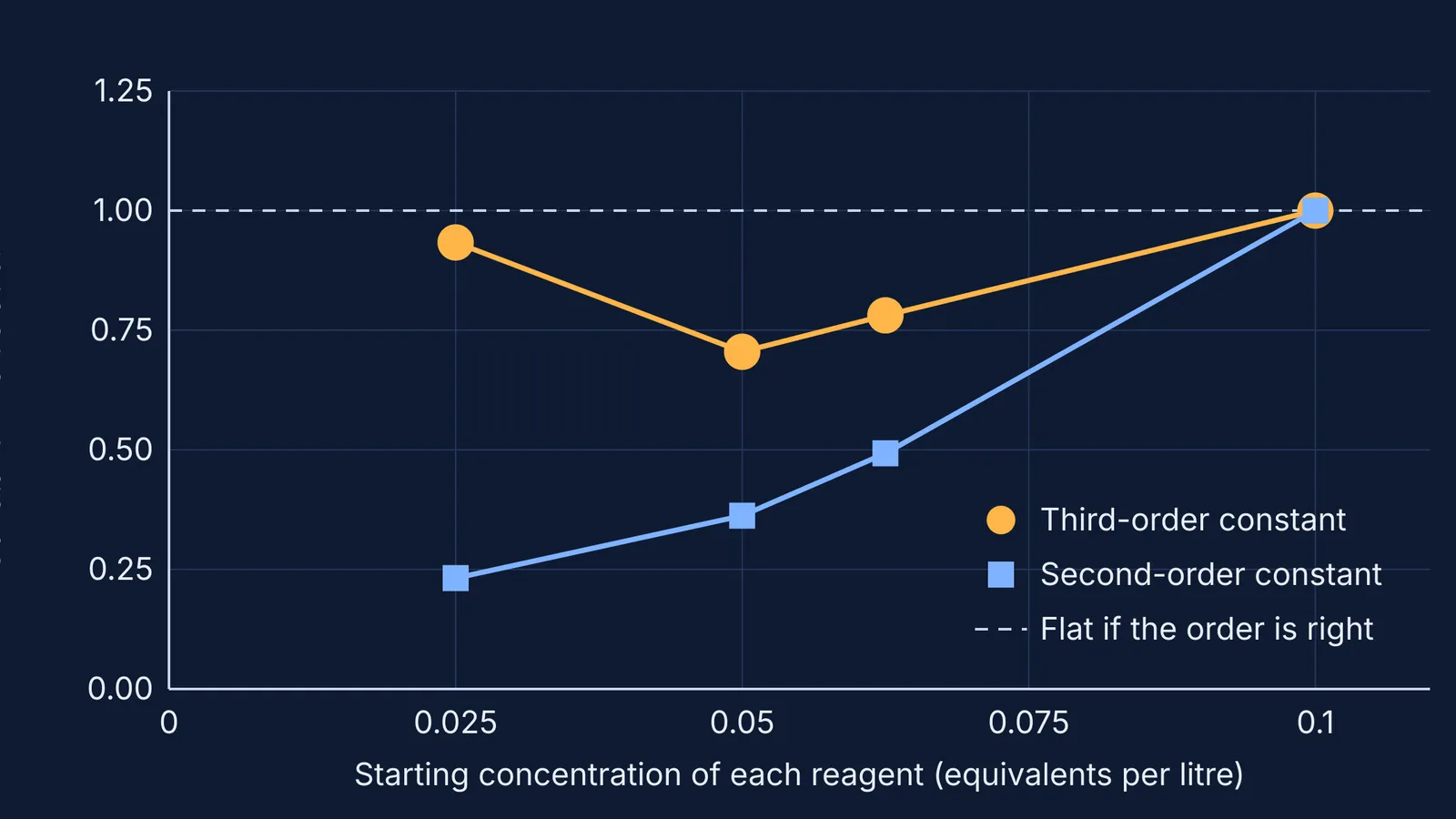
Across concentrations. Compared at half reaction, his second-order constants ranged from 1.6 to 6.9 (a spread of 330%) and his third-order constants from 74 to 105 (42%).
His verdict: the prediction from the number of reacting molecules was "here fulfilled for the first time". Read that as the first case he knew of, not a claim about all of chemistry.
Worked example: third-order kinetics from his data
Write c = [Fe³⁺] in mol L⁻¹. With equal normalities, [Sn²⁺] = c/2 all the way through, so for rate = k[Sn²⁺][Fe³⁺]²:
−dc/dt = 2 × k(c/2)c² = kc³. Integrating gives 1/c² − 1/c₀² = 2kt. This is Noyes's equation (4), and his C₃ is this k.
Units. k = (1/c² − 1/c₀²)/2t has units of L² mol⁻² min⁻¹. That is the rule for third order: (mol L⁻¹)¹⁻ⁿ time⁻¹ with n = 3.
Check his number. Table 1 is half done in 1½ minutes, so c goes from 0.1 to 0.05: k = (1/0.05² − 1/0.1²) ÷ (2 × 1.5) = (400 − 100) ÷ 3 = 100 L² mol⁻² min⁻¹. His table, using the measured 0.0510 at 1½ min, gives 106; his half-reaction figure is 105. In seconds, 105 ÷ 60 ≈ 1.75 L² mol⁻² s⁻¹.
Half-life. Put c = c₀/2: 4/c₀² − 1/c₀² = 2kt½, so t½ = 3/(2kc₀²). With his constants, 0.1 N gives 3 ÷ (2 × 105 × 0.01) = 1.4 min, and 0.025 N gives 3 ÷ (2 × 98 × 0.000625) = 24.5 min.
The 16× test. Because t½ ∝ 1/c₀², a fourfold dilution multiplies t½ by 4² = 16. Second order would give only 4. From his tables the half-times are about 1.45 min (Table 1) and 24.6 min (Table 4), a ratio of about 17. A second-order reaction would have reached half way in about 6 min.
What happened when he added hydrochloric acid?
The neat picture broke. With 0.025 N reagents and 0.1 N HCl, the second-order constant stayed between 2.67 and 2.97, while the third-order one rose from 131 to 214, by 63%. The acid slowed the start and sped up the later stages. With H. M. Goodwin he measured freezing points and found no sign that the acid made iron chloride associate into pairs. He could not explain the change: "A kinetic explanation of the phenomenon therefore seems impossible." So keep the third-order claim to neutral solution.
He also answered L. Kahlenberg, who had called the reaction second order from runs mostly in HCl. Recalculated, Kahlenberg's own neutral run drifted 120% as second order but held within experimental error as third order after the first two readings.
Does third order mean three ions collide at once?
Not necessarily. Noyes thought two iron ions and one tin ion must come together. Today we separate the rate law, which is measured, from the mechanism, which is proposed. A fast equilibrium that pairs two of the ions, followed by a slow step with the third, gives the same rate law. NCERT makes the same point: termolecular steps are rare, and order is an experimental quantity. For the full contrast, see order vs molecularity of a reaction, and for every order's half-life, half-life and initial concentration for any reaction order.
If integrated rate laws still feel shaky, the Concept Library covers every concept in physics, chemistry, biology, mathematics and computing. For timed practice on rate-law numericals, Fermi Test Prep covers JEE Main and Advanced preparation with an AI tutor.
Quick checklist
1895, Noyes: 2FeCl₃ + SnCl₂ in neutral water is third order, rate ∝ [Sn²⁺][Fe³⁺]².
Normality is not molarity: 0.1 N SnCl₂ is 0.05 M.
Third order, equal ratio: 1/c² − 1/c₀² = 2kt, t½ = 3/(2kc₀²).
k units: L² mol⁻² time⁻¹.
Fourfold dilution, 16 times the half-life.
In HCl the order shifted towards two, which he could not explain.