On this page
The binding-energy curve in the NCERT Nuclei chapter is usually explained in words: nucleons at the surface have fewer neighbours, and protons repel each other. The semi-empirical mass formula turns those words into numbers. Five terms, each with a clear physical meaning, rebuild the whole curve to within about 1% for most nuclei. The formula itself goes beyond the NCERT syllabus, so you will not be asked to quote it in a board exam, but it is the clearest way to see why iron sits at the top, why heavy nuclei carry extra neutrons and where fission energy comes from.
What are the five terms of the semi-empirical mass formula?
The formula treats the nucleus as a drop of incompressible, charged liquid. That is why it is also called the liquid-drop model. For a nucleus with A nucleons and Z protons, the binding energy B is
B = a_v A − a_s A^(2/3) − a_c Z²/A^(1/3) − a_a (A − 2Z)²/A ± δ
Volume term, a_v A. Each nucleon is held by its nearest neighbours only, because the strong force is short-ranged. So the binding grows in proportion to the number of nucleons, like the energy needed to boil a drop grows with its volume.
Surface term, −a_s A^(2/3). Nucleons at the surface have fewer neighbours, so they are bound less. The surface area of a sphere of radius R ∝ A^(1/3) grows as A^(2/3).
Coulomb term, −a_c Z²/A^(1/3). Every proton repels every other one. The electrostatic energy of a charged sphere is proportional to Z²/R.
Asymmetry term, −a_a (A − 2Z)²/A. For a given A, equal numbers of protons and neutrons give the strongest binding, because of the Pauli exclusion principle. Any imbalance costs energy.
Pairing term, ±δ. Even-even nuclei get δ = +a_p/√A, odd-odd nuclei get −a_p/√A, and odd-A nuclei get zero.
The coefficients are fitted to measured masses, not derived. Here we use the set given by James Rohlf in Modern Physics from α to Z⁰ and reproduced on HyperPhysics' liquid-drop page: a_v = 15.75, a_s = 17.8, a_c = 0.711, a_a = 23.7 and a_p = 11.18, all in MeV. Other textbooks use slightly different values, and some write Z(Z − 1) in place of Z² in the Coulomb term. The answers shift by about 1%.
Worked example: binding energy of iron-56
Iron-56 has A = 56 and Z = 26, both even. First, A^(2/3) = 14.637 and A^(1/3) = 3.826.
Volume: 15.75 × 56 = 882.0 MeV.
Surface: 17.8 × 14.637 = 260.5 MeV, subtracted.
Coulomb: 0.711 × 26² / 3.826 = 0.711 × 676 / 3.826 = 125.6 MeV, subtracted.
Asymmetry: 23.7 × (56 − 52)² / 56 = 23.7 × 16 / 56 = 6.8 MeV, subtracted.
Pairing: even-even, so +11.18/√56 = +1.5 MeV.
Total: B = 882.0 − 260.5 − 125.6 − 6.8 + 1.5 = 490.6 MeV.
Per nucleon: 490.6 / 56 = 8.76 MeV.
The 2020 Atomic Mass Evaluation (AME2020 mass table, hosted by the IAEA) gives 8.790 MeV per nucleon. The formula is 0.3% low.
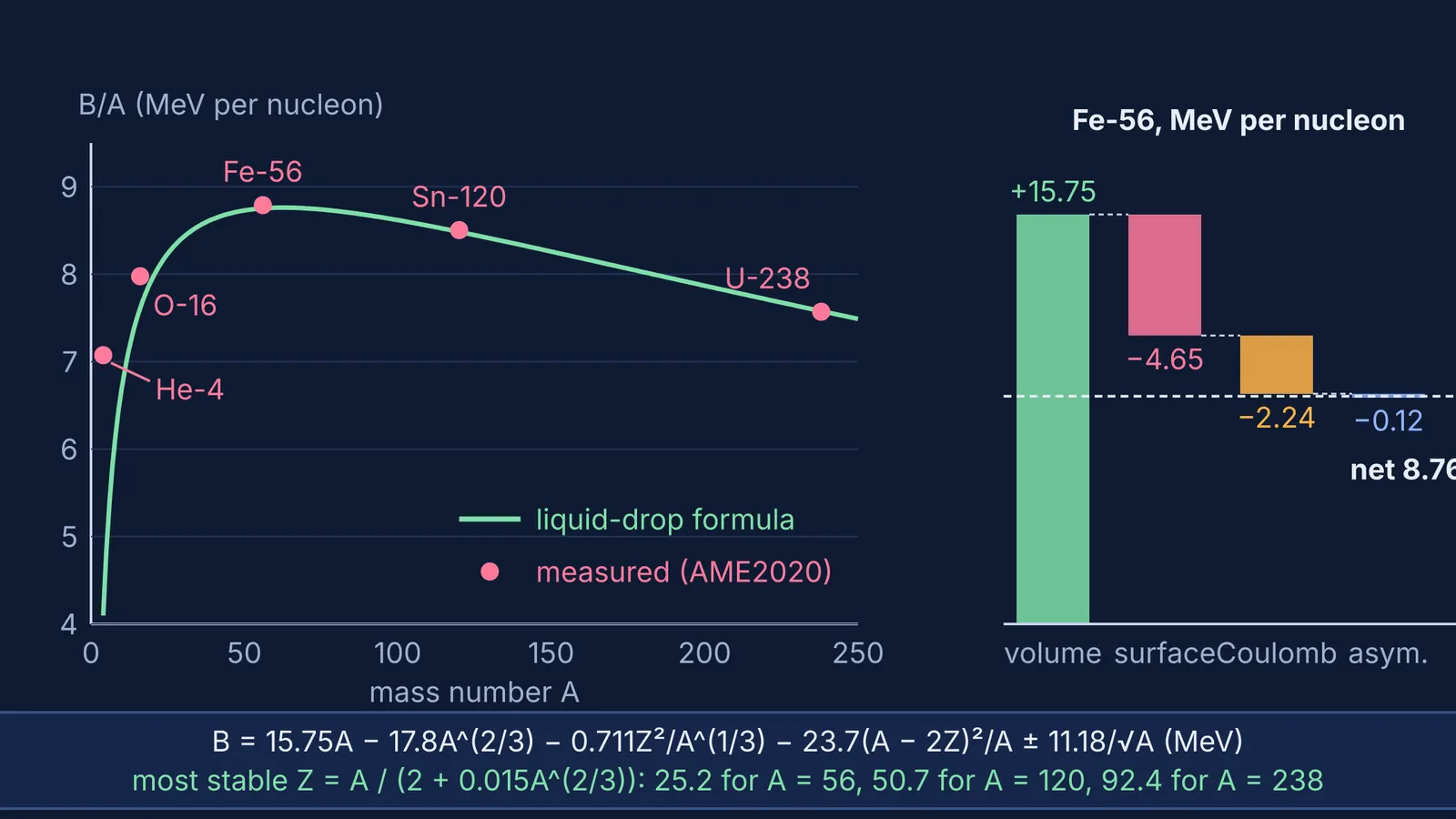
Per nucleon, the terms are +15.75 (volume), −4.65 (surface), −2.24 (Coulomb), −0.12 (asymmetry) and +0.03 (pairing). Surface and Coulomb do almost all the work of pulling the value down from 15.75 to 8.76.
How well does the formula match other nuclei?
Running the same steps for other nuclei, with measured values from AME2020:
Oxygen-16: 7.73 MeV per nucleon against 7.98, 3.1% low.
Tin-120: 8.49 against 8.50, 0.2% low.
Uranium-238: 7.58 against 7.57, 0.1% high.
Helium-4: 5.49 against 7.07, 22% low.
Helium-4 fails because four nucleons are far too few to behave like a drop: almost all of them are "surface". It is also unusually tightly bound for a reason the formula leaves out. Nuclei with 2, 8, 20, 28, 50, 82 or 126 protons or neutrons, the magic numbers, are more stable than a smooth formula predicts. Helium-4 and oxygen-16 are both doubly magic, which is why they sit above the line.
The formula also puts the peak of the curve slightly in the wrong place. Its maximum is at iron-58, 8.78 MeV per nucleon. The measured peak is nickel-62 at 8.795 MeV. The detail is covered in our post on the binding energy per nucleon curve.
Why does a nucleus with 238 nucleons have 92 protons?
For a fixed A, the most stable nucleus is the one with the largest B. Only the Coulomb and asymmetry terms depend on Z, so set dB/dZ = 0:
−2a_c Z/A^(1/3) + 4a_a (A − 2Z)/A = 0
Solving gives Z = A / (2 + (a_c/2a_a) A^(2/3)), with a_c/2a_a = 0.711/47.4 = 0.015.
A = 56: Z = 56 / (2 + 0.015 × 14.64) = 25.2. Iron has 26.
A = 120: Z = 120 / (2 + 0.015 × 24.33) = 50.7. Tin has 50.
A = 238: Z = 238 / (2 + 0.015 × 38.40) = 92.4. Uranium has 92.
For light nuclei the second term in the bracket is small, so Z ≈ A/2. For heavy nuclei the Coulomb repulsion pushes the balance towards neutrons. That is the quantitative form of the argument in why heavy nuclei need more neutrons than protons.
How much energy does the formula predict for fission?
Split uranium-236 (A = 236, Z = 92, formed when U-235 absorbs a neutron) into two equal palladium-118 nuclei (A = 118, Z = 46).
B(U-236) = 1,792.6 MeV from the formula.
B(Pd-118) = 988.8 MeV, so two of them give 1,977.6 MeV.
Energy released = 1,977.6 − 1,792.6 = 185 MeV.
Look at what changes. The two smaller drops have more surface, which costs 176.7 MeV. But the Coulomb energy falls by 360.3 MeV, because the protons are now split between two separate spheres. The Coulomb saving wins. NCERT quotes about 200 MeV per fission, and the formula gets close with a few lines of arithmetic. This is the energy balance Bohr and Wheeler used in 1939, told in how Bohr and Wheeler explained fission with a liquid drop.
To see binding energy, mass defect and nuclear stability as linked ideas, the Fermi Concept Library gives each concept its own lesson and shows what leads to what.
Quick checklist
Five terms: volume (+), surface (−), Coulomb (−), asymmetry (−), pairing (±).
Coefficients are fitted; books differ slightly. Here: 15.75, 17.8, 0.711, 23.7, 11.18 MeV.
Iron-56: 490.6 MeV, 8.76 MeV per nucleon, against 8.79 measured.
Fails for very light nuclei and misses magic-number bumps.
Most stable Z = A/(2 + 0.015A^(2/3)): 92.4 for A = 238.
Symmetric fission of U-236: about 185 MeV, close to NCERT's 200 MeV.