

On this page
In the lighter elements of the periodic table, atoms tend to keep a neat symmetry. Carbon-12 has six protons and six neutrons, and oxygen-16 has eight of each. But as you move down the table to heavier elements, this 1:1 ratio falls apart.
To hold a large nucleus together, nature starts packing in more neutrons than protons. By the time you reach the heaviest stable elements, the nucleus looks completely lopsided.
Why do heavy nuclei have more neutrons than protons?
The nucleus is a battleground between two fundamental forces: the strong nuclear force and the Coulomb force.
Protons carry a positive charge, and because like charges repel, they push against each other through the Coulomb force. This electrostatic repulsion is long-range, meaning every proton in a nucleus pushes away from every other proton, no matter where they are situated inside the atom. Even the protons on opposite sides of a large nucleus will actively push each other apart.
To keep the nucleus from flying apart, the strong nuclear force steps in. It is a powerful attractive force that acts between all nucleons—protons and neutrons alike—and is roughly 100 times stronger than the Coulomb force. However, the strong force operates over a very short distance of only about 10⁻¹⁵ meters, according to Wikipedia. This means a proton or neutron can only pull on its immediate neighbours. It cannot reach across a large atom.
As a nucleus grows, the total electrostatic repulsion increases quadratically because every new proton repels all the others. The strong force does not scale up the same way, because a new nucleon only adds attraction to the particles right next to it. To compensate for this growing disruptive force, the nucleus needs more "glue." Neutrons provide this necessary strong-force attraction without adding any electrical repulsion, which is why the ratio must shift to keep the atom stable.
How does the neutron-to-proton ratio change?
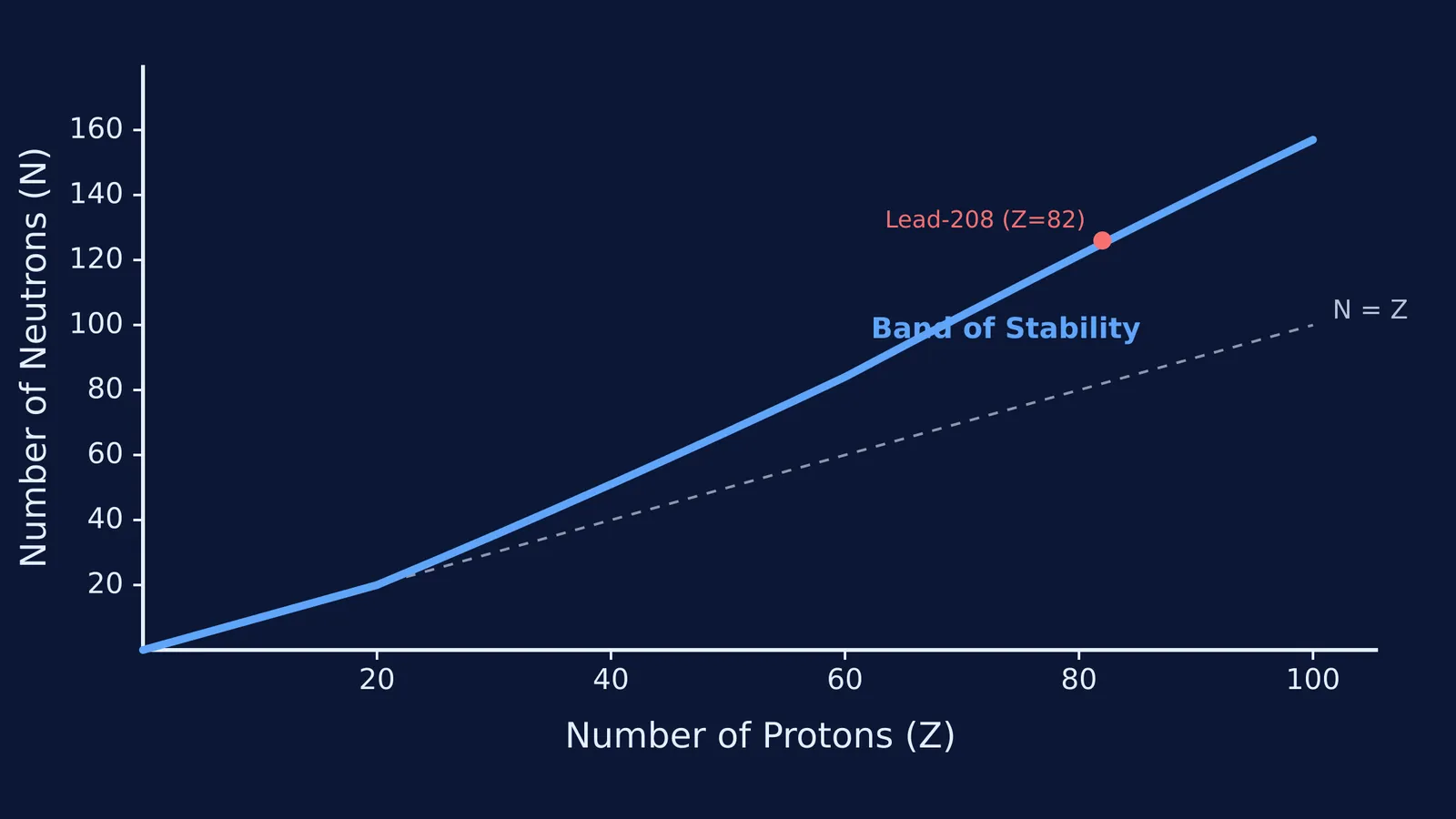
If you plot the number of neutrons against the number of protons for all known isotopes, the stable ones form a curved path known as the band of stability.
For light elements (atomic number Z ≤ 20), the band of stability follows a straight line where the neutron-to-proton ratio (N/Z) is about 1:1. But past calcium, the line bends upwards. To remain stable against the mounting Coulomb repulsion, heavier nuclei require a steady excess of neutrons. For example, stable lead-208 has 82 protons and 126 neutrons, giving it an N/Z ratio of approximately 1.5:1, as detailed in Wikipedia's stable nuclide data.
Without this precise balance, the nucleus simply has too much internal energy and must shed either mass or charge to survive.
What happens when a nucleus gets too large?
There is a limit to how much nuclear glue can help. Beyond atomic number 82 (lead), the Coulomb repulsion becomes so massive that no number of extra neutrons can make the nucleus completely stable, as noted by Wikipedia.
Every element heavier than lead is inherently unstable and radioactive, though bismuth (Z = 83) decays so slowly it is often treated as stable. These heavy nuclei eventually undergo radioactive decay to shed their excess charge and mass, bringing them back down into the stable band.
When you study these limits, keeping track of the interacting forces is crucial. The Fermi Concept Library breaks down the physics of binding energy and the strong nuclear force step by step, helping you see exactly why the stability line curves and how atoms balance their internal energies.
A quick framework for predicting nuclear decay
Because the band of stability is so well-defined, you can predict how an unstable isotope will decay based on where it sits relative to the stable curve:
Too many neutrons (above the band): The nucleus will likely undergo beta-minus decay. A neutron turns into a proton, emitting an electron and pulling the N/Z ratio down towards the stable line.
Too many protons (below the band): The nucleus will typically undergo beta-plus decay (positron emission) or electron capture. A proton turns into a neutron, pushing the N/Z ratio up.
Too heavy (beyond Z = 82): The nucleus is too bulky and will often undergo alpha decay, ejecting a helium nucleus (two protons and two neutrons) to reduce its overall size. When calculating these heavy decays, you will need to account for how the parts separate, such as the recoil of the daughter nucleus in alpha decay.
Working out what happens over long periods involves tracking these steps carefully. If you are counting alpha and beta decays in a radioactive decay series, you will see how a heavy unstable nucleus cascades down the periodic table. It will repeatedly emit alpha and beta particles until it finally rests as a completely stable isotope of lead.


