On this page
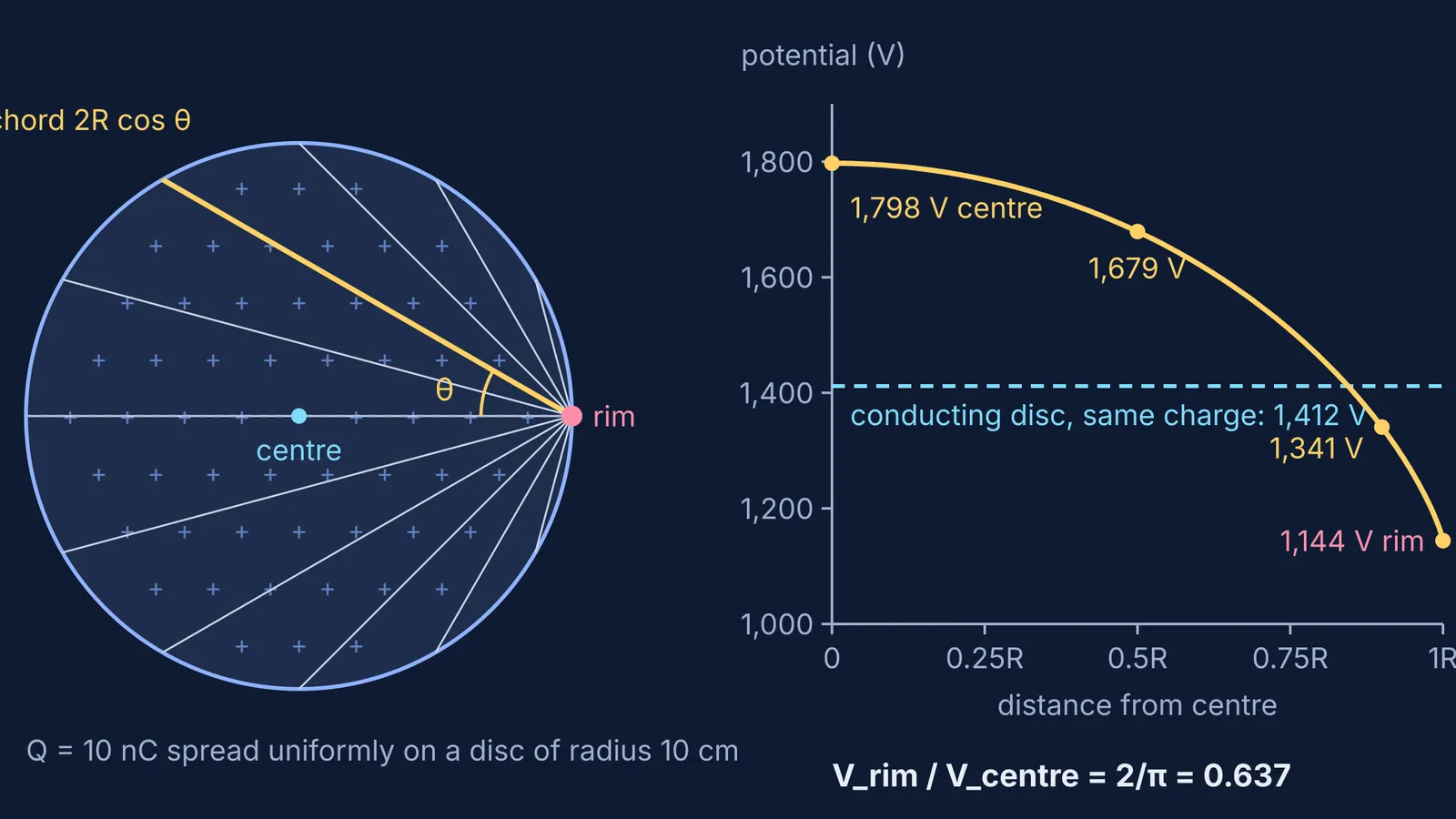
Most textbooks give the potential of a uniformly charged disc only on its axis. Ask for the potential at a point on the edge and the usual method stalls, because the rim point is not the same distance from any ring of charge. Move the origin of your polar coordinates to the rim point and the integral collapses to one line. The answer is σR/πε₀, exactly 2/π of the value at the centre. For a 10 cm disc carrying 10 nC, that is 1,144 V at the rim against 1,798 V in the middle.
What is the potential at the centre of a charged disc?
Take a thin insulating disc of radius R with charge Q fixed uniformly over one face, so the surface charge density is σ = Q/πR². The centre is easy. Split the disc into rings of radius r and width dr. Each ring has charge σ·2πr dr, and every bit of it is a distance r from the centre. So the ring adds k·σ·2πr dr/r = 2πkσ dr. The r cancels, and summing from 0 to R gives
V_centre = 2πkσR = σR/2ε₀.
This is the x = 0 case of the on-axis result derived in the field and potential of a ring and a disc. Written with Q, it is V_centre = 2kQ/R, twice what the same charge gives at the centre of a ring.
Why is the rim harder than the centre?
At the rim, the rings centred on the disc's centre no longer help. Different parts of one ring are at different distances from the rim point, so you would need a double integral with an awkward square root. The trick is to change what you slice.
Centre your polar coordinates on the rim point P itself. Now slice the disc into thin wedges that fan out from P. This is the same idea as choosing the right element in the field at the centre of a charged hemisphere: pick the element whose distance to the point is simple.
How do you find the potential at the rim?
Set up the wedges. Measure the angle θ from the diameter through P. Wedges run from θ = −π/2 to θ = +π/2, since P is on the edge and the whole disc lies on one side of the tangent there.
Find each wedge's length. The diameter through P has length 2R. A chord from P at angle θ to that diameter makes a right-angled triangle with the diameter (the angle in a semicircle is 90°). So the chord length is 2R cos θ.
Write the charge element. In polar coordinates about P, the area element is r dr dθ, so dq = σ r dr dθ.
Write its potential. dV = k dq/r = kσ dr dθ. The r cancels, just as it did for the centre.
Integrate along the chord. For fixed θ, r runs from 0 to 2R cos θ, giving kσ·2R cos θ dθ.
Integrate over the angle. ∫ 2R cos θ dθ from −π/2 to π/2 is 4R. So V_rim = 4kσR = σR/πε₀.
Divide: V_rim/V_centre = (σR/πε₀)/(σR/2ε₀) = 2/π = 0.637. The rim sits at about 64% of the centre's potential. Check the units: σR/ε₀ has units (C/m²)(m)/(C²/N·m²) = N·m/C = J/C = V.
Worked example: a 10 cm disc carrying 10 nC
Take R = 0.10 m, Q = 10 nC = 1.0 × 10⁻⁸ C, and k = 8.99 × 10⁹ N·m²/C².
Charge density. σ = Q/πR² = 1.0 × 10⁻⁸/(π × 0.010) = 3.18 × 10⁻⁷ C/m².
Centre. V_centre = 2kQ/R = 2 × 8.99 × 10⁹ × 1.0 × 10⁻⁸/0.10 = 1,798 V.
Rim. V_rim = 4kσR = (2/π) × 1,798 = 1,144 V.
In between. The same wedge method works for any point on the disc, though the chords are no longer simple. Doing the angle integral numerically gives 1,679 V at half the radius and 1,341 V at 0.9R. Most of the drop happens close to the edge.
Check by brute force. We split the disc into about 1.8 million small squares and added k dq/r for each one. The sum at the rim came to 1,144 V, matching the formula.
For comparison, the same 10 nC on a thin ring of radius 10 cm gives kQ/R = 899 V at the ring's centre. Spreading the charge over the disc brings it closer to the centre on average, which doubles the centre's potential.
The general result for a point at distance r from the centre is V = (σR/πε₀)E(r/R), where E is the complete elliptic integral of the second kind. That is beyond the syllabus, and is useful only to check the four numbers above, which it reproduces.
Is a charged metal disc the same?
No. In a metal disc the charge can move, and it will, because the potential differs between the centre and the rim. For a positive charge, a lower potential at the rim means the field in the disc's plane points outwards, so free charge drifts towards the edge. It keeps moving until the whole disc is at one potential. The edge then carries a very large surface charge density.
An isolated thin conducting disc has capacitance C = 8ε₀R. That is a standard result beyond the syllabus; it is listed, for example, in the table of capacitances on Wikipedia, which cites Jackson's Classical Electrodynamics. For R = 10 cm, C = 8 × 8.85 × 10⁻¹² × 0.10 = 7.08 pF, so 10 nC raises the metal disc to Q/C = 1,412 V everywhere. That lies between the uniform disc's rim and centre values. For a sphere, by contrast, symmetry alone makes uniform charge and equal potential the same thing, as in the capacitance of an isolated sphere.
How does this show up in JEE problems?
Questions on continuous charge rarely state "move the origin". They ask for the potential at a point that breaks the obvious symmetry: the rim of a disc, the corner of a square sheet, the edge of a half-ring. The skill being tested is choosing an element whose distance to the point is simple. A useful habit is to check whether dq/r loses its r in polar coordinates about the point you want. For any flat, uniformly charged sheet it does, and the potential becomes kσ times the integral, over angle, of the distance from the point to the sheet's edge.
The Fermi Problem Library has electrostatics problems with a step-by-step solver that explains the reasoning. If you are preparing for JEE Main & Advanced, Fermi Test Prep offers personalised preparation with an AI tutor, live classes, adaptive mocks, mentorship and a study plan that updates based on mastery.
Quick checklist
Centre of a uniformly charged disc: V = σR/2ε₀ = 2kQ/R.
Rim: put the polar origin at the rim point; the chord at angle θ has length 2R cos θ.
dq/r = σ dr dθ, so V_rim = kσ∫2R cos θ dθ = σR/πε₀.
Ratio rim to centre: 2/π = 0.637.
Example: 10 cm, 10 nC gives 1,798 V at the centre and 1,144 V at the rim.
A uniformly charged disc is not an equipotential; a conducting disc is, at Q/8ε₀R.