

On this page
Take a thin hemispherical shell of radius R with charge spread evenly over it, surface density σ. What is the field at the centre of the flat face? It is a much-reused JEE electrostatics result, the first step towards cut spheres, solid hemispheres and the force between two charged halves.
What is the electric field at the centre of a charged hemispherical shell?
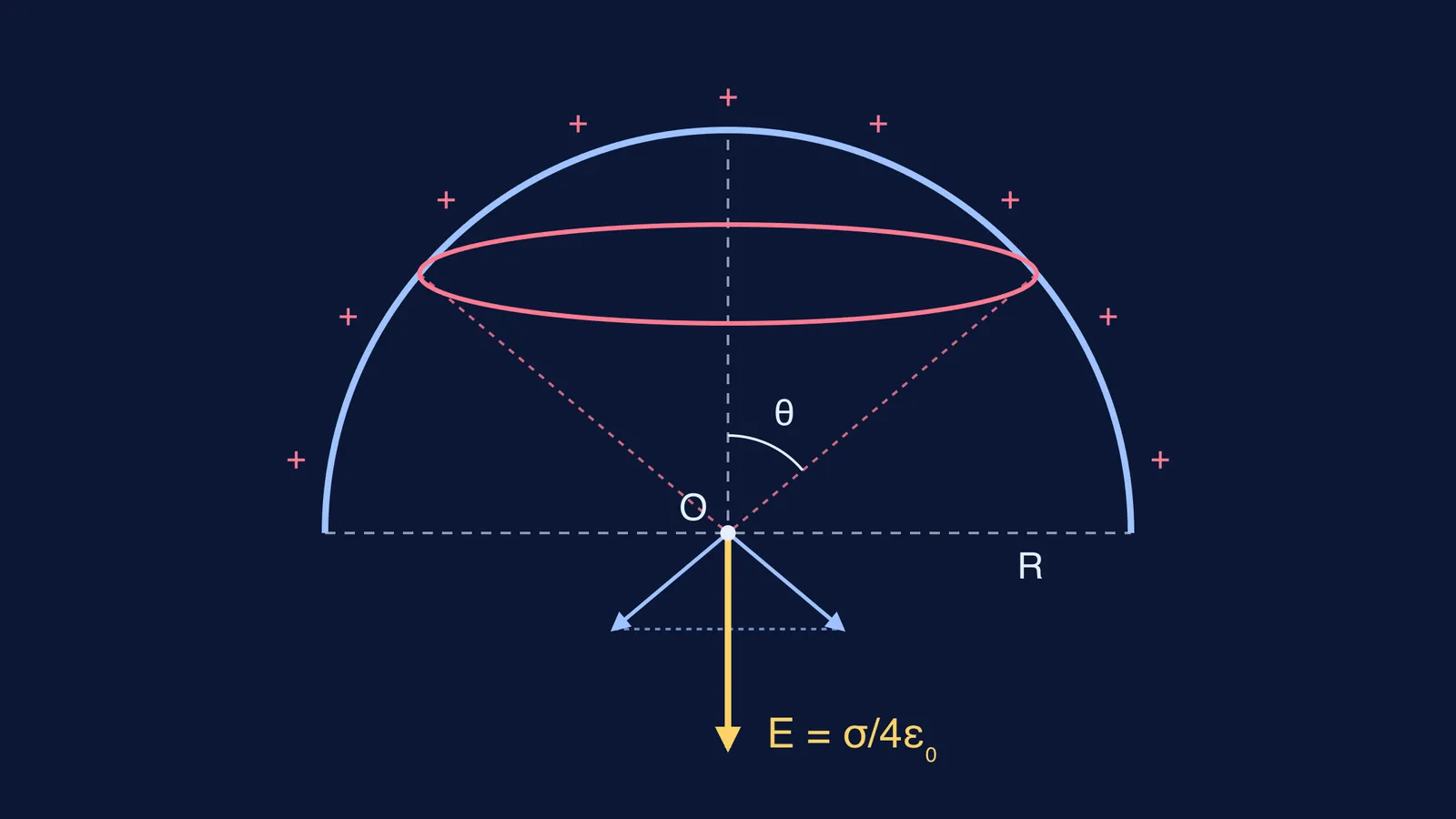
The field at the centre is E = σ/(4ε₀), directed along the axis of symmetry, away from the curved surface for positive charge. A solution on Cheenta writes the same result as E = q/(8πε₀a²) for total charge q on a hemisphere of radius a. The two forms agree because the curved area of a hemisphere is 2πR², so q = 2πR²σ. Sideways components cancel by symmetry, which is why rings are the right slice.
How do you derive σ/4ε₀ by integrating rings?
Start from the field on the axis of a charged ring. For a ring of charge Q and radius a, at distance z along its axis, E = Qz/[4πε₀(a² + z²)^(3/2)], as derived in Jeremy Tatum's electricity and magnetism notes on LibreTexts/01%3A_Electric_Fields/1.06%3A_Electric_Field_E/1.6D%3A_Field_on_the_Axis_of_and_in_the_Plane_of_a_Charged_Ring).
Put the centre O at the origin with the axis through the pole. A ring at polar angle θ, of width R dθ, has radius a = R sin θ and sits a height z = R cos θ above O.
Its charge is dq = σ(2πR sin θ)(R dθ).
Every point on that ring is exactly R from O, so a² + z² = R² and the ring formula becomes dE = dq cos θ/(4πε₀R²).
Substitute dq: dE = (σ/2ε₀) sin θ cos θ dθ.
Integrate θ from 0 to π/2. Since the integral of sin θ cos θ over that range is 1/2, E = σ/(4ε₀).
The same ring-by-ring method works for a flat sheet with a hole cut out, which we walk through in the field on the axis of a charged sheet with a circular hole. If you have met the gravitational version, the field on the axis of a ring and where it peaks uses the identical geometry.
Which way does the field point, and where do students slip?
For positive σ, every ring pushes a test charge at O away from itself, so the resultant points from the dome towards the open side. Common slips:
Using R as the axial distance in the ring formula. The axial distance is R cos θ; the distance from ring to centre is R.
Dropping the cos θ that picks out the axial component.
Taking the hemisphere's charge as 4πR²σ. That is the whole sphere; a hemisphere carries 2πR²σ.
If one of these keeps happening, the Fermi Problem Library has worked problems with a step-by-step solver that explains the reasoning rather than printing an answer, so you can see which line went wrong.
How does this help with the force between two halves of a charged sphere?
A thin shell with surface density σ feels an outward electrostatic pressure of σ²/(2ε₀); the same idea explains why a charged soap bubble expands. Add up only the axial parts of that pressure over one hemisphere and you get pressure times the projected area πR², so F = πσ²R²/(2ε₀). A JEE Advanced 2010 Paper 2 question asked what the force needed to hold two charged hemispheres together is proportional to; the answer is σ²R²/ε₀, as worked on Competishun's solution page. In terms of the total charge Q, F = Q²/(32πε₀R²), the answer accepted in a puzzle on the physics blog In the Dark.
Here is where σ/(4ε₀) earns its place. Multiply the charge on one half, 2πR²σ, by σ/(4ε₀) and you get πσ²R²/(2ε₀), the same force. Treat that as a quick memory check, not a proof: the field of one half is not uniform over the other half.
How big is the force for a 1 μC shell?
A shell of radius 10 cm carries 1.0 μC. Use ε₀ = 8.854 × 10⁻¹² F/m, the CODATA value published by NIST.
σ = Q/(4πR²) = 1.0 × 10⁻⁶/(4π × 0.01) ≈ 7.96 × 10⁻⁶ C/m².
Field at the centre from one half: σ/(4ε₀) ≈ 2.25 × 10⁵ N/C.
Force between the halves: Q²/(32πε₀R²) ≈ 0.112 N.
Check: 0.5 μC × 2.25 × 10⁵ N/C ≈ 0.112 N. It matches.
A three-session plan to make it stick
Session one: derive σ/(4ε₀) on blank paper without notes, then run the full-sphere check.
Session two: do a solid hemisphere of charge density ρ. Treat it as thin shells of thickness dr, each with σ = ρ dr, and you should get ρR/(4ε₀).
Session three: redo the force between halves from the pressure, then confirm it with the memory check above.
If the ring formula itself feels shaky, the Fermi Concept Library gives each concept in physics its own lesson and its place in the map.


