

On this page
This post builds the ring formula from small pieces, finds where the field is strongest, and shows why a charged ring gives the same answer with different letters.
What is the gravitational field on the axis of a ring?
Take a thin uniform ring of mass M and radius R, and a point P on its axis at distance x from the centre. Michael Fowler's University of Virginia lecture notes on gravity derive the result (calling the radius a): the field at P is g = GMx/(x² + R²)^(3/2), directed along the axis toward the centre of the ring.
The set-up:
Split the ring into tiny pieces of mass dm. Every piece is the same distance s = √(R² + x²) from P.
Each piece pulls P with a field of size G dm/s², along the line from P to that piece.
The piece diametrically opposite has an equal and opposite sideways part, so sideways parts cancel in pairs.
The axial part is (G dm/s²) cos α, with cos α = x/s. Since s and α are the same for every piece, summing replaces dm with M: g = GMx/s³.
Fowler pictures the ring as beads taken in opposite pairs; OpenStax University Physics Volume 2 uses the same symmetry for a ring of charge.
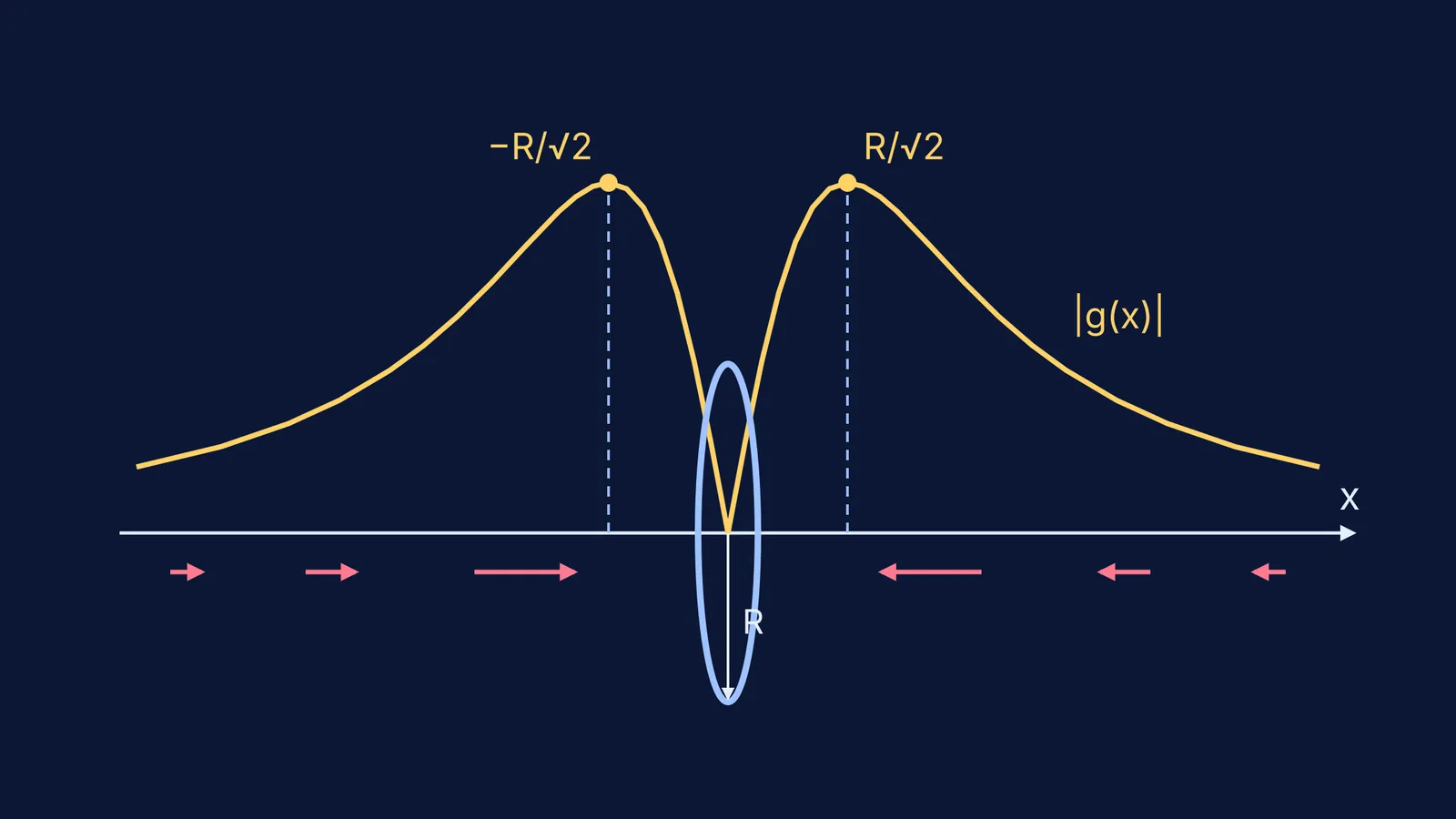
Why does the field peak at x = R/√2?
At the centre, x = 0, so g = 0: opposite pulls cancel. Far away, when x is much larger than R, g ≈ GM/x², the field of a point mass. Something that starts at zero and falls back towards zero must peak in between.
To find it, differentiate f(x) = x(R² + x²)^(−3/2):
f′(x) = [(R² + x²) − 3x²]/(R² + x²)^(5/2) = (R² − 2x²)/(R² + x²)^(5/2)
This is zero when R² = 2x², so x = R/√2, about 0.707R. Substituting back, R² + x² = 3R²/2, and the peak value is g_max = 2GM/(3√3 R²), about 0.385 GM/R².
Physically, moving out lines the pulls up with the axis (cos α grows) but puts every piece farther away (1/s² shrinks). Up to R/√2 the first effect wins.
Worked example: how strong is a real ring's pull?
Take a 1,000 kg steel ring of radius 1 m. With G = 6.67 × 10⁻¹¹ N m²/kg², the value used in OpenStax University Physics Volume 1, GM/R² = 6.67 × 10⁻⁸ N/kg.
At x = 0: g = 0.
At x = 0.707 m: g = 0.385 × 6.67 × 10⁻⁸ ≈ 2.57 × 10⁻⁸ N/kg, the largest value anywhere on the axis.
At x = 1 m: g = GM/(2√2 R²) ≈ 2.36 × 10⁻⁸ N/kg.
At x = 10 m: g ≈ 6.57 × 10⁻¹⁰ N/kg, against 6.67 × 10⁻¹⁰ N/kg for a 1,000 kg point mass.
Use those three checks on any answer you write: zero at the centre, a single peak at R/√2 on each side, point-mass behaviour far away. To check your own working, theFermi Problem Library has worked problems with a step-by-step solver that explains the reasoning rather than printing an answer.
How does this mirror the electric field of a charged ring?
Newton's law of gravitation and Coulomb's law are both inverse-square laws, so the integral is identical. OpenStax University Physics Volume 2 gives the field of a ring of total charge Q at distance z on its axis as E = (1/4πε₀) Qz/(z² + R²)^(3/2), which becomes the point-charge field Q/(4πε₀z²) when z is much larger than R.
So E is zero at the centre, largest at z = R/√2 (the same function you just differentiated) and point-like far away.
Direction does not carry across. Gravity always points toward the centre; for a positively charged ring E points away from the centre; for a negative ring, toward it.
Our post on the electric field on the axis of a charged ring and disc works through the charged version, disc included.
Where do students lose marks on ring problems?
Writing GM/(R² + x²) and forgetting the cos α factor of x/√(R² + x²).
Forgetting that g changes sign as you cross the ring.
Using the axis formula for a point off the axis. It holds only on the axis.
Treating a disc like a ring. A uniform disc is a stack of rings of radius r with mass dm = 2Mr dr/R², and you integrate the ring result over r.
Stacking rings also builds a spherical shell, as Fowler's notes do next. Our post on gravity inside a hollow shell and a sphere with a cavity takes that step, and gravitational potential energy problems beyond mgh covers the energy side.
A field that rises and then falls is the kind of idea the Fermi Simulation Lab is for: interactive simulations for ideas that are easier to see than to read. Then try deriving g_max on a blank page and check it against the three tests above.


