

On this page
Finding the electric field of an infinite charged sheet with a circular cut-out is a classic problem in electromagnetism, often appearing in JEE and university physics exams. Instead of setting up a complex integral from scratch, you can solve it in a single line using the principle of superposition.
By treating the sheet with a hole as an unbroken infinite sheet minus a charged disc, the exact field on the axis falls right out. Here is how this elegant subtraction trick works and what the resulting field looks like.
How do you use superposition for a hole?
Superposition tells us that the electric field of a complex charge distribution is the vector sum of the fields from simpler parts. For a sheet with a hole, the missing charge can be thought of as a piece of negative charge placed over a uniform positive sheet.
Imagine an unbroken infinite plane with a uniform surface charge density σ. To create a hole of radius R, you lay a circular disc of radius R and charge density −σ exactly where the hole should be. The +σ and −σ cancel out inside the circle, leaving an empty hole, while the rest of the sheet remains at +σ.
Therefore, the net electric field at any point P is simply the field of the infinite sheet plus the field of the oppositely charged disc:
E_net = E_sheet + E_disc
What is the electric field on the axis of the hole?
Let us find the field at a distance z from the centre of the hole along its central axis. We need the standard formulas for both components, which you can verify in textbooks such as OpenStax University Physics/Book%3A_University_Physics_II_-_Thermodynamics_Electricity_and_Magnetism_(OpenStax)/05%3A_Electric_Charges_and_Fields/5.06%3A_Calculating_Electric_Fields_of_Charge_Distributions).
The field of an infinite sheet is constant everywhere:
E_sheet = σ / 2ε₀
The field on the axis of a negatively charged disc of radius R is:
E_disc = (−σ / 2ε₀) × [1 − z / √(z² + R²)]
Adding the disc's field to the sheet's field gives the net electric field on the axis of the hole:
E_net = (σ / 2ε₀) − (σ / 2ε₀) × [1 − z / √(z² + R²)]
The constant terms perfectly cancel out, leaving:
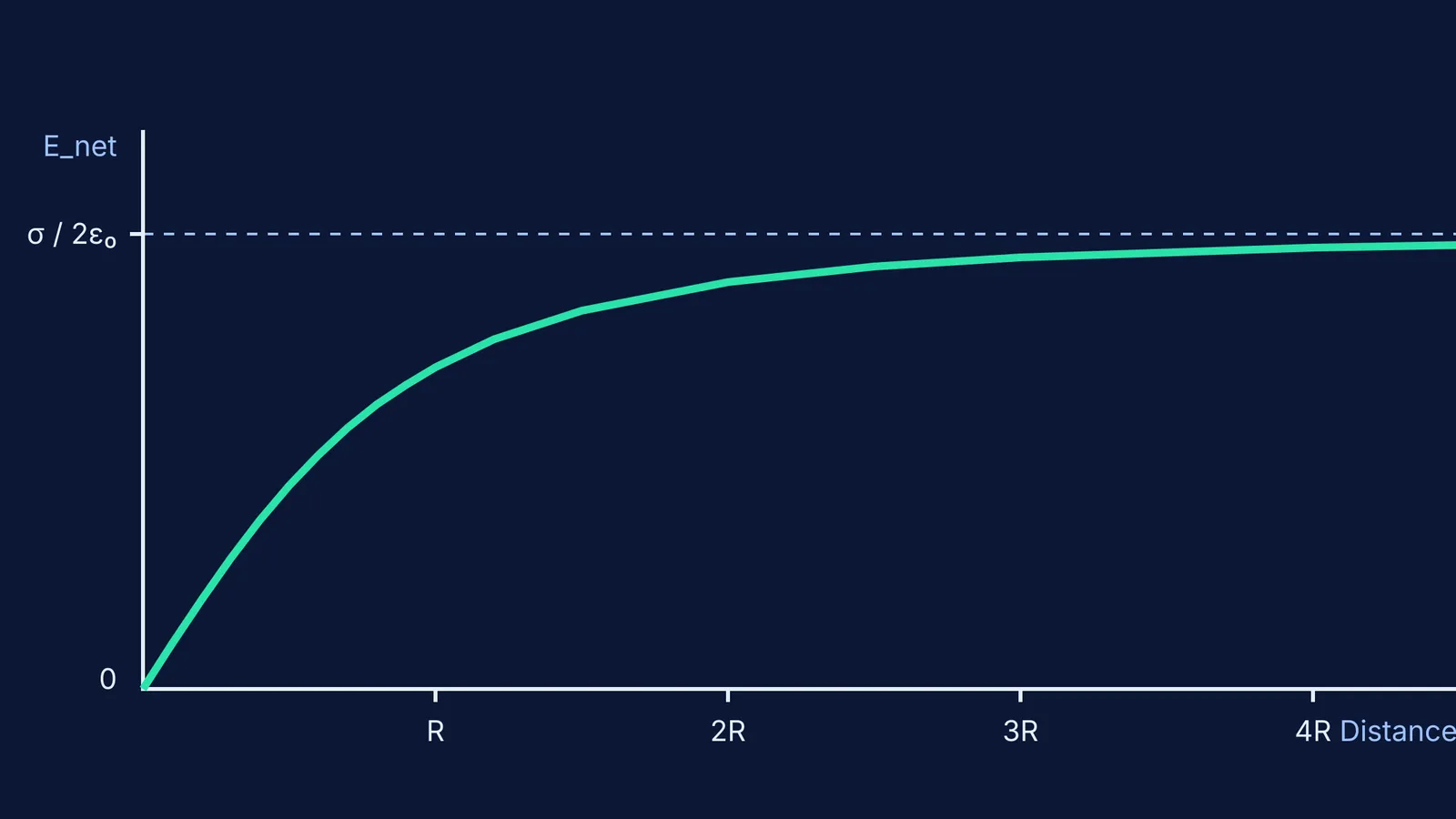
E_net = (σ / 2ε₀) × [z / √(z² + R²)]
How does the field behave near and far from the hole?
Checking the limiting cases is a great way to ensure your formula makes physical sense.
At the centre of the hole (z = 0): The formula gives E = 0. This matches what we expect from symmetry; any charge pulling you one way is perfectly balanced by a charge pulling you the exact opposite way from the other side of the hole.
Very far away (z ≫ R): When z is much larger than R, the term √(z² + R²) is approximately just z. The fraction z / √(z² + R²) approaches 1, making E_net ≈ σ / 2ε₀. From a great distance, the small hole becomes unnoticeable, and the field looks exactly like that of an unbroken infinite sheet.
Mastering electromagnetism with Fermi
Spotting the right trick—like treating a hole as a negative charge—turns a terrifying integral into a one-minute algebra step. If you find yourself staring at a blank page when faced with unusual charge distributions, Fermi's AI tutor can help.
When you bring a tricky past paper to the Fermi Problem Library, the tutor does not just print the final answer. It works out what you already know and builds a plan for the session. It teaches through the problem, drawing the figure and checking your understanding as it goes, so you learn the reasoning behind superposition.
For more practice with electric fields, try working through how to find the electric field of a charged arc or review the rules for drawing electric field lines. You can also explore the difference between the electric field near a conductor and a sheet.
Start treating holes as missing pieces, and your physics derivations will get much shorter.


