

On this page
If you can handle a point charge, you can handle a bent wire. Cut the arc into tiny pieces, treat each as a point charge, and let symmetry do half the work.
How do you set up the integral for an arc of charge?
Linear charge density λ is the charge per unit length, measured in coulombs per metre (OpenStax University Physics Volume 2). For charge Q spread evenly over an arc of radius R and angle θ₀ (radians), λ = Q/(Rθ₀); for a semicircle, λ = Q/(πR).
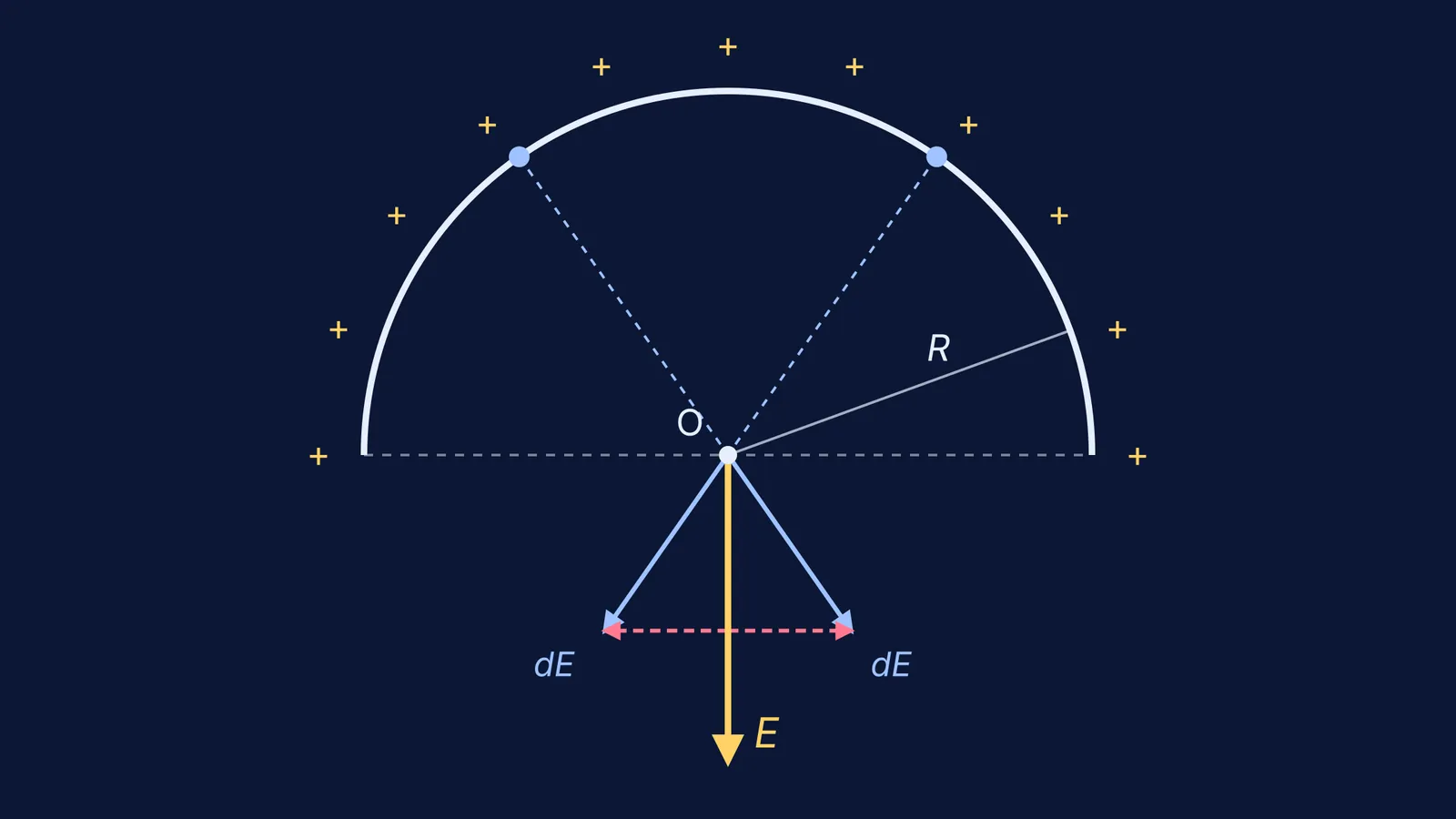
A small piece at angle θ has length R dθ and charge dq = λR dθ. Every piece sits at the same distance R from the centre O, so Coulomb's law gives dE = k dq/R² = kλ dθ/R for each one. Only the direction changes from piece to piece, so θ is your only integration variable.
Why does one component of the field cancel?
Place the semicircle above the x-axis, centred on O. Pair a piece at angle θ with its mirror image at 180° − θ. Their fields have equal size; the x-components cancel and the y-components add. OpenStax uses the same pairing argument for a ring, where the symmetry of two identical pieces "implies the horizontal (x)-components of the field cancel" (OpenStax, section 5.5).
Integration agrees: dEx = −(kλ/R) cos θ dθ, and cos θ integrates to zero from 0 to π. The University of Alabama PH 126 solution set does this same check, with the advice "If you don't believe in symmetry, believe in integration."
What is the electric field at the centre of a semicircular ring?
Keep the y-component: dEy = −(kλ/R) sin θ dθ. Integrating from 0 to π gives Ey = −(kλ/R) × 2 = −2kλ/R.
So the field at the centre of a uniformly charged semicircle has magnitude E = 2kλ/R = 2kQ/(πR²), the result derived in the University of Alabama PH 126 solutions. It points along the symmetry axis, away from a positive arc.
Compared with a point charge Q at distance R (kQ/R²), the semicircle gives only 2/π of the field, because pieces near the ends push mostly sideways and those pushes cancel.
How do you find the field of a quarter circle or any arc?
Let the arc subtend 2α, symmetric about the y-axis, with φ measured from that axis. Only the axial component survives: integrating (kλ/R) cos φ from −α to α gives E = 2kλ sin α / R. This covers the common cases:
Semicircle (α = π/2): E = 2kλ/R, matching the result above.
Quarter circle (α = π/4): E = √2 kλ/R. With λ = 2Q/(πR), that is E = 2√2 kQ/(πR²).
Full ring (α = π): E = 0, since every piece has a partner directly opposite.
For a quarter circle in the first quadrant, the field lies along the 45° line, with each component equal to kλ/R.
How big is the field for a 10 nC semicircle?
Use k = 8.99 × 10⁹ N m²/C² (OpenStax, Coulomb's law). A thin rod carries Q = 10 nC and is bent into a semicircle of radius R = 10 cm.
Charge density: λ = Q/(πR) = (1.0 × 10⁻⁸)/(π × 0.10) ≈ 3.18 × 10⁻⁸ C/m.
Field: E = 2kλ/R ≈ 5.7 × 10³ N/C.
Bend the same rod into a quarter circle of the same radius: λ doubles to about 6.37 × 10⁻⁸ C/m, and E = √2 kλ/R ≈ 8.1 × 10³ N/C.
The quarter circle wins because the same charge sits on a shorter arc, so less of it cancels.
What is the electric potential at the centre of a charged arc?
Potential is a scalar, so nothing cancels. Each piece contributes dV = k dq/R with the same R, so V = kQ/R for any arc of radius R. The Alabama solutions get V = kλπ for a semicircle, which is kQ/R once you substitute λ = Q/(πR). For the rod above, V = kQ/R ≈ 899 V, as a semicircle or a quarter circle.
So for fixed Q and R, any answer where V at the centre depends on the arc angle is wrong. You cannot get E from this single value of V; the method in finding the electric field from the potential gradient needs V as a function of position.
Which mistakes cost marks on arc problems?
Writing dq = λ dθ: its units are C/m, not C.
Adding magnitudes without resolving them, which gives πkλ/R for a semicircle instead of 2kλ/R.
Wrong limits after the arc is rotated. Draw it and mark where θ starts.
No direction. State it: along the symmetry axis, away from positive charge.
For the same method on a straight wire, see the field of a finite charged rod. To practise setting up dq and limits yourself, the Fermi Problem Library has worked problems with a step-by-step solver that explains the reasoning rather than printing an answer. If linear charge density itself still feels shaky, start with its lesson in the Fermi Concept Library.


