On this page
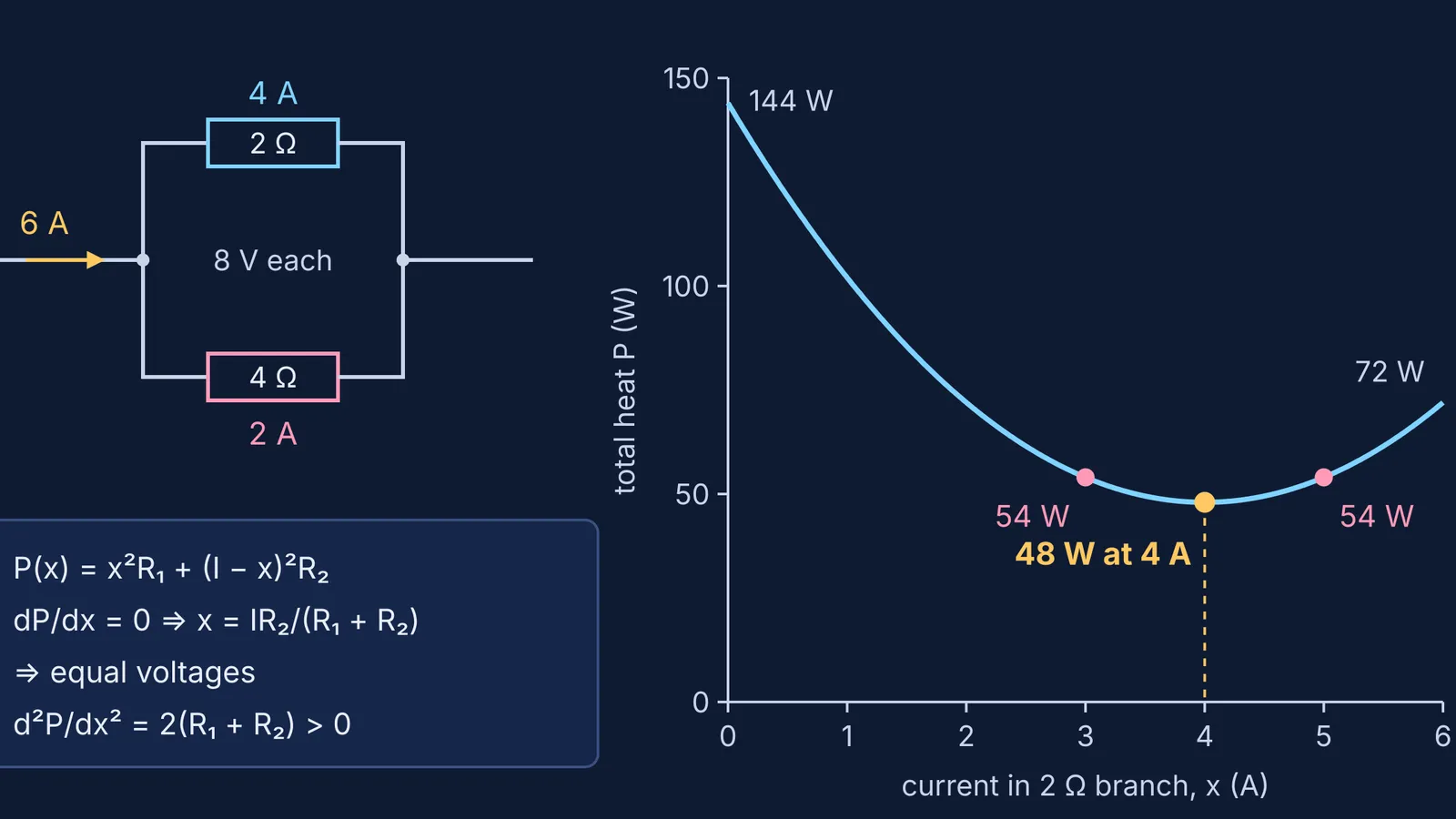
Send 6 A into a 2 Ω and a 4 Ω resistor in parallel. Ohm's law sends 4 A through the 2 Ω resistor and 2 A through the 4 Ω one, and together they turn 48 W into heat. Force a different split, say 3 A each, and the heat rises to 54 W. Every split other than the one Kirchhoff's laws give makes more heat. Here is why, with one line of calculus, and how to use it as a check in JEE circuit problems.
How does current split between two parallel resistors?
Both resistors sit between the same two points, so they share one potential difference. That gives I₁R₁ = I₂R₂, and with I₁ + I₂ = I you get the current divider rule, I₁ = IR₂/(R₁ + R₂). It is covered step by step in the current divider rule for parallel resistors.
For our numbers, I₁ = 6 × 4 ÷ (2 + 4) = 4 A through the 2 Ω resistor and I₂ = 2 A through the 4 Ω resistor. Check: 4 × 2 = 8 V and 2 × 4 = 8 V. The voltages match, as they must.
Now ask a different question: if the 6 A could split any way it liked, which split would waste the least heat?
Which split of the current makes the least heat?
Let x be the current through R₁. Then I − x goes through R₂, and the total Joule heating per second is
P(x) = x²R₁ + (I − x)²R₂
This is an upward-opening parabola in x. Set the derivative to zero:
dP/dx = 2xR₁ − 2(I − x)R₂ = 0
Rearranged, xR₁ = (I − x)R₂. That is the equal-voltage condition again, and solving it gives x = IR₂/(R₁ + R₂), exactly the current divider rule.
The second derivative, d²P/dx² = 2(R₁ + R₂), is positive, so the turning point is a minimum, not a maximum. The split Kirchhoff's laws give is the split that makes the least heat.
Two more facts drop out of the algebra:
The minimum heat is I²R_eq. Put x = IR₂/(R₁ + R₂) back into P(x) and you get P_min = I²R₁R₂/(R₁ + R₂), which is I² times the equivalent resistance of the pair.
The extra heat grows as a square. Expanding the parabola gives P(x) = P_min + (R₁ + R₂)(x − x₀)², where x₀ is the divider-rule current. Move 1 A away from the right split and the heat rises by (R₁ + R₂) × 1² watts.
Worked example: 6 A into 2 Ω and 4 Ω
Take I = 6 A, R₁ = 2 Ω and R₂ = 4 Ω.
Write the heat as a function of the split. P(x) = 2x² + 4(6 − x)² watts, with x in amperes.
Differentiate and solve. dP/dx = 4x − 8(6 − x) = 12x − 48 = 0, so x = 4 A. The other branch carries 2 A.
Confirm it is a minimum. d²P/dx² = 12 W/A², which is positive.
Find the minimum heat. P(4) = 2 × 16 + 4 × 4 = 32 + 16 = 48 W.
Check with the equivalent resistance. R_eq = 2 × 4 ÷ 6 = 4/3 Ω, and I²R_eq = 36 × 4/3 = 48 W. The two answers agree.
Compare other splits. For 3 A each, P = 2 × 9 + 4 × 9 = 54 W. For 5 A and 1 A, P = 2 × 25 + 4 × 1 = 54 W. Both are 6 W more, which matches (R₁ + R₂)(x − 4)² = 6 × 1² = 6 W.
A numerical scan of every split from 0 to 6 A in steps of 1 mA finds the lowest heat at x = 4.000 A and 48.000 W. Units check: A² × Ω = W.
Does this work for any resistor network?
Yes, for networks of ohmic resistors fed by a fixed current that enters at one point and leaves at another. Of all the ways the current could spread while obeying the junction rule, the actual currents make the total I²R heat smallest. Doyle and Snell's Random Walks and Electric Networks, a Mathematical Association of America monograph, proves this and calls it Thomson's principle, after William Thomson (Lord Kelvin), citing Thomson and Tait's Treatise on Natural Philosophy. You will also see it called a minimum heat theorem.
The reason is the same as in the two-resistor case. Changing the split by pushing a small extra current δ round any closed loop changes the heat by 2δ × (sum of IR round the loop) to first order. That sum is zero exactly when the loop rule holds. So the loop rule is the condition for the heat to be stationary, and since every term I²R is a positive square, the stationary point is a minimum.
So Kirchhoff's laws and "least total heat for the given input current" lead to the same currents. You still solve JEE networks with the junction and loop rules, but any trial set of currents that obeys the junction rule must give at least as much heat as the true answer.
When does the minimum-heat rule not apply?
No batteries inside the loops. The result is for resistor networks driven from outside by a fixed current. With an EMF inside a loop, the loop rule includes that EMF, and the currents no longer minimise I²R alone.
Linear resistors. Each must obey V = IR with a fixed R. Diodes and hot filament bulbs break the argument.
Fixed total current, not fixed voltage. If you hold the voltage fixed instead, a smaller resistance draws more current and more heat. Do not mix this up with maximum power transfer, where the load matches the source's internal resistance. That result maximises the power in one load. Here we minimise the total heat in the whole network for a given current.
It is not a general law that "nature is efficient". It is a property of linear resistors.
How can you use this in a JEE problem?
For heat in a parallel group, use P = I²R_eq for the total and P₁/P₂ = R₂/R₁ for the branches, since they share a voltage: here 32 W ÷ 16 W = 2 = 4 Ω ÷ 2 Ω. After solving a bridge or ladder, add up I²R over every resistor and check it equals I²R_eq. A mismatch usually means a sign slip; Kirchhoff's laws: sign conventions that stop circuit mistakes covers the common ones.
For practice on JEE Advanced style current electricity problems, Fermi Test Prep offers personalised preparation for JEE Main & Advanced with an AI tutor, live classes, adaptive mocks, mentorship and a study plan that updates based on mastery. To work single problems with each step explained, try the Fermi Problem Library.
Quick checklist
For a fixed total current, the heat P(x) = x²R₁ + (I − x)²R₂ is a parabola.
dP/dx = 0 gives xR₁ = (I − x)R₂: equal voltages, the current divider rule.
d²P/dx² = 2(R₁ + R₂) > 0, so it is a minimum.
Minimum heat = I²R_eq. Any other split adds (R₁ + R₂)(x − x₀)².
6 A into 2 Ω and 4 Ω: 4 A and 2 A, 48 W. A 3 A and 3 A split gives 54 W.
The rule holds for ohmic resistor networks fed from outside, with no EMFs inside the loops.