

On this page
Every real battery has some resistance inside it. Connect a resistor and the current must push through both the resistor and the battery's insides. That one fact explains a favourite exam question: which external resistor gets the most power, and what does it cost you?
What is the condition for maximum power to an external resistor?
The amount of resistance to the flow of current within a voltage source is called its internal resistance, and the terminal voltage falls as V = ε − Ir when current I flows, as OpenStax University Physics, Volume 2 puts it.
The condition itself is short: maximum power is transferred from a source to a load when the load resistance equals the internal resistance of the source (course notes, IIT (ISM) Dhanbad). This result is often called the maximum power transfer theorem, or Jacobi's law (Wikipedia summary).
Only R changes; the emf ε and the internal resistance r are fixed. Most wrong answers start by forgetting this.
Why does R = r give the maximum power?
The current is I = ε/(R + r), so the power in R is:
P = I²R = ε²R/(R + r)²
With calculus. Differentiate with respect to R and simplify: dP/dR = ε²(r − R)/(R + r)³. This is zero only at R = r, positive below it and negative above it, so R = r is a maximum.
Without calculus. Write (R + r)²/R as (R − r)²/R + 4r. Then P = ε²/[(R − r)²/R + 4r]. The denominator is smallest when the squared term is zero, which happens at R = r. Either way, the maximum power is P = ε²/4r.
Worked example: one battery, four resistors
Take a battery with ε = 12 V and r = 2 Ω. Use P = 144R/(R + 2)² and efficiency η = R/(R + r).
R = 1 Ω: I = 4 A, P = 16 W, efficiency 33 percent
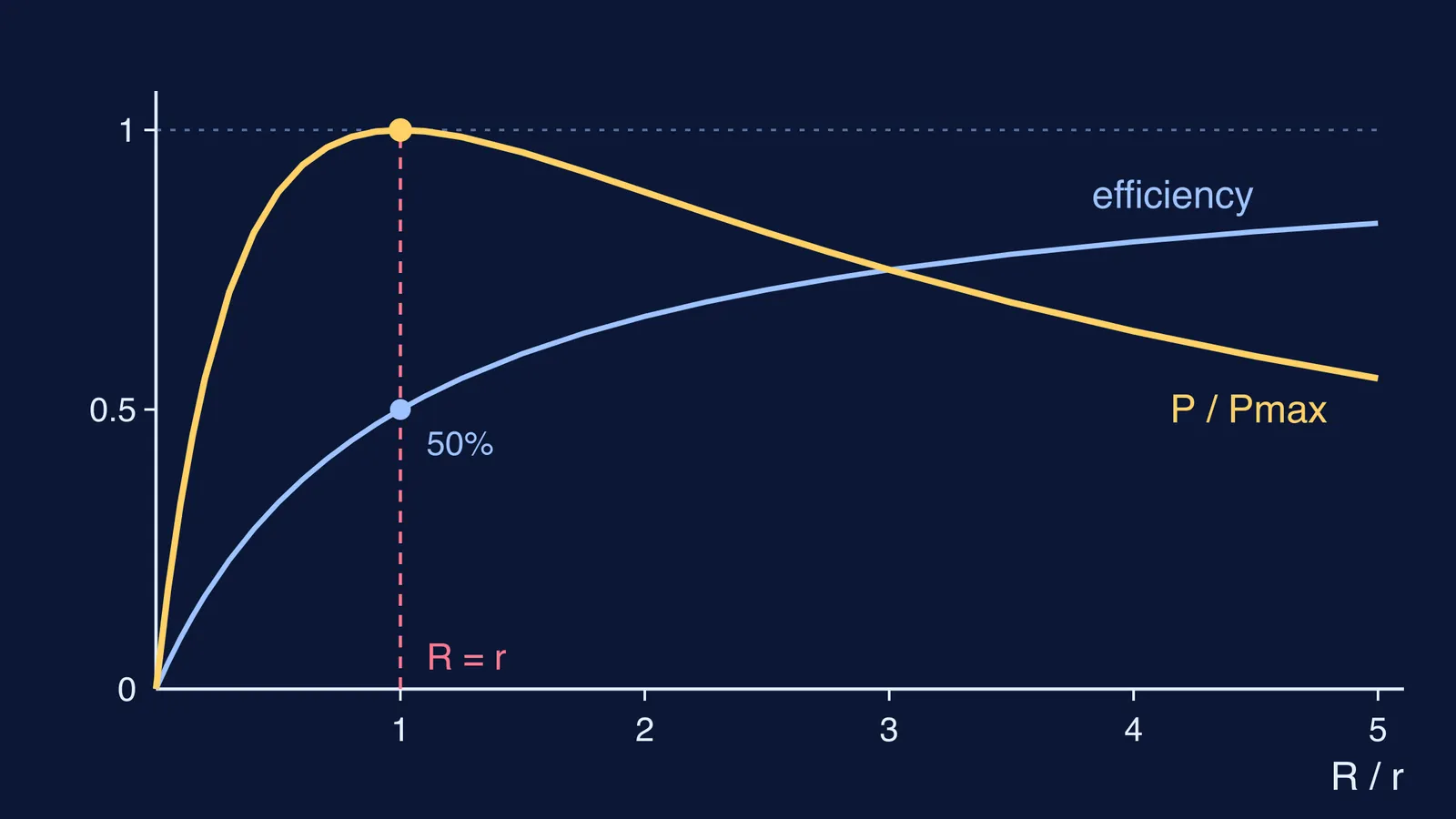
R = 2 Ω: I = 3 A, P = 18 W, efficiency 50 percent
R = 4 Ω: I = 2 A, P = 16 W, efficiency 67 percent
R = 8 Ω: I = 1.2 A, P = 11.52 W, efficiency 80 percent
The peak is at R = 2 Ω, and 18 W matches ε²/4r = 144/8. Notice that 1 Ω and 4 Ω give the same 16 W, because 1 × 4 = 2², just as the shortcut says. Efficiency keeps climbing as R grows, even after power starts falling.
Why is the efficiency only 50 percent at maximum power?
The same current flows through r and R. Power is I²r inside the battery and I²R outside, so when R = r the two are equal. Half the energy the source produces heats the source itself, which is why the efficiency at maximum power transfer is 50 percent (IIT (ISM) Dhanbad notes).
In general the efficiency is η = R/(R + r), which approaches 100 percent only when r is tiny compared with R (Wikipedia summary). So maximum power and maximum efficiency are different goals. If you want most of the energy to reach the load, you make R much larger than r and accept less power.
OpenStax shows this trap in numbers: a 12 V battery driving a 0.500 Ω load delivers 200 W when its internal resistance is 0.100 Ω, but only 72 W when the internal resistance rises to 0.500 Ω (OpenStax Example 10.1). Here r = R, yet the power has dropped, because the theorem is about varying R, not r.
Which mistakes cost marks on this topic?
Before you write R = r, run through this checklist:
Ask what is variable. If R varies with r fixed, use R = r. If r varies with R fixed, make r as small as allowed.
Find the effective internal resistance. With cells in series or parallel, or a resistor already inside the source's part of the circuit, work out the equivalent r seen by the load first.
Use ε, not terminal voltage, in ε²/4r.
Do not confuse maximum power with maximum efficiency. The question may ask for either.
Sanity-check: P at your R should beat P at nearby values.
If you keep getting the setup wrong rather than the arithmetic, work a few circuit problems in the Fermi Problem Library, where the step-by-step solver explains the reasoning rather than printing an answer. To revisit emf and internal resistance from the start, the Fermi Concept Library has a lesson for each concept and shows where it sits in the map.
Next time you see "for what value of R is the power maximum?", ask first which resistance is allowed to change. The rest is one line.


