On this page
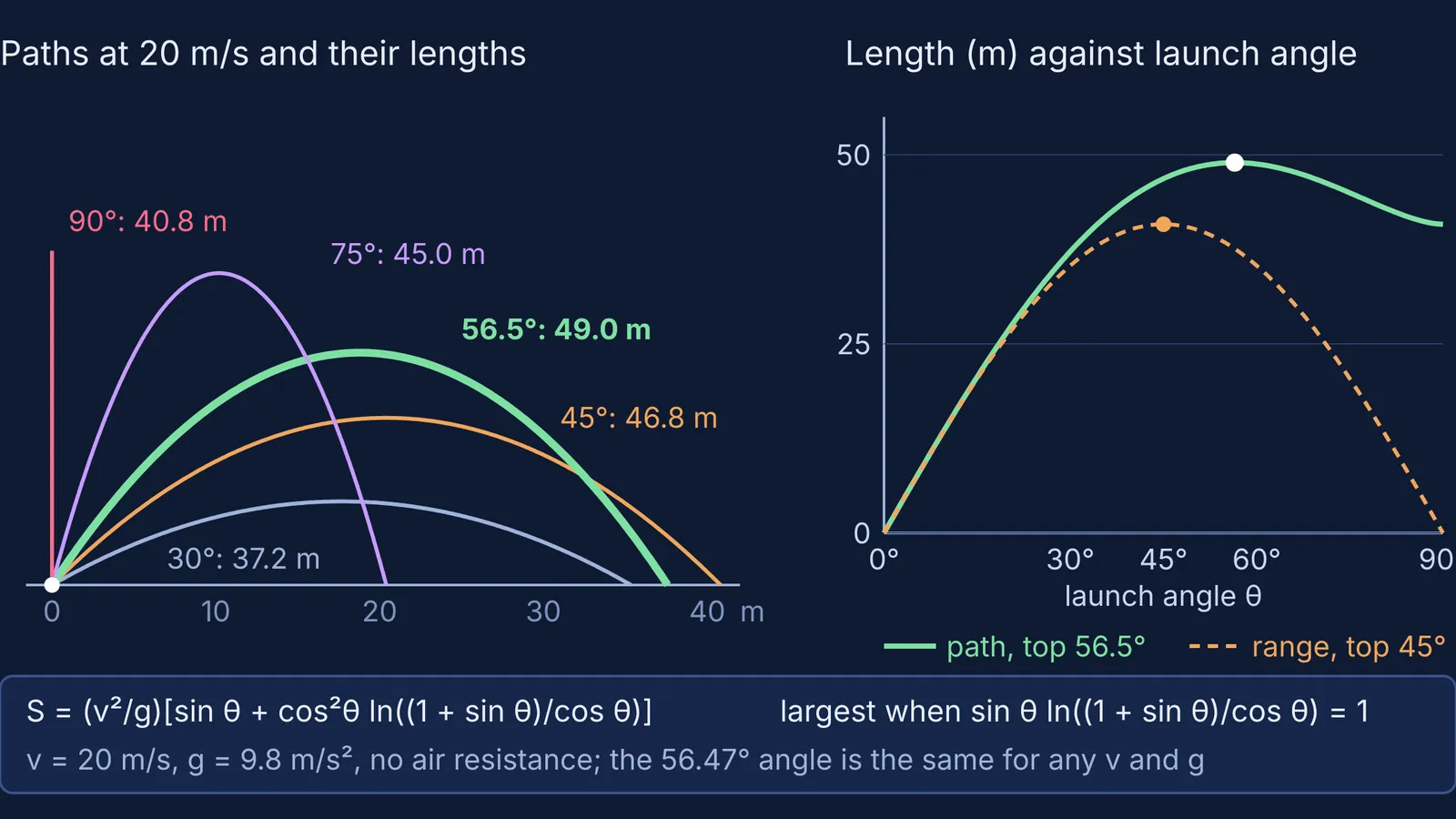
Every student knows that a projectile goes furthest along the ground when it is launched at 45°. Ask a different question: at what angle is the curved path itself longest? That is the total distance the ball travels through the air. The answer is not 45° but 56.47°. For a 20 m/s throw, the path is 49.0 m long at 56.5° and only 46.8 m at 45°. The angle does not depend on the speed or on g.
Is the path length the same as the range?
No. The range is the straight-line distance along the ground from launch to landing. The path length is measured along the curve, so it equals the total distance travelled, and it is always longer than the range. It is the same idea as the distance moved by a point on a rolling wheel's rim, where the answer comes from adding up tiny pieces of a curve.
Two simple cases give a feel for it, with v = 20 m/s and g = 9.8 m/s²:
At 45° the range is v²/g = 40.8 m, but the arch is 10.2 m high, so the path is longer: 46.8 m.
At 90° the range is zero, but the ball goes up 20.4 m and comes back down, so the path is 40.8 m.
Somewhere between these two the length must peak, and it is not at 45°.
How do you find the length of a projectile's path?
Use the arc length formula. A small piece of the curve has length √(dx² + dy²) = √(1 + y′²) dx, so
S = ∫₀^R √(1 + y′²) dx
The trajectory is y = x tan θ − gx²/(2v² cos²θ), so
y′ = tan θ − kx, with k = g/(v² cos²θ)
Substitute u = tan θ − kx. As x goes from 0 to R, u goes from tan θ down to −tan θ, and dx = −du/k. The integrand is even in u, so
S = (2/k) ∫₀^(tan θ) √(1 + u²) du
Now you need the standard integral from NCERT Class 12 (Integrals chapter), with a = 1:
∫√(u² + a²) du = (u/2)√(u² + a²) + (a²/2) ln|u + √(u² + a²)| + C
Put in the limits. With tan θ √(1 + tan²θ) = sin θ/cos²θ and ln(tan θ + sec θ) = ln((1 + sin θ)/cos θ), and 1/k = v² cos²θ/g:
S = (v²/g)[sin θ + cos²θ ln((1 + sin θ)/cos θ)]
Check it at 90°: cos θ = 0, and cos²θ times the logarithm goes to zero, so S = v²/g, the up-and-down distance. Check the units: v²/g is a length and the bracket is a pure number.
You can also reach the same S by adding speed × time along the flight, S = ∫₀^T √(vₓ² + v_y²) dt. A direct numerical sum of this for the 45° throw gives 46.85 m, matching the formula.
Why is the longest path at 56.5°?
Differentiate S with respect to θ. Use d/dθ[ln((1 + sin θ)/cos θ)] = sec θ, which follows because (1 + sin θ)/cos θ = sec θ + tan θ. Then
dS/dθ = (v²/g)[cos θ − 2 sin θ cos θ ln((1 + sin θ)/cos θ) + cos θ] = (2v² cos θ/g)[1 − sin θ ln((1 + sin θ)/cos θ)]
So S has its maximum when
sin θ ln((1 + sin θ)/cos θ) = 1
This has no neat closed-form answer, so solve it by trial:
θ = 55°: the left side is 0.819 × 1.154 = 0.946. Too small.
θ = 58°: 0.848 × 1.249 = 1.059. Too big.
θ = 56.47°: 0.8336 × 1.1998 = 1.000. This is the answer.
There is a tidy bonus. At the maximum, the logarithm equals 1/sin θ, so the bracket becomes sin θ + cos²θ/sin θ = 1/sin θ. So
Smax = v²/(g sin 56.47°) = 1.200 v²/g
The physical reason for the steeper angle: as you raise the angle above 45°, the range falls, but slowly at first, while the height grows quickly. The extra climb and fall add more length than the lost range takes away, until about 56.5°. Beyond that the range shrinks faster and the total falls.
Worked example: path lengths for a 20 m/s throw
Take v = 20 m/s and g = 9.8 m/s², so v²/g = 40.82 m.
At 45°. sin θ = cos θ = 0.7071, (1 + sin θ)/cos θ = 2.414, ln 2.414 = 0.8814. Bracket = 0.7071 + 0.5 × 0.8814 = 1.148. S = 40.82 × 1.148 = 46.8 m. Range 40.8 m.
At 56.47°. sin θ = 0.8336, cos θ = 0.5524, ln 3.320 = 1.1998. Bracket = 0.8336 + 0.3052 × 1.1998 = 1.200. S = 49.0 m. Range = v² sin 2θ/g = 37.6 m, height (v sin θ)²/2g = 14.2 m, flight time 3.40 s.
Shortcut check. Smax = 40.82/0.8336 = 49.0 m. It agrees.
The full set at the same speed:
30°: path 37.2 m, range 35.4 m
45°: path 46.8 m, range 40.8 m
56.5°: path 49.0 m, range 37.6 m
60°: path 48.8 m, range 35.4 m
75°: path 45.0 m, range 20.4 m
90°: path 40.8 m, range 0
The top is flat: every angle from 55° to 58° gives a path within 0.05 m of the maximum. Notice too that 30° and 60° share a range of 35.4 m, as complementary angles always do, but their paths differ by 11.6 m.
When does the 56.5° result hold?
It assumes no air resistance, launch and landing at the same height, and constant g. Under those conditions v and g only scale the answer through v²/g, so the angle is 56.47° for a pebble or a cannon shell, on Earth or on the Moon. It is a calculus result for exam problems, not a rule any sport uses. A projectile from a height lands below its launch point, and then both the angle for maximum range and the longest-path angle change.
Mustafa Karadag reached the same angle, about 56.5°, in a 2020 paper in Physics Education.
This is a JEE Advanced-style mix of projectile motion and definite integration. To check your own working step by step, the Fermi Problem Library has a solver that explains the reasoning. If you are preparing for JEE Main & Advanced, Fermi Test Prep offers personalised preparation with an AI tutor, live classes, adaptive mocks, mentorship and a study plan that updates based on mastery.
Quick checklist
Path length is distance along the curve; range is displacement along the ground.
S = (v²/g)[sin θ + cos²θ ln((1 + sin θ)/cos θ)].
The integral needs ∫√(1 + u²) du, a standard NCERT result.
S is largest when sin θ ln((1 + sin θ)/cos θ) = 1, at θ = 56.47°, for any v and g.
Smax = v²/(g sin 56.47°) ≈ 1.20 v²/g; for 20 m/s, 49.0 m against 46.8 m at 45°.