On this page
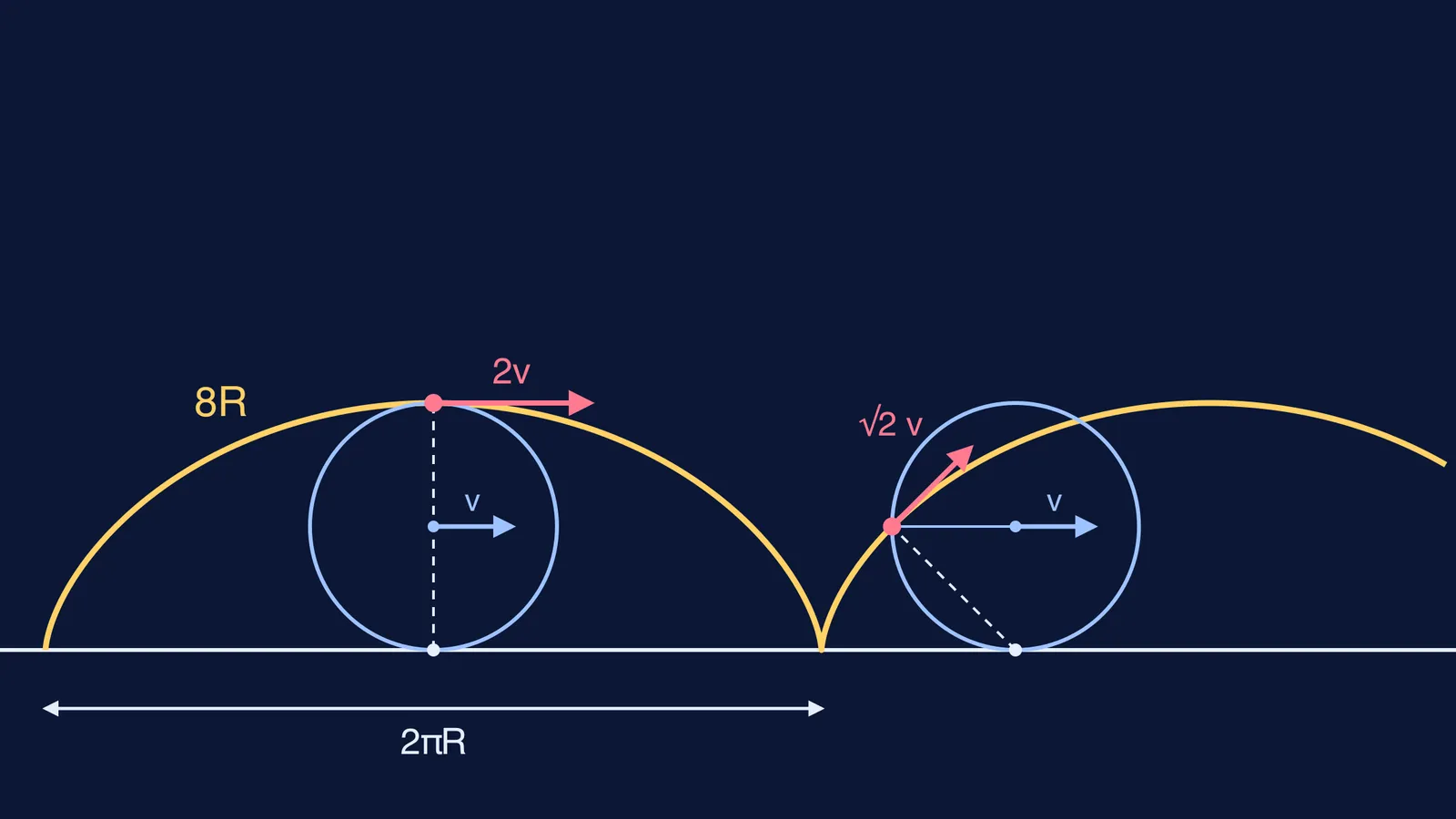
Most students write 2πR, but that is how far the wheel's centre moves. A mark on the rim rises, swings over the top and comes back down, and that curved path is longer than the road the wheel covers.
What path does a point on the rim of a rolling wheel trace?
It traces a cycloid, “the curve traced by a point on a circle as it rolls along a straight line without slipping” (Wikipedia: Cycloid). Start the point at the origin, touching the ground, and let θ be the angle the wheel has turned. The centre has moved Rθ forward, so the point sits at:
x = R(θ − sin θ)
y = R(1 − cos θ)
These are the standard cycloid equations given by Wolfram MathWorld. One arch, from one ground contact to the next, is one full rotation.
How fast is the rim point moving at each moment?
Rolling without slipping means v = Rω, and the bottom of the wheel is momentarily at rest relative to the ground, as OpenStax University Physics, section 11.2/Book%3A_University_Physics_I_-_Mechanics_Sound_Oscillations_and_Waves_(OpenStax)/11%3A__Angular_Momentum/11.02%3A_Rolling_Motion) explains. Differentiate the position with respect to time, using dθ/dt = ω:
dx/dt = v(1 − cos θ)
dy/dt = v sin θ
Square, add, and use 1 − cos θ = 2 sin²(θ/2). The speed is v√(2 − 2 cos θ) = 2v sin(θ/2).
Check the ends. At θ = 0 the point touches the road and its speed is zero. At θ = π it is at the top and moves at 2v, twice the speed of the centre. The same answer falls out if you treat the contact point as an instantaneous axis: the rim point is 2R sin(θ/2) from it, and multiplying by ω gives 2v sin(θ/2). Our post on angular momentum of a rolling disc about the contact point uses that axis too.
What is the distance travelled by a point on the rim in one rotation?
Distance is the integral of speed, so ds = 2R sin(θ/2) dθ. For one rotation, θ runs from 0 to 2π:
s = ∫ 2R sin(θ/2) dθ, from 0 to 2π
Put u = θ/2, so dθ = 2 du and u runs from 0 to π: s = 4R ∫ sin u du
∫ sin u du from 0 to π = [−cos u] = 1 − (−1) = 2
s = 8R
This matches the arc length of one cycloid arch, 8 times the radius, listed by MathWorld and Wikipedia. MathWorld credits Roberval and Wren with finding this length.
Compare it with the road covered, 2πR ≈ 6.28R. The rim point travels 8/(2π) ≈ 1.27 times as far as the wheel moves forward, about 27% more. So its average speed over a rotation is 8R ÷ (2πR/v) = 4v/π, about 1.27v.
The same integral up to any angle gives s = 4R(1 − cos(θ/2)). Half a rotation, from the ground to the top, is 4R. A quarter rotation is not 2R but 4R(1 − 1/√2) ≈ 1.17R, because the point crawls near the ground and races near the top.
If the substitution or the half-angle step tripped you up, the Fermi Problem Library has worked problems with a step-by-step solver that explains the reasoning rather than printing an answer.
How can you check 8R at home with a chalk mark?
You need a round steel plate or tin lid, chalk, a sheet of chart paper taped to a wall at floor level, a pencil, a thread and a ruler. You are checking the arch length of 8R from MathWorld.
Measure the lid's radius R. If R = 5 cm, expect 8R = 40 cm for the path and 2πR ≈ 31.4 cm for the road.
Put a chalk mark on the rim. Stand the lid upright against the chart paper with the mark touching the floor, and mark that spot on the paper.
Roll the lid slowly along the floor, keeping it against the paper and not letting it slip. After every centimetre or so of rolling, put a pencil dot on the paper beside the chalk mark.
Stop when the mark touches the floor again. Mark the spot and measure the straight gap: it should be close to 2πR.
Join the dots into a smooth arch. Lay the thread along it, pinch where the arch ends, straighten the thread and measure. You should get close to 8R.
Expect a small error from spaced dots and tight bends near the floor. A lopsided arch means the lid slipped; a rubber band round the rim helps. Look at the dots too: they bunch up near the floor and spread out near the top. That spacing is the speed 2v sin(θ/2) you just derived.
The same curve turns up elsewhere in physics: see why a charge in crossed electric and magnetic fields traces a cycloid and why the fastest slide is a cycloid, not a straight line. If parametric equations still feel shaky, the Fermi Concept Library has a lesson for every concept in physics and mathematics.