On this page
When you want to get from point A to point B as quickly as possible, intuition suggests taking the shortest route: a straight line. But if you are relying on gravity to pull you down a frictionless slide, the shortest physical distance is not the fastest path.
The path of fastest descent is a specific mathematical curve called the brachistochrone. If you race a bead down a straight ramp against one on a brachistochrone curve, the curved path wins every time.
What is the brachistochrone problem?
The brachistochrone problem asks for the exact shape of the curve down which a bead, sliding from rest and accelerated only by gravity, will slip from a higher point to a lower point in the least amount of time. The term is derived from the Greek words *brachistos* (the shortest) and *chronos* (time).
This puzzle was first posed as a public challenge in 1696 by the Swiss mathematician Johann Bernoulli. He published the problem in the journal *Acta Eruditorum*, giving the mathematical community six months to solve it. When the deadline passed with few responses, he extended it. When Isaac Newton finally received the challenge by mail, he famously solved it in just 12 hours overnight, submitting his solution anonymously. Upon reading it, Bernoulli recognised Newton's genius, remarking that he recognised "the lion by his claw".
The solution they both found—along with Leibniz, L'Hôpital, and Jakob Bernoulli—was the cycloid. A cycloid is the curve traced by a point on the rim of a circular wheel as it rolls along a flat surface.
Why does a curve beat a straight line?
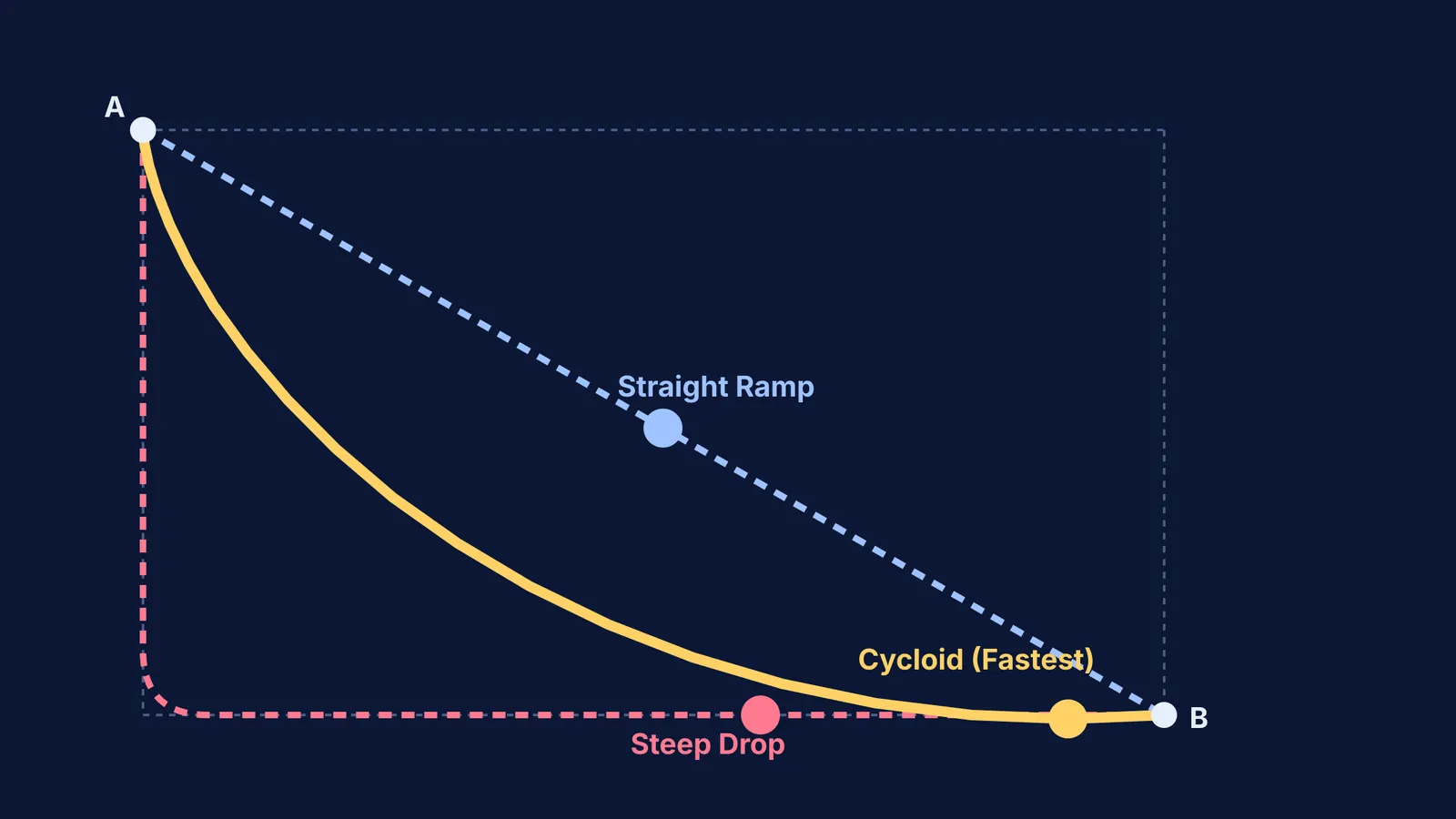
In a physical race between a straight ramp, a steep drop that levels out, and a cycloid, the straight line loses because it maintains a constant, relatively low acceleration.
Straight line: This is the shortest physical distance. However, it takes too long for the bead to build up speed. The low initial acceleration means it spends a large portion of its journey travelling slowly.
Steep drop (L-shape): This path builds speed instantly by letting the bead fall straight down. However, the overall path is extremely long, and the final stretch is perfectly horizontal, meaning the bead spends too much time coasting towards the finish line.
Cycloid: This curve represents the perfect compromise between distance and speed. It drops steeply at the start, converting potential energy into kinetic energy very quickly. The bead travels a longer total distance than it would on the straight line, but it completes the journey at a much higher average speed, reaching the end in less time.
Testing it with a simulation
You can work through the calculus of variations and the Euler-Lagrange equations to prove this on paper, but it is much easier to understand the concept when you can see the beads race. Setting up a physical track in a classroom is often tricky because air resistance and friction change the result, but a computer simulation lets you test the pure mathematics effortlessly.
In the Fermi Simulation Lab, you can set up different track shapes, adjust the starting heights, and watch the race in real time. Fermi's AI tutor can run the simulation alongside you, pausing to ask you to predict which bead will win and explaining exactly how the steepness of the curve changes the acceleration vector at each moment. If you are struggling with the calculus and the energy equations behind it, the AI tutor holds a line of reasoning across the session, noticing where you are stuck and drawing the physical forces on a board to help you step through the proof.
You can also read more about related topics on Fermi News, such as how to calculate Projectile motion on level ground: range, height and time of flight, or how to approach Equations of motion: choosing the right one and getting signs right.
How to use this in your studies
The brachistochrone is a classic example of why active learning—learning by making and testing predictions—works so much better than simply reading the answer in a textbook. Before you look up a solution to a difficult mechanics problem, try drawing out three possible paths and guess which one will win based on the physics.
Sketch the extremes: Always draw the most direct path and the most exaggerated path (like a sudden drop).
Predict the physical trade-off: Ask yourself what you gain (such as early kinetic energy) and what you lose (such as travelling a longer physical distance) for each shape.
Run the test: Use an interactive model, a physical experiment, or the underlying mathematics to see which approach wins out.
When you learn physics by predicting and testing, the foundational concepts stick in your memory. Try applying this same mental framework to your next physics assignment.