

On this page
A disc rolls along the floor. Ask for its angular momentum about its centre and you get one answer. Ask about the point touching the ground and you get three times as much. Both are right, and one short formula explains why.
What is the formula for angular momentum about any point?
For any body, angular momentum about a point splits into two parts: the spin about the centre of mass, plus the angular momentum of the centre of mass treated as a single particle carrying the whole mass. The Dourmashkin Classical Mechanics text on LibreTexts writes this as total = orbital + spin, with the orbital part equal to r × p of the whole system.
In symbols:
L_P = L_cm + r × Mv_cm
Here r is the vector from your chosen point P to the centre of mass, M is the total mass and v_cm is the velocity of the centre of mass. The first term is the same whatever point you pick. Only the second term depends on P.
How do you find the angular momentum of a rolling disc about the contact point?
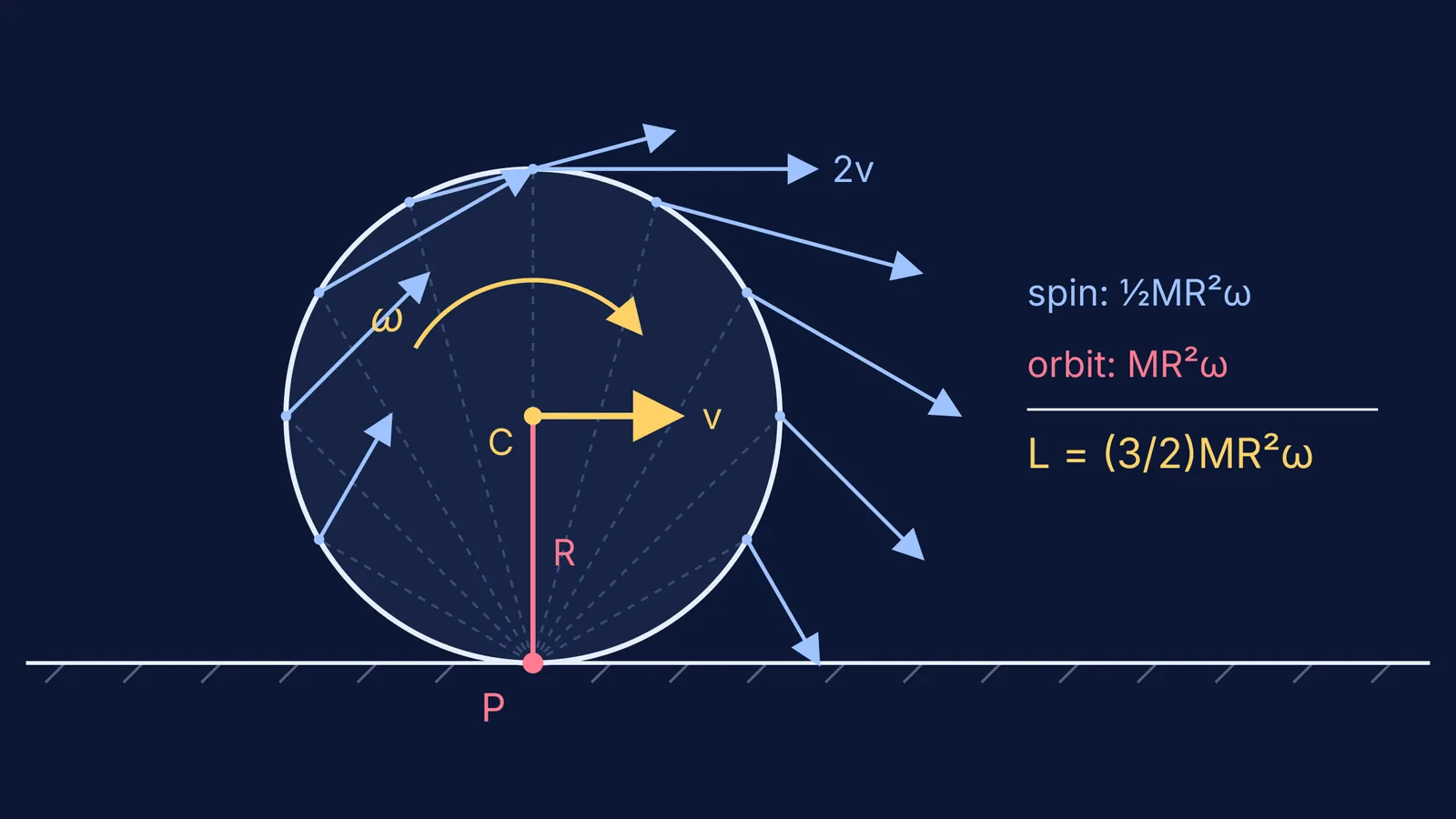
Take a uniform disc of mass M and radius R rolling without slipping at angular speed ω. OpenStax University Physics gives the two facts you need: in rolling without slipping, v_cm = Rω, and the point touching the ground is at rest relative to the surface. A uniform disc has moment of inertia ½MR² about its central axis, as derived in OpenStax's chapter on moments of inertia.
Spin term: L_cm = I_cm ω = ½MR²ω.
Orbital term: r runs from the contact point straight up to the centre, length R, and v_cm is horizontal. They are perpendicular, so |r × Mv_cm| = R × M × Rω = MR²ω.
Direction: for a disc rolling to the right, it turns clockwise, and both terms point into the page. They add.
Total: L_P = ½MR²ω + MR²ω = (3/2)MR²ω.
Let M = 2 kg, R = 0.1 m and ω = 10 rad/s, so v_cm = 1 m/s. Spin: ½ × 2 × 0.01 × 10 = 0.1 kg m²/s. Orbital: 0.1 × 2 × 1 = 0.2 kg m²/s. Total: 0.3 kg m²/s, which equals (3/2) × 2 × 0.01 × 10. The orbital part is twice the spin part, which is why the contact-point answer is three times the answer about the centre.
Why does the parallel-axis theorem give the same answer?
There is a second route. The contact point is momentarily at rest, so at that instant the whole disc is turning about it. The parallel-axis theorem, I = I_cm + Md² (OpenStax), gives I_P = ½MR² + MR² = (3/2)MR², and L = I_P ω = (3/2)MR²ω.
Getting the same answer both ways is a good exam self-check. But the shortcut has a limit.
Does the answer change if you pick a different point?
Yes, and the orbital term tells you exactly how. Because v_cm is horizontal, only the perpendicular distance h from your point to the line the centre moves along matters: the orbital term has size Mv_cm h.
About the centre: h = 0, so L = ½MR²ω.
About the contact point, or any point on the ground: h = R, so L = (3/2)MR²ω. Sliding your point along the ground changes nothing.
About any point level with the centre: h = 0 again, so L = ½MR²ω.
About the top of the disc: the centre is R below it, so the orbital term is MR²ω but points the opposite way. L = ½MR²ω, opposite to the spin.
The last result surprises most students. With the numbers above it is 0.1 − 0.2 = −0.1 kg m²/s. Notice that using I_top = (3/2)MR² here would give the wrong sign and three times the size, which is the trap in action.
Try one yourself: find L about a point 0.05 m above the ground, below the centre. (Answer: h = 0.05 m, orbital term 0.1 kg m²/s in the spin direction, total 0.2 kg m²/s.)
Where does this show up in JEE problems?
Ground points earn their place when friction acts. About a fixed point on the ground, friction has zero torque because it acts along the ground, and gravity and the normal reaction cancel because they act along one vertical line. Angular momentum about that point is therefore conserved even while the ball is skidding. Our post on when a sliding ball starts pure rolling uses exactly this to get the final speed in two lines.
If you keep losing marks on signs or axes, run through rotational motion: five common JEE mistakes. For the force side of the same motion, read why pure rolling at constant speed needs no friction.
To practise picking the point on more problems, the Fermi Problem Library has worked problems with a step-by-step solver that explains the reasoning rather than printing an answer. If the parallel-axis theorem still feels shaky, start with its lesson in the Fermi Concept Library.


